
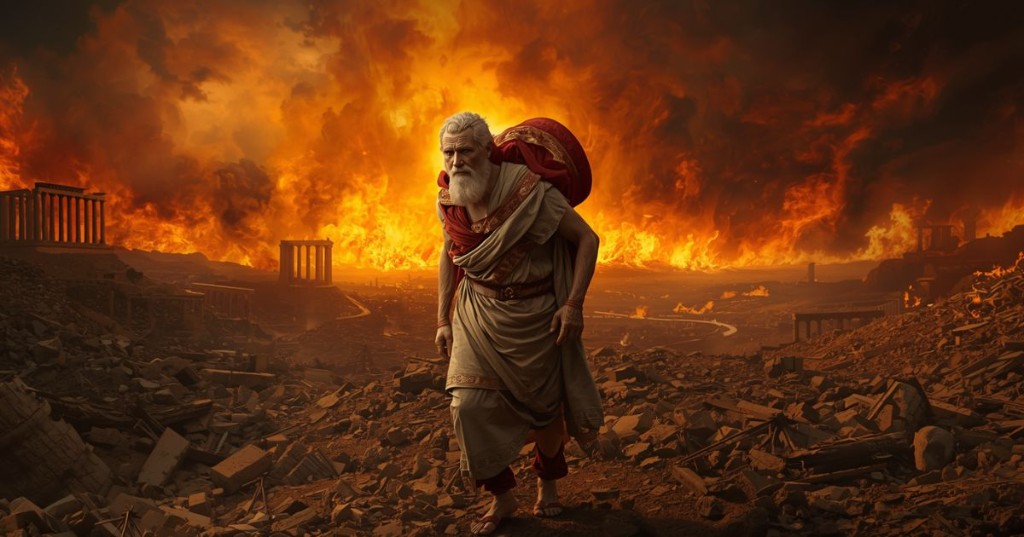
Jupiter summons the gods and orders them to stop taking sides in the Latin war. Venus pleads for the Trojans; Juno defends her interventions; the council murmurs like wind in trees. Jupiter declares that fate, not divine favoritism, will decide the outcome, and the immortals withdraw from open meddling, at least for the moment. On earth the siege continues. Inside the camp, exhausted Trojans hold the walls while Aeneas, far away, secures Tuscan support from Tarchon and sails back with thirty ships and a powerful allied army. His former vessels, now sea nymphs, surround his flagship and warn him that Ascanius is hard pressed and that Turnus plans to cut him off before he can land.
They tell him to arm at dawn and carry the divine shield Vulcan forged. Aeneas prays to Cybele and pushes toward the coast as the sun rises. The besieged Trojans see his armor blazing from the water and take heart. Turnus, undaunted, meets the landing and tries to crush the Trojans before they can form on shore. Tarchon runs his ship aground on purpose, accepting wreckage as the price of a beachhead. The Tuscans and Trojans form under fire while Latin spears seek the chaos of wet sand and splintered hulls.
The battle that follows is immense. Aeneas cuts through Latin ranks, killing Theron, Gyas, and others as if the field were narrow and the war personal. Pallas, the young Arcadian prince fighting at Aeneas's side, rallies his horsemen when they falter and drives into the Latin line with devastating effect. Turnus hears that the Trojans have broken out of the camp and races to confront them. He singles out Pallas, dismisses the youth's prayer to Hercules, and kills him with a spear that pierces shield and breastplate. The Arcadians carry the body away on a shield while Aeneas is still cutting through Latin ranks, unaware that the youth he promised to protect is already gone.
Then he commits the act that will haunt him: he strips Pallas's ornate belt and wears the trophy in triumph. News of the death reaches Aeneas, who enters a grief-stricken rage. He kills without mercy, taking living captains to sacrifice at Pallas's funeral pyre and refusing Magus's ransom because Turnus showed no mercy to the young prince. The battlefield becomes a corridor of vengeance. Aeneas hunts Turnus while lesser names fall around him: Tarquitus beheaded, Lucagus and Liger killed in their chariot, and priest Emoanides struck down despite his holy fillets.
Juno, still defying the spirit of Jupiter's command, sends a phantom Aeneas to lure Turnus onto a ship and carries him far from the battlefield. Turnus survives but loses honour. Ashamed, he wishes the earth would swallow him rather than face his men as a man who fled a phantom. With Turnus absent, Mezentius, the exiled tyrant hated by his own people, returns to the front and fights with savage despair. The Tuscans concentrate their hatred on him, hurling weapons from a distance because his cruelty has made him untouchable in life.
Aeneas wounds him with a spear that pins his thigh. Mezentius tries to flee, but his son Lausus, a virtuous young man stained by his father's reputation, throws himself between the Trojan hero and the wounded king. Lausus's courage is real and costly. Aeneas kills him, then pauses in grief, recognizing a son's love that mirrors his own duties to Ascanius and Anchises. He sends Lausus's body back untouched, honouring the youth even as he destroyed him. Mezentius hears the news, rejects survival, mounts his horse Rhoebus, and charges Aeneas in a final duel.
Aeneas kills the horse, then the king, who asks only to be buried beside his son. Even Jupiter and Juno resume their argument in heaven, testing whether Trojan success comes from fate or favor. Juno is forced to accept that Turnus's hour is limited, yet she still seeks ways to soften his fall. Book 10 therefore moves on two levels at once: the gods claim neutrality while Juno still manipulates outcomes, and mortals pay for those manipulations in sons, fathers, trophies, and shame. Aeneas returns as savior and avenger. Turnus wins a duel and loses standing.
Mezentius and Lausus show how love can survive even in a house built on cruelty. The war is no longer an abstraction on the horizon. It has names, belts, funeral processions, and rage that will not sleep. Every reader feels that the belt on Turnus's shoulder is not decoration but a countdown, and that the next books will ask whether piety and fury can coexist in the man destined to found Rome. Book 10 is the war's hinge: rescue arrives, a prince dies, a father follows, and the man who fled in a phantom ship must still answer for the belt he took and the shame he carries.
Virgil understood something about power that we still struggle with today: sometimes the people who claim they're trying to help are actually making things worse. In The Aeneid, Jupiter forbids divine interference in the war, then sits back while Juno immediately breaks that rule. The result isn't peace, it's prolonged suffering for everyone involved. This pattern shows up everywhere in working-class life. Hospital administrators mandate patient-centered care while cutting staff, making quality care impossible. School boards support teachers publicly while implementing policies that set them up to fail. Union leaders promise solidarity while cutting side deals. Family patriarchs insist they just want peace while secretly taking sides in conflicts, ensuring the drama continues. The mechanism is always the same: authority figures create contradictory rules or expectations, claim neutrality while secretly playing favorites, then blame the people caught in the middle when things go wrong. Recognizing this pattern doesn't make you cynical, it makes you strategic. When you can see the game being played, you can protect yourself and the people you care about. You can document the contradictions, build alliances with others facing the same impossible choices, and focus your energy on what you can actually control instead of trying to make inconsistent authority figures consistent.
Explore this chapter with AI to uncover deeper meaning and practical takeaways.
AI Discussion