
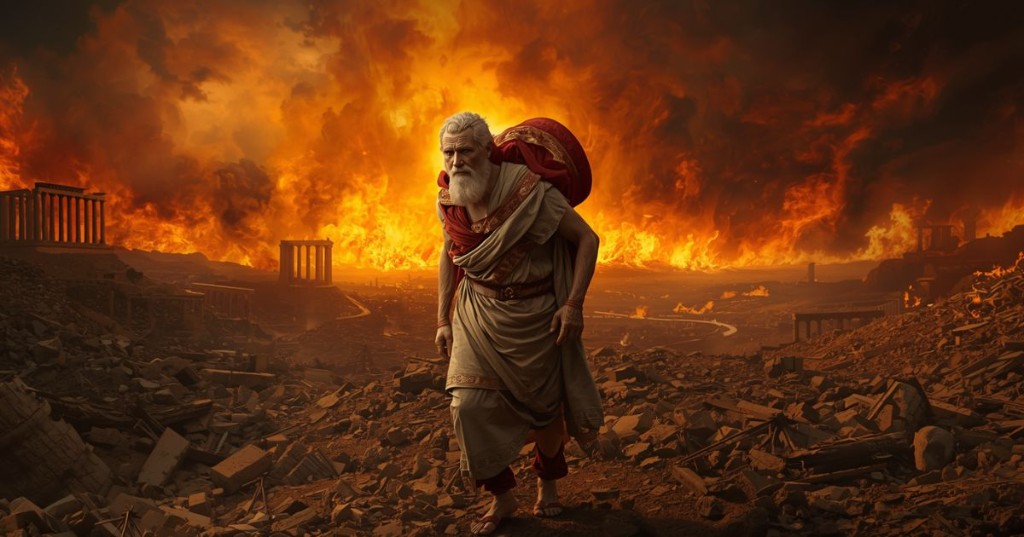
The Latin army breaks, and Turnus feels public scorn pressing on his promise to fight. Humiliation sharpens rather than softens him. He demands single combat with Aeneas, telling Latinus that if he falls, the bride and kingdom can go to the Trojan. Latinus pleads with fatherly caution, listing omens, losses, and the cost of pride, but Turnus hears only shame. Queen Amata clings to him, begging him to avoid the duel; Lavinia weeps without speaking, her blush rising and falling like light on ivory as Turnus watches and hardens his heart. Turnus sends the herald to renew the challenge for the next day.
Aeneas accepts and offers remarkably generous terms if he wins: Trojans and Latins will live as equals under Latin law, with Aeneas building a separate city rather than ruling as conqueror. The armies prepare a sacred field, altars, and oaths. For a moment the war seems ready to end in ritual rather than massacre. Latinus and Aeneas sacrifice together while Rutulians and Trojans look on, measuring each champion's shoulders and already guessing the outcome. Juno, unwilling to lose, sends Turnus's sister Juturna to break the truce. Disguised as a Latin captain, she whispers that one man should not die for everyone and that the Trojans will swarm them if they wait. She invents omens, inflames fear, and triggers a thrown spear that kills a Tuscan prince.
Both sides rush back to war. Altars overturn. Peace burns with the sacrificial fire. Messapus knocks Aulestes onto a flaming altar, Corynaeus answers with fire to the face, and the violated rites turn the sacred list into another battlefield. Aeneas calls for calm and is struck by an arrow. He leaves the field wounded while Turnus rampages through retreating Trojans. Venus heals him with divine medicine hidden in Iapis's treatment. Restored, he returns with the fury of a storm and drives the Latins toward the city.
He kills Sucro, Amycus, Diores, and others in pairs, while Turnus answers with his own slaughter, the two champions like fires racing through opposite woods. Juturna delays the final meeting by disguising herself as Turnus's charioteer and racing him away from Aeneas whenever the rivals near each other. Aeneas, tired of the chase, turns on Laurentum itself. Trojans scale walls, fire roofs, and panic spreads through streets that believed the duel would decide everything. Women join the defense, hurling poles from the towers in Camilla's spirit, but the fire brands multiply faster than courage can contain them.
Queen Amata, seeing the city burn and hearing Turnus is lost, hangs herself in despair. Latinus tears his beard in grief. A messenger reaches Turnus with the truth: the queen is dead, the city is burning, and only he can stop the collapse. He finally abandons evasion, sends Juturna away, and rides back to call both armies off. The field clears. The duel begins. Both armies drop their swords without knowing it, and even Latinus watches like a man seeing his own future decided in another man's body.
Aeneas and Turnus fight like forces of nature, equal until Turnus's sword shatters on Aeneas's divine shield. Jupiter weighs their fates on golden scales, and Turnus's side sinks. The broken blade was never the fated sword, only a charioteer's substitute seized in haste. Turnus flees in panic until Faunus traps Aeneas's spear in the sacred olive tree and Juturna restores Turnus's real sword. Aeneas rages at the delay, hurling a rock that fails because grief and fate have already drained his strength to the edge of mortal limits. Even the gods are now closing accounts.
Jupiter orders Juno to stop intervening. She extracts a final promise that Latins will keep their name, language, and customs when Trojans merge with them. A Fury drives Juturna from the field. Turnus, cornered and wounded, begs for mercy, asking Aeneas to spare him for his father's sake and send his body home if revenge must be satisfied. Aeneas hesitates, moved by pity, until he sees Pallas's belt still hanging from Turnus's shoulder. Memory of the young Arcadian prince transforms mercy into vengeance. Aeneas drives his sword into Turnus's chest, and the poem ends with the killer's rage, not with a gentle peace. The war stops, but the ending is brutal, reminding readers that treaties broken, cities burned, and sons lost do not vanish because one man falls.
Italy will be blended, not simply conquered, yet the last note is iron: fate moves forward through grief, trophy, and a leader who chooses remembrance over clemency at the final second. Virgil does not soothe the reader with a wedding feast. He leaves us with the thud of Turnus's body and the knowledge that empires can be founded without ever making their founders gentle. The epic ends where history begins: in blood, oath, and the hard work of turning enemies into countrymen after the killing stops. Book 12 is the Aeneid's last word on whether Rome will be built by mercy, memory, or the sword, and Virgil refuses to pretend the answer is simple.
Virgil understood something we see everywhere today: people will often choose a catastrophic ending over a difficult but honorable one. Turnus could have faced Aeneas in single combat from the start, with clear terms and mutual respect. Instead, divine interference and broken oaths turn their conflict into a bloodbath that destroys innocent people. The pattern isn't unique to ancient epics, it's the story of every workplace that avoids firing the problem employee until they poison the whole team, every family that won't address addiction until someone ends up in the ER, every relationship that limps along in misery rather than ending with kindness. We tell ourselves we're being compassionate or avoiding conflict, but we're actually choosing the cruelest possible outcome. The hard truth is that clean endings require courage in the moment, while messy endings just require us to wait until we have no choice left. Virgil shows us that honor isn't about avoiding difficult decisions, it's about making them while we still can control how they unfold. The most merciful thing is often the thing that feels harsh right now.
Explore this chapter with AI to uncover deeper meaning and practical takeaways.
AI Discussion