
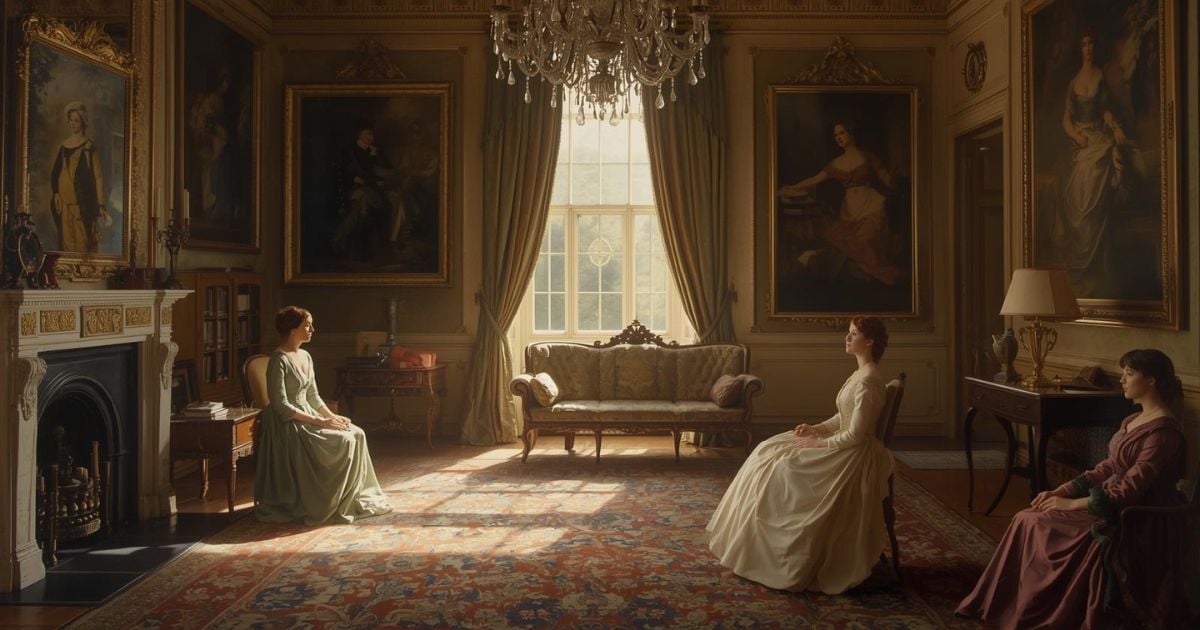
A comfortable house feels wrong because it fails the picture of a cottage. The journey is melancholy until Barton Valley comes into view, pleasant, wooded, and rich in pasture. The house is small, compact, and in good repair. As a cottage it fails. The building is regular. The roof is tiled. The shutters are not painted green. The walls have no honeysuckle. A narrow passage runs through to the garden. On each side is a sitting room of about sixteen feet. Four bedrooms and two garrets make up the rest. Beside Norland it is poor and small. The tears dry. The servants are glad to see them, and each of them, for the sake of the others, resolves to look happy. It is early September. The fine weather gives them a liking for the place that may last.
Mrs. Dashwood is, on the whole, satisfied with the size and the furniture. She still means to add elegance. The house is too small, she says, but it is too late in the year to build. In the spring, if she has plenty of money, as she dares say she shall, they may think of it. She will throw the passage into one parlour, add a drawing room, with a bedroom and a garret above, and she could wish the stairs were handsome. Those changes would have to come from the savings of five hundred a year, by a woman who has never saved in her life. Until then they are wise enough to be content with the house as it is. They set their books around them. Marianne's pianoforte is unpacked. Elinor's drawings go up on the sitting-room wall. The spring rooms are a picture. The income is the fact. Nobody in the cottage says she has never saved.
The next morning, after breakfast, Sir John Middleton comes to welcome them. He is about forty, good-humoured, and as friendly as his letter. He visited at Stanhill once, too long ago for the girls to remember him. He presses them to dine at Barton Park every day until they are settled. The pressing goes past civility, and still it cannot give offence. Within an hour a large basket of fruit and vegetables arrives from the park, and before night a present of game. He will carry their letters to the post, and he will send his newspaper every day. Lady Middleton sends word that she will call when it suits them, and she comes the next day. She is about twenty-six, handsome, tall, and graceful. Her manners have the elegance his lack. The visit lasts long enough to show that she is reserved and cold, and that she has nothing to say beyond an ordinary question. She has brought their eldest boy, about six, shy before company though noisy at home. It takes ten minutes to decide whether he is more like his father or his mother. Sir John will not leave until they promise to dine at the park the next day. The cottage has not been altered. Will that dinner still feel like kindness once they are inside the house, or only like a visit they could not refuse?
Sir John Middleton represents something we all encounter: the person whose desire to help becomes another problem to manage. He genuinely cares about the Dashwood women's welfare, but he never stops to consider whether his constant invitations and introductions align with what they actually need. This dynamic reveals how helping can become a form of control, even when the helper has pure intentions. In Austen's time, women had limited ability to refuse social obligations without seeming ungrateful or rude. Today, we face similar pressures in workplaces, families, and communities where saying no to help feels like rejecting kindness itself. The challenge is that helpful overwhelm often comes from people we can't easily avoid, supervisors, family members, or community leaders who have genuine affection for us but lack the emotional intelligence to calibrate their support. They mistake activity for assistance and quantity for quality. The pattern persists because it serves the helper's emotional needs: they feel useful, needed, and morally superior. Meanwhile, the person being 'helped' becomes exhausted from managing both their original problem and their helper's emotional investment in solving it. Learning to distinguish between support that serves you and support that serves the supporter is a crucial life skill that literature teaches through character observation.
Explore this chapter with AI to uncover deeper meaning and practical takeaways.
AI Discussion