
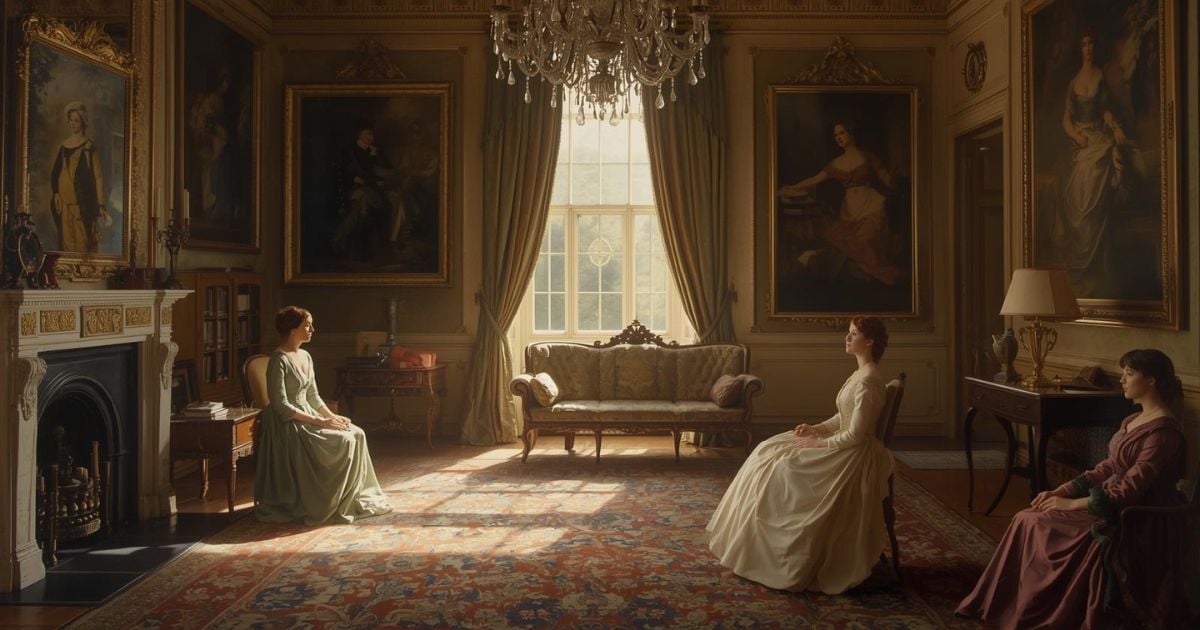
The loudest praise in the room is not the same as listening. Barton Park is half a mile from the cottage, hidden from it by a hill. The house is large and handsome. The hospitality is for Sir John. The elegance is for his wife. They are almost never without guests, and they keep more company than any family nearby. They are unlike in manner and alike in having little talent and little taste. He hunts and shoots. She looks after the children. Her work lasts all year. His lasts half the year. Visits and parties fill the rest. She is proud of her table. He is happy when the house holds more young people than it can seat, and the noisier they are, the better. A new family delights him. The Miss Dashwoods are young, pretty, and unaffected, and for him that is enough to make a mind as pleasing as a face. Settling only women in his cottage also suits him. He does not want other sportsmen living on his ground.
He meets them at the door and is sorry, again, that he could find no smart young men. Moonlight has filled every other house. There will be only one gentleman besides himself, a friend who is neither very young nor very gay, and Lady Middleton's mother, arrived within the hour and said to be cheerful. The Dashwoods are content with two strangers. Mrs. Jennings is merry, elderly, and rather vulgar. Before dinner is over she has joked about lovers and husbands, hoped they have not left their hearts in Sussex, and pretended to see them blush whether they do or not. Marianne is vexed for Elinor's sake, and she watches Elinor so hard that the look hurts Elinor more than the jokes. Colonel Brandon is silent and grave. His face is not handsome, but it is sensible, and his manner is gentlemanlike. Marianne and Margaret are sure he is an old bachelor. He is on the wrong side of thirty-five. After dinner Lady Middleton's four children pull her about, tear her clothes, and stop every subject but themselves. Beside her coldness, his gravity is interesting.
Marianne is found to be musical, and she is asked to sing. The pianoforte is unlocked. She sings the songs Lady Middleton brought to the marriage and then gave up, songs that may have lain in the same place ever since. Sir John is loud in admiration at the end of every song, and just as loud in talk with the others while every song lasts. Lady Middleton calls him to order, wonders that anyone could look away from the music, and asks Marianne for a song she has just finished. Colonel Brandon alone does not go into raptures. He pays her only the compliment of attention. She respects him for it. The others have lost that respect by not listening. His pleasure is not the rapture that would match hers, but it is worth something next to their failure to hear. She is willing to allow that a man of thirty-five may have outlived sharpness of feeling, and every fine power of enjoyment. She will make every allowance that kindness requires for so advanced a life. The only person who listened has been judged too old to feel. Will the room leave his attention as attention, or decide what it meant?
When the Dashwood women face their new reality, each responds differently to the same loss. Elinor organizes, Marianne retreats into nature, their mother accepts help gracefully. None of these approaches is wrong, yet we often judge others for not handling crisis the way we would. This reveals something deeper about human psychology: we tend to believe our coping mechanism is the 'right' one because it works for us. Maya's methodical rebuilding feels responsible to her, but Jess's social chaos might be exactly what she needs to process trauma. The problem isn't the different styles, it's our inability to recognize them as different paths to the same destination. In families, workplaces, and communities, this plays out constantly. The practical person judges the emotional processor as weak. The emotional processor judges the practical person as cold. Meanwhile, both are trying to survive the same storm. Austen shows us that Sir John's overwhelming hospitality, annoying as it seems to Elinor, represents genuine care. Sometimes the help we need doesn't come in the package we expect. The most successful rebuilding happens when we stop judging others' methods and start recognizing the underlying human need for security, connection, and forward movement. What rebuilding style do you default to, and how might that blind you to other valid approaches?
Explore this chapter with AI to uncover deeper meaning and practical takeaways.
AI Discussion