
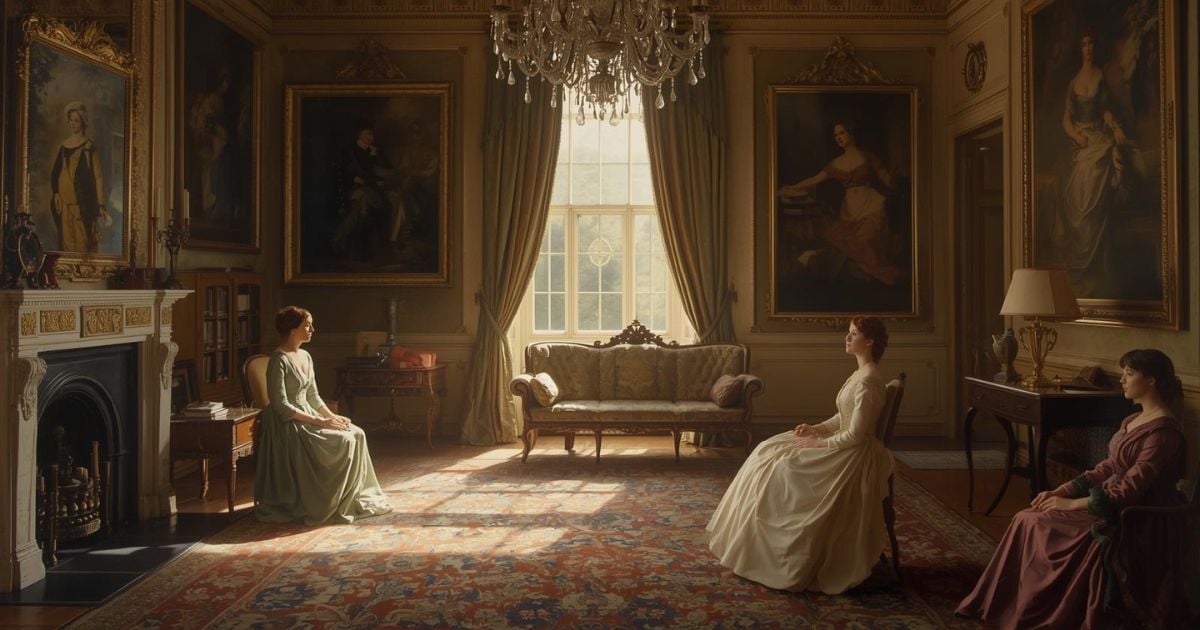
Fanny calls the next day, and of the quarter of an hour she gives Berkeley Street, seven minutes and a half are silence. She will not mention Edward until his marriage with Miss Morton is resolved, or until Colonel Brandon has answered her husband's hopes. Lucy tells what Fanny will not. Edward is in town, and dare not come to Bartlett's Buildings. Twice his card is on the table when they return. Elinor is pleased that he called, and more pleased that she missed him. The Dashwoods, not much in the habit of giving anything, give a dinner in Harley Street. Mrs Ferrars will be there. Elinor cannot learn whether her sons will. The Miss Steeles are invited as Lady Middleton's guests, and Lucy has seldom been happier. Elinor can hardly bear the thought of meeting Edward, after everything that has passed, with Lucy in the room. Lucy believes she is causing pain when she says he certainly will not come on Tuesday, kept away by an affection he cannot conceal.
On the stairs she says, Pity me. In a moment she will see the person her happiness depends on, who is to be her mother. Elinor could relieve her by suggesting they may be about to see Miss Morton's mother instead. She does not. She says, sincerely, that she does pity her. Lucy, who had hoped to be envied, is amazed. Mrs Ferrars is little, thin, upright, and sour. Not one of her few syllables falls to Elinor. The kindness she and Fanny show the Miss Steeles, apparently to humble Elinor further, only amuses her. They are gracious to the one person they would most wish to mortify, if they knew what Elinor knows.
After dinner the ladies compare the heights of Harry Dashwood and Lady Middleton's son William. Elinor gives her opinion once, on William's side, and does not repeat it. Marianne says she has no opinion, never having thought about it. John then hands Colonel Brandon the screens Elinor painted for Fanny before they left Norland. Mrs Ferrars, not knowing whose they are, looks because she is asked, says they are very pretty, and returns them without regarding them. Fanny asks whether they are not something in Miss Morton's style. She does paint most delightfully. Mrs Ferrars says she does everything well. Marianne cannot bear it. What is Miss Morton to us? It is Elinor of whom we think and speak. She takes the screens back. Mrs Ferrars draws herself up. Miss Morton is Lord Morton's daughter. Elinor is more hurt by her sister's warmth than by the slight itself. Brandon sees only the affectionate heart. Will the screens still be called Elinor's, once Miss Morton's name has been set in front of them?
Edward's dilemma exposes a brutal truth about honor: sometimes the very quality that makes someone worthy of love also prevents them from claiming it. He's trapped not by love but by his own integrity, staying engaged to Lucy because breaking his word feels dishonorable, even though the engagement serves no one's happiness. This pattern runs deep in life on tight wages, where your word is often all you have, and breaking commitments can feel like losing your identity. But Austen shows us the difference between honor that builds and honor that destroys. True honor sometimes requires admitting you made a promise you were too young or desperate to make wisely. The nurse who married at nineteen to escape a bad home, the worker who promised a dying parent they'd never leave the hometown, the friend who co-signed a loan out of loyalty, all face Edward's choice between keeping promises that no longer serve anyone and breaking free to become who they're meant to be. The most interesting question isn't whether Edward should break his engagement, but how we distinguish between commitments that deserve our loyalty and those that demand our destruction. When does keeping your word become a form of cowardice, a way of avoiding the harder choice to grow?
Explore this chapter with AI to uncover deeper meaning and practical takeaways.
AI Discussion