
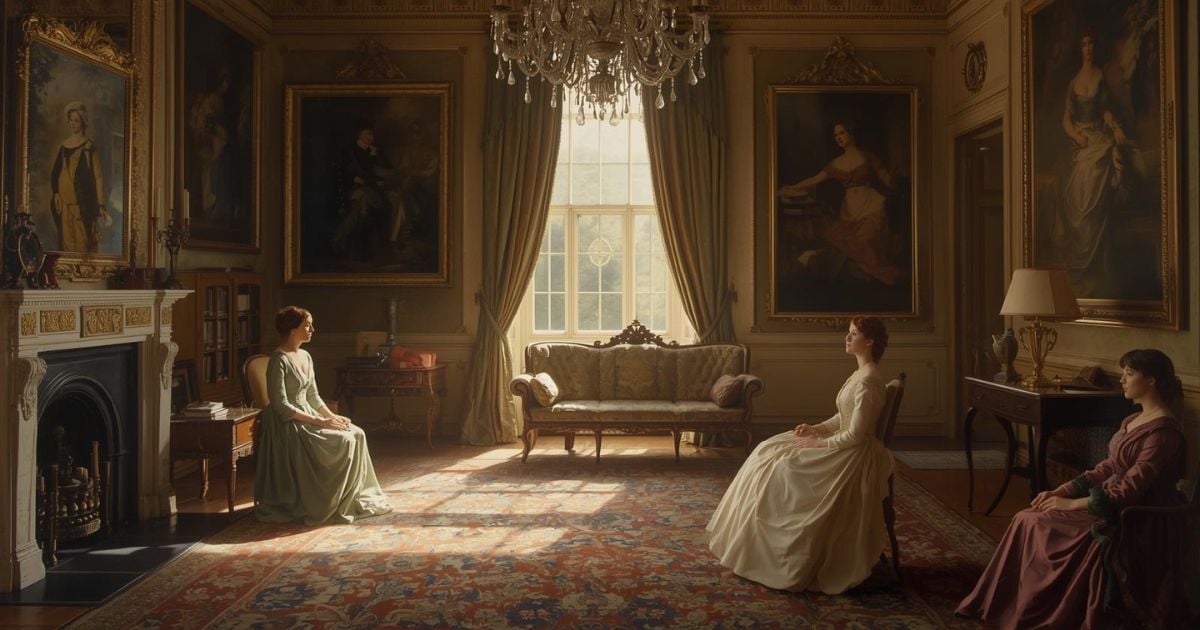
Marianne will go out for half an hour, and she will pay no visits. They stop only at the jeweller in Sackville Street, where Elinor is exchanging a few old-fashioned jewels of her mother's. A gentleman spends a quarter of an hour on a toothpick-case, ivory, gold, and pearls, names the last day he can exist without it, and leaves. Elinor is about to finish when her brother is beside her. He and Fanny have been two days in town. Yesterday Harry had to see the wild beasts at Exeter Exchange, and the rest of the day was Mrs Ferrars. He has come to bespeak Fanny a seal. Tomorrow he will be introduced to Mrs Jennings, a woman of very good fortune. Edward, he says, called the cottage the most complete thing of its kind.
On the walk to Conduit Street he asks who Colonel Brandon is, and whether he is a man of fortune. About two thousand a year. John wishes, with all his heart, that it were twice as much, for Elinor's sake, and he congratulates her on a very respectable establishment. She says Brandon has not the smallest wish of marrying her. A very little trouble on her side, he answers, will secure him. Any prior attachment is out of the question. The objections are insurmountable. In an important whisper, the match will be exceedingly welcome to all parties. Then he recollects himself. He means only that her friends wish her well settled, and that Mrs Ferrars said as much the other day. Edward's own match is not settled, but it is in agitation. The lady is the Hon. Miss Morton, daughter of the late Lord Morton, with thirty thousand pounds. If it takes place, Mrs Ferrars will settle a thousand a year on him, a great deal for a mother to give away for ever. The same liberality has already put two hundred pounds in bank-notes into Fanny's hands.
Their income, Elinor says, is a large one. Not so large as people suppose. Norland Common is being enclosed. East Kingham Farm, where old Gibson lived, adjoined his own land, so he felt it his duty to buy it. Not a stone of Fanny's green-house is laid, and the old walnut trees are down to make room for it. Elinor keeps her censure to herself, and is glad Marianne is absent. Having made his poverty clear enough that he need not buy his sisters earrings, he turns to Mrs Jennings. When she dies, the sisters will not be forgotten. Elinor says there is only a jointure, which goes to her children. The daughters, he replies, are already well married, and the kindness shown in town has given the sisters a claim. Elinor tells him the anxiety carries him too far. Marianne, he notices, has lost her colour. An illness at her time of life destroys the bloom for ever. He doubts she will now marry on more than five or six hundred a year, and he expects Elinor to do better. He has just enough compunction, for having done nothing for them himself, to be exceedingly anxious that everybody else should do a great deal. Will the two thousand a year he named be left standing as a match she agreed to?
Edward's awkward visit reveals something uncomfortable: sometimes the kindest people cause the most pain. He's trying to protect everyone by keeping his engagement secret, but his obvious misery is actually torturing Elinor more than the truth would. She's left guessing, hoping, and analyzing every stilted word for hidden meaning. This dynamic appears everywhere in modern life, the parent who hides their cancer diagnosis 'to protect the family,' the friend who won't admit they're struggling financially while declining every invitation, the coworker who pretends everything's fine while clearly falling apart. We tell ourselves we're being considerate, but often we're just avoiding the discomfort of difficult conversations. The person we're 'protecting' usually knows something's wrong anyway, they just don't know what, which can be far more distressing than the truth. Elinor would rather know Edward's engaged than spend months wondering why the man she loves suddenly treats her like a stranger. There's a difference between privacy and performance. Privacy protects your inner world; performance forces others to participate in a lie. When we perform normalcy while radiating distress, we're not protecting anyone, we're making them complicit in our suffering while denying them the chance to respond with genuine care or appropriate boundaries.
Explore this chapter with AI to uncover deeper meaning and practical takeaways.
AI Discussion