
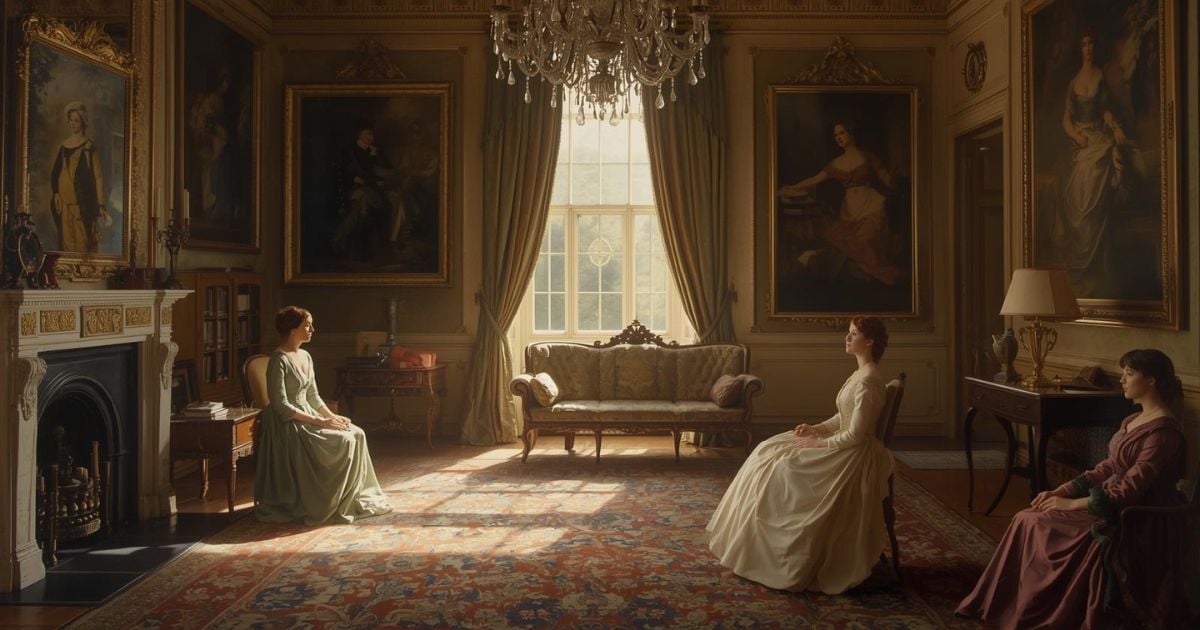
Lucy comes the next morning to talk of her happiness. Mrs Ferrars was so affable. The moment they were introduced, it should seem she had taken a fancy to her. Elinor says she was certainly very civil. Civil is not enough for Lucy. She saw a vast deal more, kindness that fell to nobody else, and Fanny all sweetness too. Elinor is pressed to own that there is reason for the joy. If they had known the engagement, she says, nothing could be more flattering. But that was not the case. Lucy will not be talked out of her satisfaction. There was no reason for Mrs Ferrars to seem to like her if she did not. They are charming women, both of them. If the manner had been only a formal curtsey, and no pleasant look afterwards, Lucy would have given it all up. Where that woman dislikes, the dislike is violent.
The door opens, and Edward walks in. All three look foolish. He seems as ready to leave as to come further. Lucy must not put herself forward. Secrecy still has to look like secrecy, so she only looks her tenderness, and after a slight greeting says no more. Elinor forces a welcome that is almost easy. She is happy to see him, and she was sorry to be out when he called before. Lucy's eyes watch her narrowly. Edward sits. His embarrassment is the greater. His heart has not Lucy's indifference, and his conscience has not quite Elinor's ease. Almost every sentence is Elinor's. She offers the news of her mother and of their coming to town, which he ought to have asked for and does not.
Then she leaves them, under the pretence of fetching Marianne, and she does it handsomely. She waits several minutes on the landing before she goes to her sister. Marianne hurries in. Dear Edward. This would almost make amends for everything. Before these witnesses he dares not say half of what he feels. Do not think of her health, Marianne tells him. Elinor is well. That must be enough. She does not like London. The sight of him is its only comfort, and he is what he always was. Why was he not at the dinner? He was engaged elsewhere. Lucy asks whether Marianne supposes young men never keep an engagement, little or great, if they have no mind to. Marianne does not feel the sting. Conscience alone kept him away. He has the most delicate conscience in the world. The praise is so unwelcome that he soon gets up to go. When Lucy has gone too, Marianne demands what brings her so often. Elinor says Lucy has been known to him longest, and that it is natural he should be glad to see her. Marianne will not bear that kind of talking. She will not be tricked into contradicting an assurance that was not really wanted. She leaves. Elinor dares not follow her. The promise of secrecy leaves her nothing that would set the mistake right. Will those minutes on the landing be counted as fetching her sister, or as time she chose to stay outside?
Edward's dilemma reveals a cruel irony: the very qualities that make us decent human beings can become the tools of our own destruction. His honor, his integrity, his refusal to break his word - these aren't flaws, they're virtues. Yet they've trapped him in a situation where everyone loses. This pattern is everywhere in life on a wage. The single mom who won't leave her abusive boyfriend because she promised her kids they'd be a family. The factory worker who won't quit a job that's destroying his health because he gave his word to see the project through. The daughter who sacrifices her own dreams because she promised to take care of aging parents who guilt-trip her constantly. We're taught that keeping promises is sacred, that your word is your bond. But what happens when life changes the game entirely? When the promise you made in good faith becomes a source of suffering for everyone involved? Austen shows us that sometimes the most honorable thing you can do is admit you made a commitment you shouldn't have, or that circumstances have changed so dramatically that rigid adherence to your original promise now causes more harm than good. The real question becomes: who benefits from your sacrifice? If the answer is 'absolutely no one,' then your virtue has become a trap.
Explore this chapter with AI to uncover deeper meaning and practical takeaways.
AI Discussion