
Crusoe holds south ten or twelve days on short rations, landing only for water, hoping for a European ship near the Gambia or Senegal and Cape de Verde. People appear at last, black and naked. Xury says not to go in. Crusoe begs food by signs anyway. Dried flesh and corn are laid on the beach and left until the boat takes them. Two great creatures then rush from the mountains into the sea. Crusoe shoots one in the head. It is a spotted leopard, dead in the shallows, and the gun knocks some of the watchers down with terror. They skin it with a sharpened stick, take the flesh as his gift, and give him the hide, more food, and water. Eleven days farther on he doubles a point and sees the Cape de Verde Islands, too distant to chase if the wind rises.
Xury cries out a sail and fears their old master. The ship is Portuguese. Crusoe waves his patron's flag, fires a gun, and in about three hours is taken aboard with his goods. He offers everything. The captain, calling him Seignior Inglese, refuses, and will carry him to the Brazils in charity rather than save him and then leave him to starve. The boat sells for eighty pieces of eight. Sixty more are offered for Xury. Crusoe will not sell the boy's liberty until the captain promises freedom in ten years if Xury turns Christian, and Xury agrees. All Saints' Bay is about twenty-two days off. Skins, bottles, guns, and beeswax leave Crusoe about two hundred and twenty pieces of eight.
A sugar planter houses him. He learns the work, gains a letter of naturalisation, and buys uncleared land. His neighbour Wells, of Lisbon and born of English parents, plants beside him. Two years go mostly to food, the third to tobacco and ground for canes, and he misses Xury's labour. He has stumbled into the quiet middle life his father praised, five thousand miles from home, and he says he already feels cast away. The captain, nearly three months in port, has him risk only a hundred pounds of the London money. The widow pays, and sends a present. Tools and a servant bound for six years arrive. Cloth sells so well that he reckons more than four times the cargo. He buys an enslaved African and another European servant, and cures fifty great rolls of tobacco.
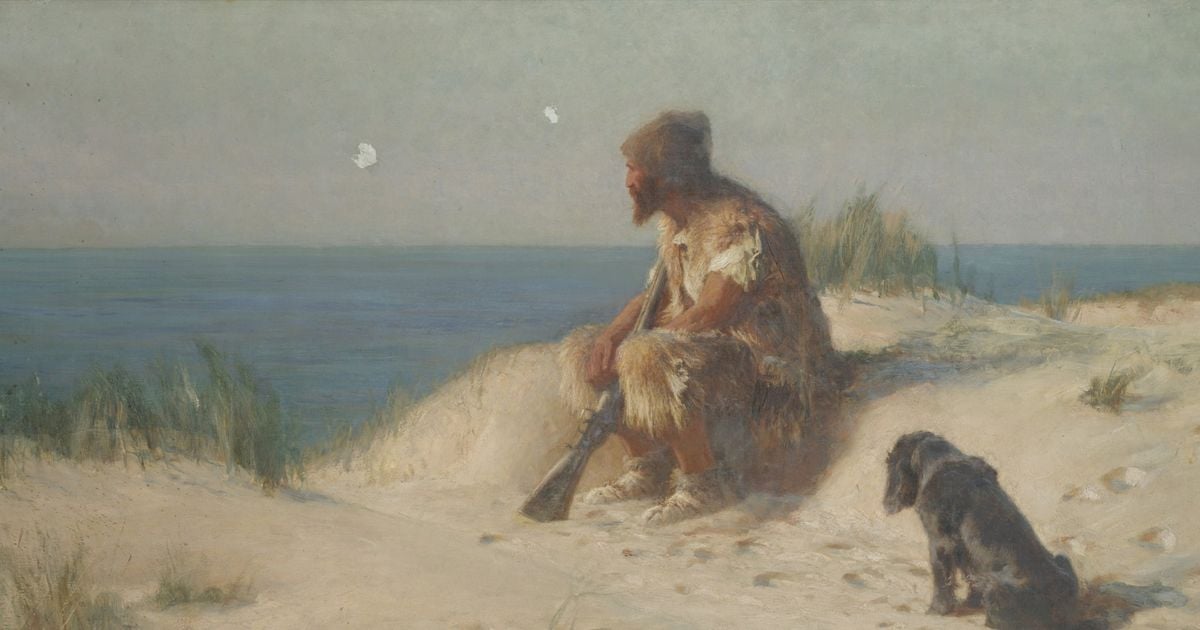
At St. Salvador he tells how cheaply people can be bought on the Guinea coast for beads and knives. Three planters offer one secret voyage, Crusoe as supercargo, the captives landed privately and divided, his share free. He knows the plantation might make him rich if he stayed. He goes if they will keep it and sell it should he miscarry, and he wills the captain who saved him as heir. On the 1st of September 1659, eight years after he left Hull, he boards a ship of about a hundred and twenty tons and six guns. Past the line a tornado blows twelve days. A man dies of the calenture, a man and the boy wash overboard, and they find themselves off Guiana, towards the Orinoco. Crusoe will not turn back to Brazil. A second storm drives the leaky ship west until she strikes sand. Eleven men take to the boat. A wave oversets it. Crusoe is thrown ashore, dashed on a rock, and climbs the cliffs alone. Three hats, a cap, and two unmatched shoes are what remain of the others. He has a knife, a pipe, and a little tobacco, drinks at a stream a furlong inland, cuts a stick for his defence, and sleeps in a thorny tree. He wakes refreshed, and the day is still to be faced.
Robinson Crusoe reveals a pattern that transcends centuries: the compulsion to sabotage our own success. In 1719, Robinson had achieved exactly what his father advised: modest wealth, security, respectability: yet he threw it away for an illegal slave-trading venture he himself called preposterous. Today, we see this same pattern everywhere. The nurse who finally gets day shift, then quits for a chaotic travel assignment. The couple who refinances their paid-off house to flip properties, losing everything when the market crashes. The employee who leaves a solid job for a startup that promises equity but delivers chaos. What drives this self-destructive restlessness? Often it's not about moving toward something better, but running from the responsibility of maintaining what we've built. Success can feel like settling, security like stagnation. We tell ourselves we deserve more, that we're meant for bigger things. The very stability that should bring contentment becomes evidence we're not living up to our potential. But Defoe shows us where this leads: Robinson ends up naked, weaponless, and alone on a beach, contemplating which form of death will claim him first. The pattern is ancient, but so is the solution: learning to find growth and challenge within stability rather than burning it down for the illusion of something greater.
Explore this chapter with AI to uncover deeper meaning and practical takeaways.
AI Discussion