
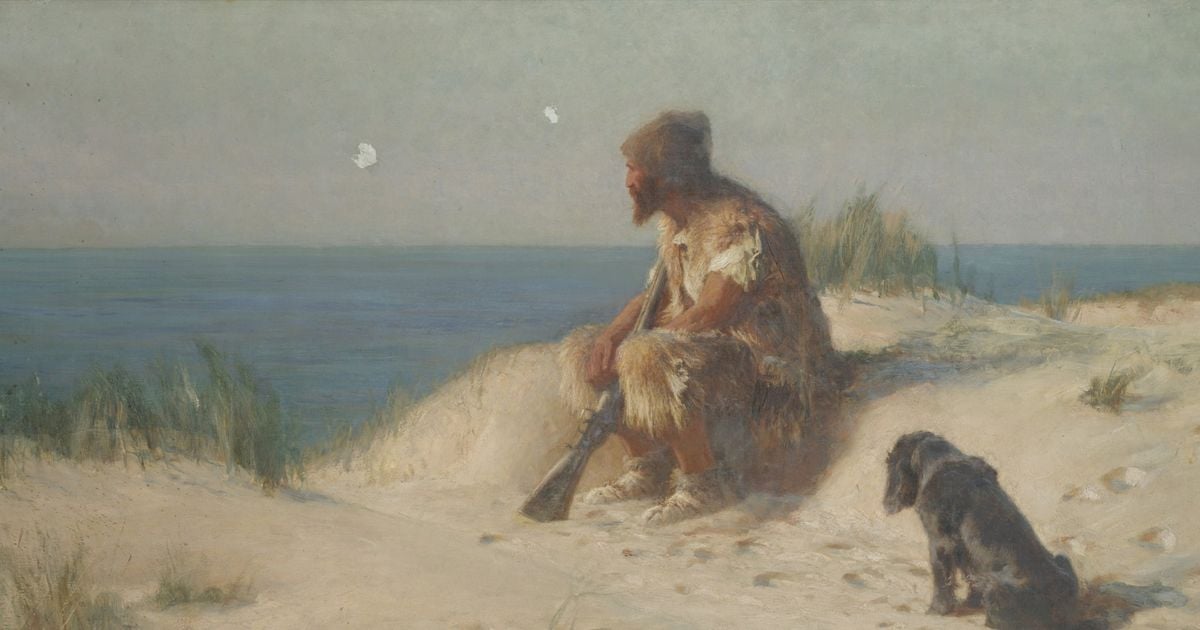
Robinson Crusoe ships for Africa on the voyage sailors call a voyage to Guinea, and he goes aboard as a gentleman. Money and good clothes mean he has no work and learns no sailor's duty. In London a Guinea captain offers the passage free, as messmate, if Crusoe will carry goods. About forty pounds in toys and trifles, handled honestly, come home as five pounds nine ounces of gold-dust, almost three hundred pounds. The gain fills him with plans to rise. He learns to keep a course and take an observation, and the heat still throws him into a violent calenture. Then that captain dies.
He sails again under the old mate, with less than a hundred pounds aboard and two hundred left with the widow. Between the Canaries and the African shore a rover from Sallee takes them in the grey of the morning. Twelve guns answer eighteen. Sixty men board, the deck is cleared twice, and they yield with three dead and eight wounded. The rest of the crew go up country. Crusoe is kept as the captain's own slave. His father's warning, that he would be miserable and have none to relieve him, seems already true. The master leaves him to the garden and the cabin instead of taking him to sea, where a Spanish or Portuguese ship might free him. For about two years there is no fellow slave, and no countryman, to run with him.
Want of money keeps the master home. After a fog carries the fishing boat two leagues out, he has an English carpenter-slave fit a cabin, compass, and stores into the captured longboat. A day with Moorish guests is provisioned, then cancelled. Crusoe is sent with the man and the boy to catch fish for supper, and he loads for flight. Ismael, whom he calls Moely, brings biscuit, water, powder, and shot without suspecting him. Crusoe adds bottles, beeswax, twine, a hatchet, a saw, and a hammer. They pass the castle. The wind is north-north-east, useless for Spain, and he goes all the same.
He hides every fish that bites, says they must stand farther off, and runs nearly a league before he throws Moely overboard. Moely swims after the boat and begs to be taken in. A fowling-piece turns him towards shore. The boy Xury smiles and swears to go all over the world with him. While Moely can still see them, they stand out as if for the Straits, and at dusk Crusoe turns south. Next afternoon he reckons a hundred and fifty miles south of Sallee, and he keeps off the land five days from fear. A wind shift lets him anchor in a nameless river. Beasts roar in the dark, and a huge swimmer closes to two oars' length before his shot drives it off. Not a pint of water is left. Xury offers to land alone so that, if wild men come, they may eat him and Crusoe can get away. They wade in together. Xury kills a creature like a hare and finds water; higher up, the ebb is fresh. Two tries for the peak of Teneriffe fail. One morning he shows Crusoe a lion asleep under a hillock. Crusoe breaks its leg and shoots it in the head. Xury swims ashore and fires into its ear. They skin it all day, spread the hide on the cabin, and leave the sun to dry a bed.
Crusoe's escape involves throwing a man overboard at gunpoint: hardly heroic by today's standards. But Defoe isn't writing a morality tale; he's documenting how desperate circumstances force impossible choices. In 1719, slavery was legal business, and Crusoe's readers would have understood his predicament as economic disaster, not moral awakening. The uncomfortable truth is that survival sometimes requires actions that comfortable people can condemn from safety. Modern workers face parallel dilemmas daily. The single mother who doesn't report workplace harassment because she can't risk her job. The immigrant who stays silent about wage theft because deportation looms. The older worker who watches age discrimination but needs health insurance. We tell ourselves we'd be heroes, but Crusoe's story suggests otherwise. When your children's food depends on keeping quiet, moral purity becomes a luxury. The chapter doesn't excuse these compromises: it recognizes them as human reality. Crusoe's violence serves the story's larger truth: when systems trap people, they create conditions where ordinary folks must choose between different kinds of harm. The real question isn't whether we'd be better than Crusoe, but whether we're working to build systems that don't force such choices on desperate people.
Explore this chapter with AI to uncover deeper meaning and practical takeaways.
AI Discussion