
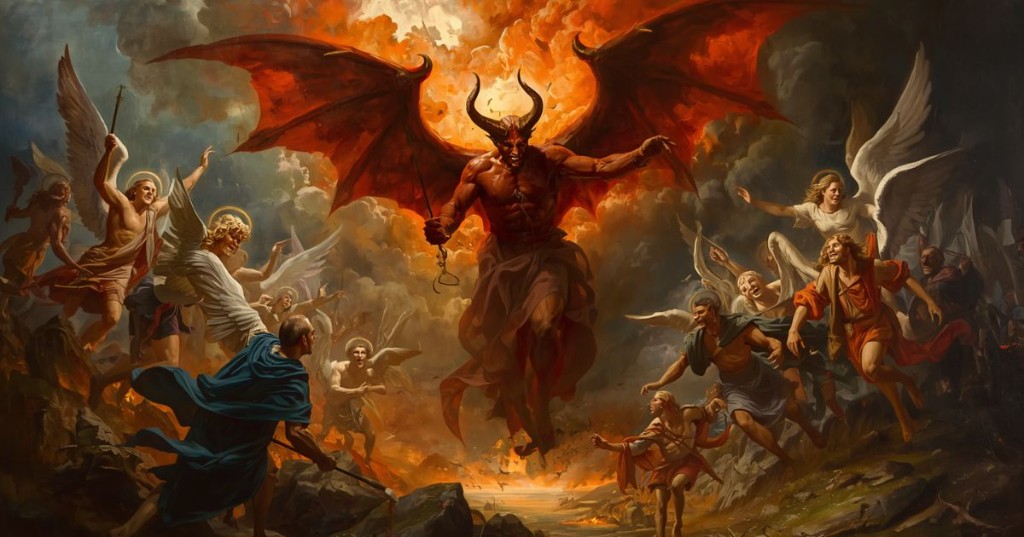
Abdiel walks all night back to Heaven and finds the loyal armies already fully drawn up for war. God praises him for standing alone against the rebels in word when none else spoke, then sends Michael and Gabriel to drive the apostates out with force toward Tartarus. When the hosts meet at the frontier of Heaven, Abdiel strikes Satan down with a single blow before the general clash begins, and Gabriel's trumpet launches the loyal charge as the first day's fighting rages until Michael wounds Satan deeply, though spirits heal quickly and night brings truce while Satan rallies his council in the dark dislodged camp. Satan and Abdiel exchange defiant speeches at the front before blades and chariots fill the plain. Michael's sword draws the first deep wound Satan feels, yet angelic bodies knit again until night ends the day.
Satan spends the darkness inventing cannon from the deep materials of Heaven, rifling the armory of the empyrean, and at dawn his host advances behind engines that blast the faithful ranks with chained thunder and iron globes. Loyal angels answer by uprooting hills and hurling mountains at the rebel engines until the battlefield becomes absurd carnage that even Heaven's faithful find grotesque and threatens the crystal wall itself, and God, consulting from his sanctuary, assigns the third day to the Son to end what arms and invention have swollen beyond reason. Nisroch urges new engines after pain teaches the rebels that open combat alone will not win. The Son alone is chosen from the Father's sanctuary to finish what invention has made monstrous.
The Father transfers full power to Messiah in open sight of both armies, who mounts the chariot of deity with bow and thunder while angels stand aside at his command. He drives the rebels to the crystal wall of Heaven without using half his strength, opens the abyss beneath them, and watches them throw themselves downward for nine days until Hell receives them with a yawning mouth and the mural breach is repaired while Hell shuts on the fallen host. Heaven rejoices as the Son returns triumphant through palm-bearing choirs to the throne of the Father.
Raphael closes the tale for Adam and Eve at the same table: remember this example of disobedience, guard the weaker partner, and do not repeat the fall of those who might have stood firm. He warns that curiosity about forbidden power feeds the same appetite Satan exploited in Heaven, and that foreknowledge is meant to strengthen obedience, not entertain pride. The war in Heaven is already past; the tempter now plots seduction in Paradise, and the same enemy who could not win by force now targets Eve's waking will with subtler, patient fraud.
Milton's war in Heaven reveals something disturbing about human nature: sometimes the smartest people make the most destructive choices. Satan isn't stupid—he's brilliant, charismatic, a natural leader. Abdiel isn't naive—he's courageous and principled. Yet their conflict nearly destroys Heaven itself. Why do intelligent people escalate conflicts until everyone loses? The answer lies in the sunk cost fallacy and social proof. Once you've invested your reputation in a position, backing down feels like admitting you were wrong all along. When others are watching, compromise looks like weakness. Each escalation feels rational in isolation—if they hit you with cannons, throwing mountains seems proportionate. But step by step, you cross lines you never intended to cross. Modern examples are everywhere: divorce proceedings that cost more than the assets being divided, workplace disputes that destroy careers on both sides, family feuds that outlast the people who started them. The tragedy isn't that conflicts happen—it's that people who should know better choose mutual destruction over admitting they were wrong. Milton suggests that sometimes only outside intervention can break these cycles. But what if that intervention never comes? What if you have to be the one who chooses to lose face in order to save what really matters?
Explore this chapter with AI to uncover deeper meaning and practical takeaways.
AI Discussion