
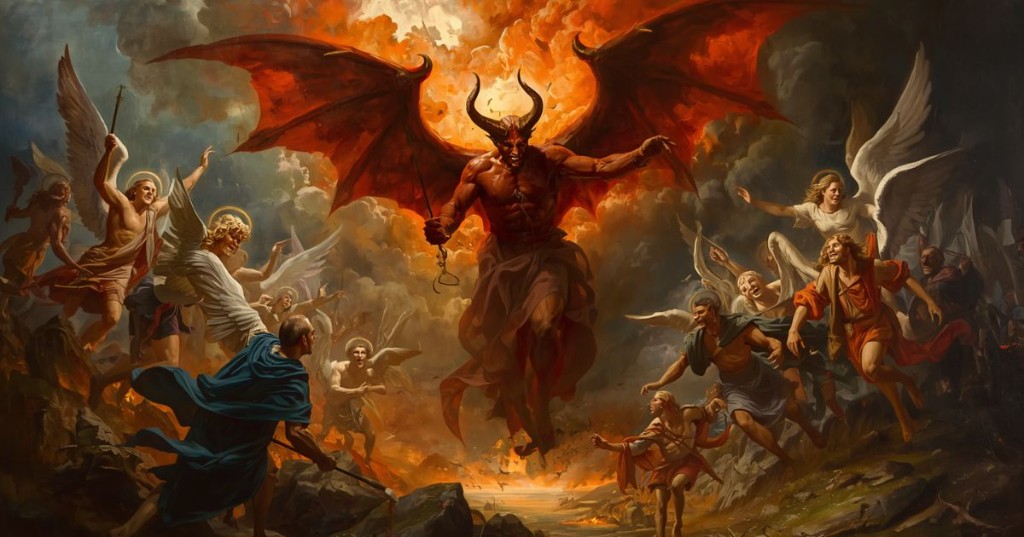
Adam wakes to find Eve troubled by a dream in which a voice like his led her to the forbidden tree, where a winged figure ate the fruit, praised knowledge, and pressed her to taste until she flew and then fell. She wakes relieved it was only sleep, but Adam is shaken and explains that Fancy can misjoin images in dreams without making guilt, and that evil thoughts may pass unreproved if waking will refuses them at the table of choice. They pray at dawn in spontaneous praise of creation, then return to garden work until God sends Raphael to warn Adam of Satan's plot and teach him what free will requires, and Adam kisses the tears she hides before they go out to labor.
Raphael descends through Heaven in six wings of radiant speed, lights on Eden's cliff, and joins Adam and Eve at noon as a guest they honour with fruit and flowing cups. Over a turf table piled with autumn in spring beneath Eden's noon shade, he eats plainly, praises Eden's bounty, and answers Adam's questions about how spirit and body relate on a ladder from earth to Heaven. He cautions that happiness continues only while obedience holds, because God made humans perfect but not immutable, leaving the will free though mutable and able to fall if they grow too secure, ministering at table with innocent hospitality. Eve listens as the angel explains that reason is but choosing, and that constancy to good is the truest freedom.
Adam asks what that warning means for creatures already blessed in Eden, and Raphael explains that angels too serve freely, love freely, and can fall, then begins the story of Satan's rebellion at God's decree anointing the Son. Heaven's host rejoices in song and feast at the Father's decree, but Satan, envying the honour given another, gathers his legions under false pretense and marches north to rally a third of the angels against the new King, casting doubt with ambiguous words, pretending the march honors Messiah while he plots revolt and hides envy under specious talk of liberty.
Only Abdiel, one against a multitude, answers Satan's case for equality with defiance, calling the decree just and urging repentance while the host applauds rebellion and counts numbers as proof. He names Satan's titles usurped and warns that numbers cannot make wrong right, that servitude to law is freedom when law is just and rebellion is only pride rehearsed as principle. Unmoved by scorn, he walks alone through the applauding ranks back toward Heaven's light, faithful among the faithless as Raphael's tale ends and the dreadless angel's night journey prepares the war that morning will bring on those proud towers doomed to swift destruction.
Milton understood something crucial about human nature: the most dangerous corruption doesn't announce itself with horns and pitchforks. It arrives wearing the mask of justice, speaking the language of fairness, carrying legitimate grievances. Satan's rebellion begins with a reasonable question—why should the Son rule over angels who were created first? It's not obviously evil to ask about fairness in leadership structures. But watch how the question evolves. First it's about equality, then it's about being undervalued, then it's about being actively oppressed, then it's about righteous resistance, then it's about war. Each step feels logical based on the previous one. The person walking this path genuinely believes they're fighting injustice, not becoming the problem. This pattern appears everywhere in modern life. The nurse who starts by questioning unreasonable patient loads and ends up cutting corners that hurt people. The parent who begins by rejecting their own strict upbringing and ends up with no boundaries at all. The employee who starts by pointing out legitimate workplace problems and becomes the toxic person everyone avoids. The key insight isn't that we should never question authority or fight injustice—it's that we must constantly examine our motives and methods. Are we actually solving problems, or are we using problems to justify what we wanted to do anyway? The most dangerous corruption feels completely reasonable to the person doing it.
Explore this chapter with AI to uncover deeper meaning and practical takeaways.
AI Discussion