
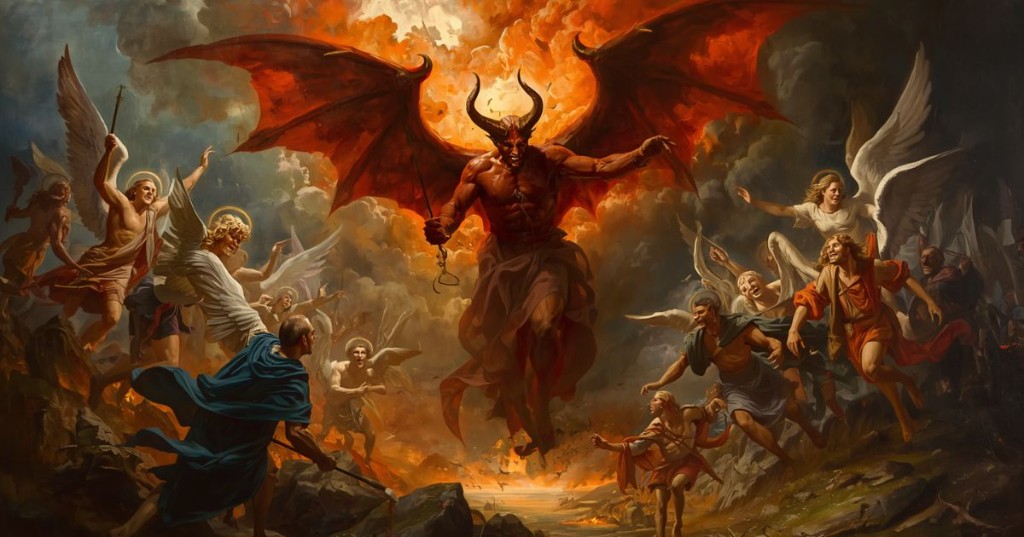
Milton opens Book IV by wishing Adam and Eve had heard Revelation's warning before Satan reaches Eden. The fiend pauses at Paradise's border with conscience warring against mission, speaking aloud to the sun and admitting God deserved praise, not rebellion, yet pride and shame forbid repentance. He names the inward hell he carries, rejects submission as weakness before his followers, and hardens into defiance: farewell remorse, evil be thou my good. Uriel's earlier warning still tracks him, marking his borrowed face with passions no heavenly mind should show. He knows he cannot turn back without losing face before the infernal council that sent him.
Satan disdains Eden's eastern gate and leaps the wall like a wolf into a fold, then broods from the tree of life, perverting its height into a spy post over a garden Milton paints as Heaven on earth: four rivers branching from one source, each with its own legend, orchard, innocence without shame. Adam and Eve pass hand in hand, naked majesty reflected in each other, then rest by a fountain sharing fruit and gentle speech. Their love is shared work, mutual praise, and delight without suspicion while tame beasts sport around them and the serpent already insinuates, unheeded, among the herd at Eve's heel, and Milton insists honest nakedness carries no guilty shame.
Watching them, Satan flinches between pity and envy before he settles on the forbidden tree of knowledge as his lever. Adam's evening praise leads Eve to recount her awakening by the pool and her guided meeting with him; their kiss turns Satan aside with jealous hate. He learns the one prohibition, decides knowledge is hoarded unjustly, and vows to spy through the garden while they still feel secure, shifting shape among lions and tigers to draw nearer unobserved, framing envy as public reason for private ruin. He roams the garden like a prowling wolf, studying paths and habits while innocence still sleeps secure.
Evening settles; Adam and Eve discuss stars, labor, and the unseen angels who praise God through the night while they still feel no fear before walking to their bower and offering pure adoration in sleep. Gabriel posts watch; Uriel brings news of an infernal spirit, and Ithuriel finds Satan squat like a toad at Eve's ear until celestial touch forces his true shape back. Zephon's rebuke shames him for having fallen from native form and looking less like a spirit than a fiend; Gabriel and Satan trade threats until Heaven's golden scales, held out between them, show Satan's side the lighter weight and he flees murmuring into night, and the shades of night flee with him without the cosmic war both nearly unleashed on the sleeping garden below them.
Milton wrote Satan's crisis at Eden's border during England's political upheaval, when former revolutionaries faced similar choices about doubling down or seeking reconciliation. Satan's internal monologue reveals something devastating: he knows God would forgive him, but he can't forgive himself for being wrong. This isn't about divine mercy—it's about human psychology. We see this pattern everywhere in working-class communities. The supervisor who implements a policy that clearly isn't working but can't back down because the crew is watching. The parent who punishes a child too harshly, then escalates rather than apologize because admitting the mistake feels like losing authority. The union leader who takes a hard stance in negotiations, then can't compromise even when it would benefit everyone because changing course might look weak to members. Pride becomes our warden, keeping us locked in positions that hurt us and everyone around us. The tragedy isn't that we make mistakes—it's that we often choose to compound them rather than face temporary embarrassment. Milton understood that the real hell isn't punishment from above, but the prison we build from our own inability to say 'I was wrong.' The question becomes: what would change in your life if you could separate your worth from being right?
Explore this chapter with AI to uncover deeper meaning and practical takeaways.
AI Discussion