
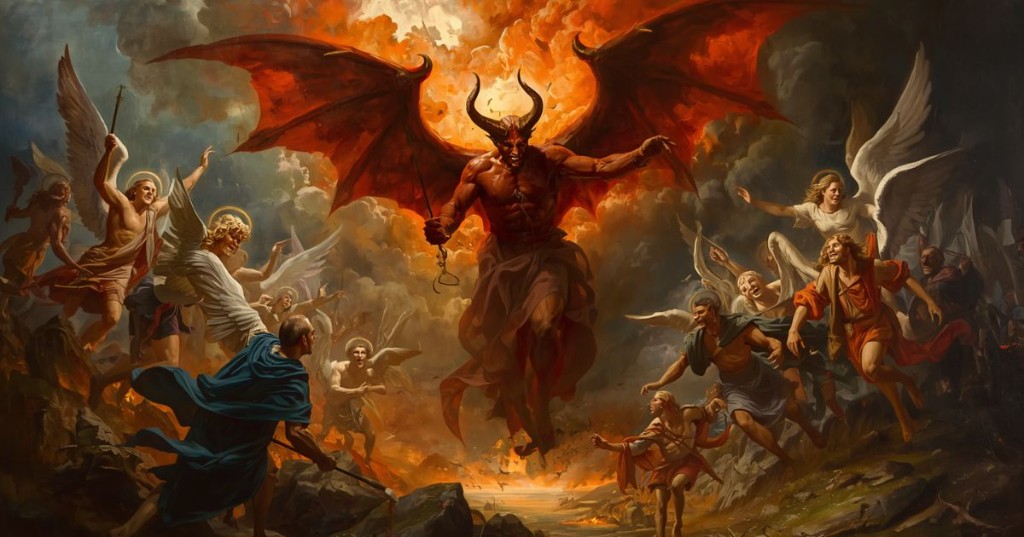
Milton invokes holy Light after the infernal books, confessing blindness and asking inner illumination so he can tell what mortal eyes cannot see. He names blind poets and prophets as his kin and begs Light to shine inward, planting eyes in the mind. Heaven opens on the Almighty and the Son reviewing creation: Adam and Eve reaping joy in Eden while Satan coasts the outside of the new world, bound for revenge. God foresees the fall yet insists Adam was made just, sufficient to stand, and free to fall. He tells the Son that Man will hear Satan's glozing lies and break one easy command, yet grace awaits the willing. Angels and humans remain authors of their own choices; foreknowledge does not force guilt, and mercy will brightest shine when Man accepts grace.
When disobedience makes death the just price and no created spirit will pay it, the Son alone answers: account me Man, let wrath fall on me, die, and rise to bind death and lead redeemed souls home. The Father accepts, ordains incarnation, imputed merit, and the Son's throne as God and Man united. Heaven explodes in hymn; crowns are cast before thrones, and angels sing that love offered before the crime exists outdoes the hate that still destroys those who reject grace.
Meanwhile Satan walks the dark outer shell of the world, through Limbo where vain pilgrims, friars, and Babel builders circle in wind-blown folly until dawn reveals Jacob's ladder and the wide gate above Paradise. He surveys the hemisphere from Libra to Andromeda, dives through marble air toward the sun, and disguises himself as a young cherub eager to praise the Creator's newest works.
Uriel, regent of the sun, takes the visitor for a sincere pilgrim and describes Earth's globe, the moon's borrowed light, and Paradise at Adam's bower. Milton warns that hypocrisy alone walks invisible except to God, so even sharpest sight fails when vice wears devotion. Satan bows like a courtier, wheels down the ecliptic, and lights on Niphates with a map to Eden. Book III ends with flattery mistaken for faith and mankind still unwarned.
Milton understood something brutal about human nature: the better you are, the easier you are to fool. Uriel gets deceived not despite being a good angel, but because of it. When you're genuinely good-hearted, you assume others are too. You interpret their words through your own honest lens. This creates a devastating blind spot that predators exploit systematically. They study what you care about—family, faith, fairness, community—then mirror it back perfectly. The healthcare worker who talks about 'caring for patients' while cutting corners. The neighbor who mentions shared values while planning to take advantage. The family member who weaponizes concern for others to get what they want. Modern life amplifies this pattern through social media, where people can research your values before approaching you. They know exactly what language will make you lower your guard. The cruelest part? When you finally realize you've been manipulated, you don't just feel hurt—you feel stupid for trusting. But the problem isn't your goodness; it's that goodness assumes goodness in others. The solution isn't becoming cynical—it's creating verification systems. Trust, but verify. Watch actions over time, not perfect opening speeches. Real alignment reveals itself through consistency, not through saying exactly what you want to hear. Your values aren't the problem. Being targeted because of them is the pattern you need to recognize.
Explore this chapter with AI to uncover deeper meaning and practical takeaways.
AI Discussion