
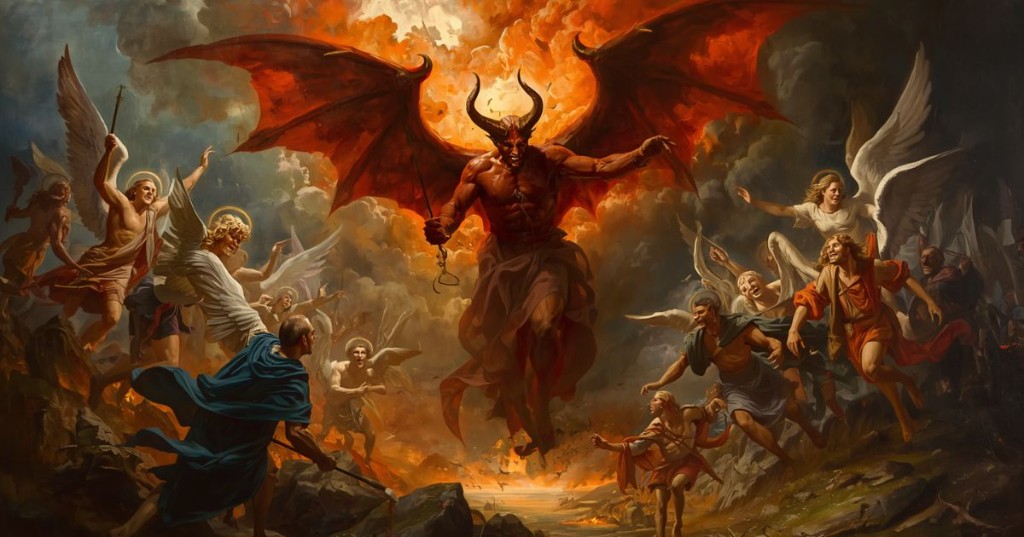
Adam and Eve stand repentant; prevenient grace softens stony hearts, and sighs the Spirit wings to Heaven faster than oratory while their petition reaches the golden altar mixed with incense. The Son presents their prayers as first-fruits sweeter than Eden's unfallen trees, offers himself as advocate and propitiation, and wins acceptance: Man may live reconciled, though not forever in Paradise, until death yields a better life through faith and faithful works. The Father calls synod, decrees expulsion before Man reaches the tree of life, and sends Michael with Cherubim to drive the pair out without terror if they obey, revealing future days, intermixing covenant in the Woman's seed renewed, and posting sword-flame at the east gate lest foul spirits steal the tree of life.
Michael descends at dawn in human form, purple-clad and kingly; birds and beasts run east as Nature eclipses. He tells Adam exile is fixed, death delayed for repentance, and Eve laments flowers and the nuptial bower she will never tend, though the Angel says her native soil is wherever Adam abides. Adam submits but grieves losing visible presence and sacred places he hoped to mark with grassy altars; Michael teaches that God fills land, sea, and air, not Eden alone, that the earth remains his gift, and that signs of paternal love will follow them wherever they dwell. Eve sleeps while Adam ascends the highest hill, eyes purged with euphrasy and rue and drops from the well of life, so he can see what his offspring will do.
What he is shown is not a map he asked for. The first picture is a brother killing a brother over whose offering was accepted, and then a long hospital of bodies ruined by appetite, until he understands that the image of God can be forsaken one habit at a time. Tents and song harden into mixed marriages and a race of giants; a plain is given over to war; one just man is taken while violence still rules. Peace does not save the next age either. Luxury softens what war had not killed, and only Noah's ark is left when the flood covers the world Adam still thinks of as his children. He mourns as if they had already died, wishes he had never been shown the future, and begs Michael to say why peace corrupts no less than war.
The waters fall. Noah's dove returns with an olive leaf, and God sets the rainbow as a covenant never to destroy the earth by flood again, though fire will purge all things new at last. Adam rejoices that one just man can preserve seed and that wrath can relent, and he asks what the coloured streaks mean. Michael names the bow as a memorial of seed-time, harvest, and seasons held until the just dwell renewed. Mortal sight fails before Babel and the promised seed are shown. Paradise is already preparing to close, and the rest of the pageant waits on a later hill.
Adam can't see past his immediate crisis until Michael shows him the bigger picture. This reveals something fundamental about human psychology: we're terrible at seeing our own lives in context. When we're in the middle of failure, shame, or loss, our vision narrows to the crisis. We lose the ability to imagine recovery or growth. Milton understood that wisdom often comes from outside perspective—someone who's walked similar roads and can map the territory ahead. This isn't about toxic positivity or minimizing real pain. Michael doesn't tell Adam the Fall was actually good or that everything happens for a reason. Instead, he provides what psychologists now call 'post-traumatic growth'—the recognition that crisis can become catalyst. In working-class communities, this wisdom traditionally passed through informal networks: the older woman who helped younger mothers navigate difficult pregnancies, the veteran who helped newcomers understand workplace politics, the neighbor who'd survived foreclosure and could guide others through bankruptcy. But social mobility and geographic dispersal have weakened these networks. We're more isolated in our crises, more likely to spiral in shame rather than seek perspective. The pattern Milton captures—that we need others to help us see our story's arc—remains as relevant today as it was in 1667. Sometimes the most radical act is accepting help to see beyond our immediate pain.
Explore this chapter with AI to uncover deeper meaning and practical takeaways.
AI Discussion