
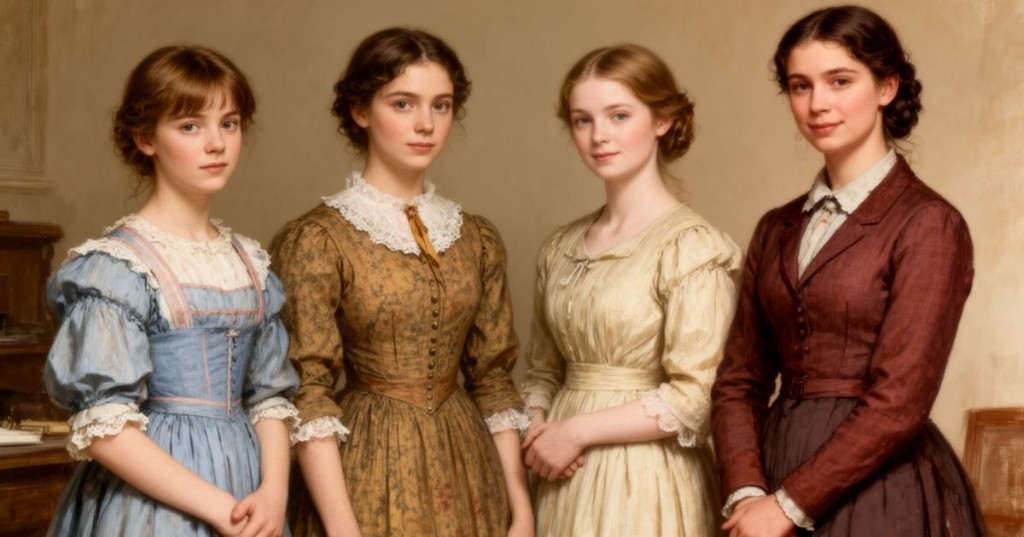
Holiday sparkle fades into Monday burdens. Meg sighs that taking up packs and going on feels brutal after parties and bouquets. Jo tries to cheer her by comparing Aunt March to the Old Man of the Sea, but the house wakes cross: spilled ink, broken laces, cats on Meg's back, Amy's ruined sums, and Marmee trying to finish a letter while everyone complains. Hannah's hot turnovers send the two eldest out into bitter wind with a wave from the window that steadies them more than any lecture could. Jo calls them ungrateful wretches and means it as repentance, not theater.
The chapter's middle widens to each sister's labor. Meg governs spoiled children at the Kings' and envies luxuries she once knew, watching ball dresses and theater gossip she cannot afford. Jo serves peppery Aunt March for wages, marches home in temper, and steals library time until Josy-phine is shouted from paradise. Beth keeps house, nurses broken dolls in a miniature hospital, and quietly grieves the piano she cannot afford. Amy endures hand-me-down clothes, flat-nose vanity, and school humiliation when Susie Perkins is punished for a caricature. Alcott pauses on Beth to say there are many shy girls living for others until the cricket stops chirping, a warning the chapter will later echo in Marmee's story hour.
Evening sewing brings stories back to the table. Jo entertains with Aunt March, Belsham, and smuggled Vicar of Wakefield; Meg reports scandal at the Kings'; Amy recounts Susie's carnelian-ring downfall; Beth tells how Mr. Laurence gave a poor woman fish at the market. Marmee answers with the old man who said he gave his boys and gave them free, then a parable about four discontented girls who learned gratitude by counting blessings instead of cravings. Meg calls it a sermon disguised as romance. Jo ends with Tink ob yer marcies. Amy vows to watch her pride; Beth straightens Jo's needles. The chapter closes with softened hearts, not solved problems: same work, same envy, same Aunt March, but a different angle of light and a family language they can reuse when Monday returns. Nobody's job got easier, but the girls leave the evening less alone inside their complaints. Marmee never raised her voice; she changed the story they were telling about themselves.
The March sisters experience something universal: the contrast effect that makes ordinary struggles feel unbearable after moments of joy or hope. This isn't weakness—it's human wiring. When we taste something better, our baseline shifts, making previously acceptable circumstances feel like punishment. Today's version might be feeling trapped in your job after seeing a friend's career breakthrough, or your apartment feeling cramped after visiting someone's house, or your relationship seeming stagnant after witnessing someone else's engagement excitement. Social media amplifies this constantly, showing us curated highlights that make our behind-the-scenes reality feel inadequate. But Alcott reveals something crucial: the problem isn't the contrast itself, but what we do with it. The sisters could have stayed stuck in resentment, comparing their reality to their Christmas joy. Instead, their mother's story about the man who gave four sons to war without complaint provides a different lens. Not to minimize their struggles, but to show how perspective choice determines emotional experience. This isn't about toxic positivity or pretending problems don't exist. It's about recognizing that we always have some degree of choice in how we frame our circumstances. The same situation can be evidence of unfairness or opportunity for growth, depending on which story we tell ourselves about it.
Explore this chapter with AI to uncover deeper meaning and practical takeaways.
AI Discussion