
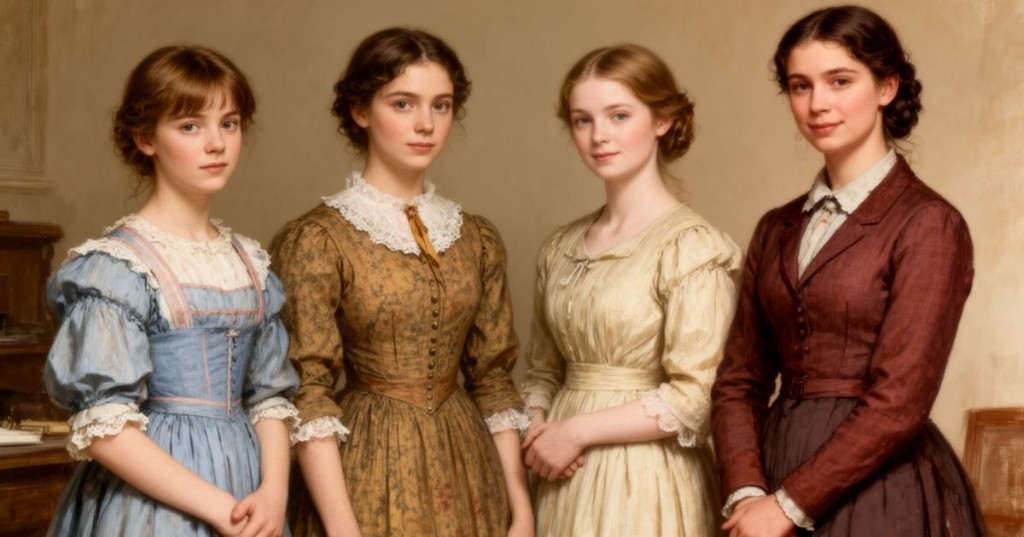
Restless Jo cannot sit by the fire while snow fills the garden between the shabby March house and the grand Laurence mansion. When Meg advises comfort indoors, Jo declares she never takes advice and goes out with broom and shovel to make paths for Beth's invalid dolls. She sees Laurie at an upper window, lonely and recovering from a cold, and tosses a snowball that turns his listless face into a smile. A few shouted questions become an invitation, and Jo marches inside with Marmee's permission, carrying Meg's blanc mange and Beth's kittens because each sister wanted to help.
Laurie's room brightens under Jo's hands and talk. He admits he watches their warm kitchen scenes through the window when the curtain is left up, hungry for the family life he lacks since his mother died. Jo promises they will never draw that curtain any more and invites him into their world. Laurie shows her the conservatory, library, portraits, and grand piano while his grandfather is out. Jo covets the books; Beth's need for music hangs unspoken in the room. Laurie plays while Jo buries her nose in flowers, and respect replaces distance.
Old Mr. Laurence catches Jo critiquing his portrait and, instead of punishing her blunt honesty, laughs, tests her, and says she has her grandfather's spirit. When he asks what she did to his boy, Jo says she was only trying to be neighborly. Tea with the old gentleman, flowers sent home to Marmee, and Laurie's promise to visit complete the afternoon. That night Marmee explains why the grandfather flinches at music: pride, loss, and fear of losing Laurie to an artist's life like his mother's. Meg teases Jo about compliments; Beth hears Palace Beautiful in the distance while Jo says lions remain. Wealth without warmth is loneliness, and one brave first move can redraw the boundary between houses that pride and grief had kept shut. The March girls wanted a neighbor; Laurie wanted a household. Jo's snowball started both. By dusk the Laurence house is no longer only a symbol of wealth next door. It is a door the March girls may walk through because Jo moved first.
In Jo's world and ours, there's an unspoken rule that someone else should be the bridge-builder. We see the new person at work eating alone, the neighbor who never talks to anyone, the family member who's been distant since their divorce—and we wait. We tell ourselves they want privacy, that we might be intruding, that surely someone closer to them will reach out. Meanwhile, they're often waiting too, hoping someone will notice they're struggling and care enough to break the silence. This mutual hesitation creates invisible walls that keep people isolated in plain sight. The pattern plays out everywhere: in workplaces where new employees remain outsiders for months, in neighborhoods where people live side by side as strangers, in families where pride prevents anyone from admitting they need help. Jo's snowball moment reveals something profound about human nature—most of our social barriers exist only because everyone's too afraid to be the first to ignore them. When someone finally does make that move, the relief is mutual. The 'intimidating' person usually turns out to be lonely. The 'antisocial' coworker is often just shy. The distant relative is typically hurt and hoping someone will notice. What looks like rejection is usually protection. This chapter asks us to consider: how many potential friendships, mentorships, or support networks never form simply because everyone's waiting for someone else to make the first move?
Explore this chapter with AI to uncover deeper meaning and practical takeaways.
AI Discussion