
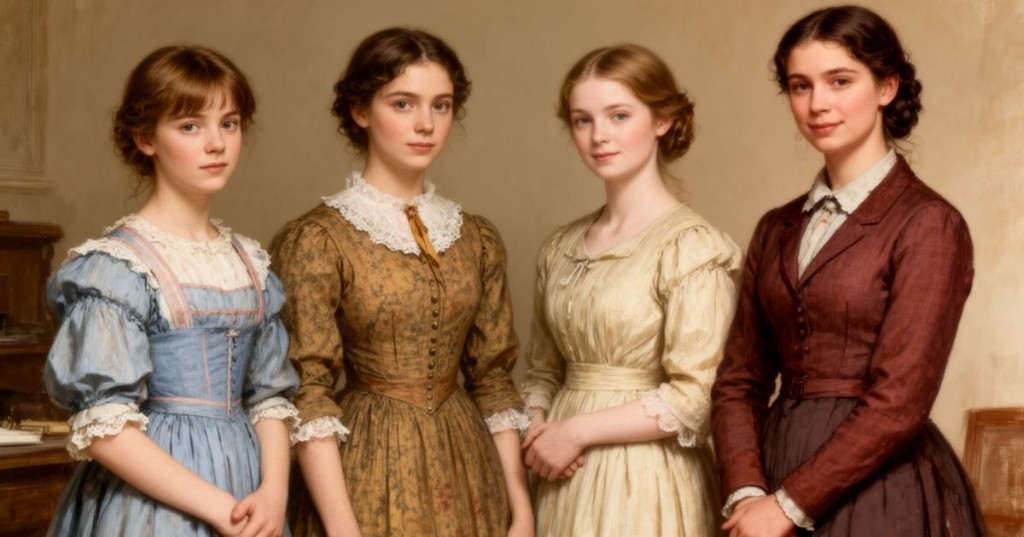
New Year's Eve pulls the sisters into the social world they have mostly watched from afar. Meg receives a dance invitation from Mrs. Gardiner and immediately worries about poplins, gloves, curls, and the burn Jo scorched into her dress with hot tongs. Jo would rather stay home than perform ladyhood badly, but Meg's mortification over stained gloves wins, and the sisters solve poverty cosmetically: one good glove each, hidden bad one, tight slippers, and nineteen hairpins stabbing Jo's head because, as they tell themselves, one must be elegant or die.
At the party Meg sails into acquaintance while Jo stands against the wall like a colt in a flower garden, longing to join boys talking about skates. Marmee's last shout about pocket handkerchiefs follows them down the walk. Jo hides behind a curtain to avoid a red-headed partner and collides with Laurie, the Laurence boy, who is hiding for the same reason. Their talk is immediate and unfiltered: hated formal names, school in Switzerland, burned frocks, and a private dance in the hall where Jo's damage does not matter. Laurie fetches coffee when Jo blunders into the china closet, serves Meg with easy manners, and arranges his grandfather's carriage when Meg sprains her ankle in tight shoes.
The ride home feels luxurious and the sisters debrief freely: Meg's invitation to spend a week with Annie Moffat, Jo's adventures behind the curtain, Laurie's German step. Beth and Amy wake demanding stories and bonbons. Back upstairs Jo binds Meg's ankle with arnica and delivers the chapter's closing judgment: fine young ladies in carriages and dressing gowns do not enjoy themselves more than the March girls with burned hair, old gowns, one glove apiece, and sore feet. The party was not a transformation into another class. It was proof that authenticity and one true friend matter more than flawless entrance, and it introduces Laurie as the boy who sees Jo before she learns to perform for anyone else. Mrs. Gardiner's crowded rooms looked like success; the curtain recess held the connection that will last. That is the chapter's quiet thesis: one honest corner can outweigh an entire polished room.
Meg's tight shoes literally trip her up, while Jo's burned dress becomes irrelevant once she finds real connection. This pattern reveals something crucial about social mobility and belonging: the very efforts we make to fit in often signal our outsider status more clearly than just being ourselves. In Alcott's time, the March sisters navigated the rigid social expectations of genteel poverty—too poor to belong with the wealthy, too educated to fit with the working class. Today's version might be the first-generation college student who can't afford the right clothes for internships, or the healthcare worker trying to sound 'professional' in meetings with administrators. The pressure to perform belonging creates a terrible bind: the more you try to hide your background, the more obvious it becomes. But here's what Jo discovers—and what modern research confirms—authenticity is magnetic. People are drawn to those who can acknowledge their struggles without shame, who can laugh at their mistakes, who ask genuine questions instead of pretending to know everything. The hospital administrator who admits they don't understand the floor dynamics, the manager who says 'I'm still learning this too'—these people build trust. Meanwhile, those desperately performing competence often isolate themselves. The question isn't whether you belong, but whether you're brave enough to show up as yourself and find the people who appreciate that authenticity.
Explore this chapter with AI to uncover deeper meaning and practical takeaways.
AI Discussion