
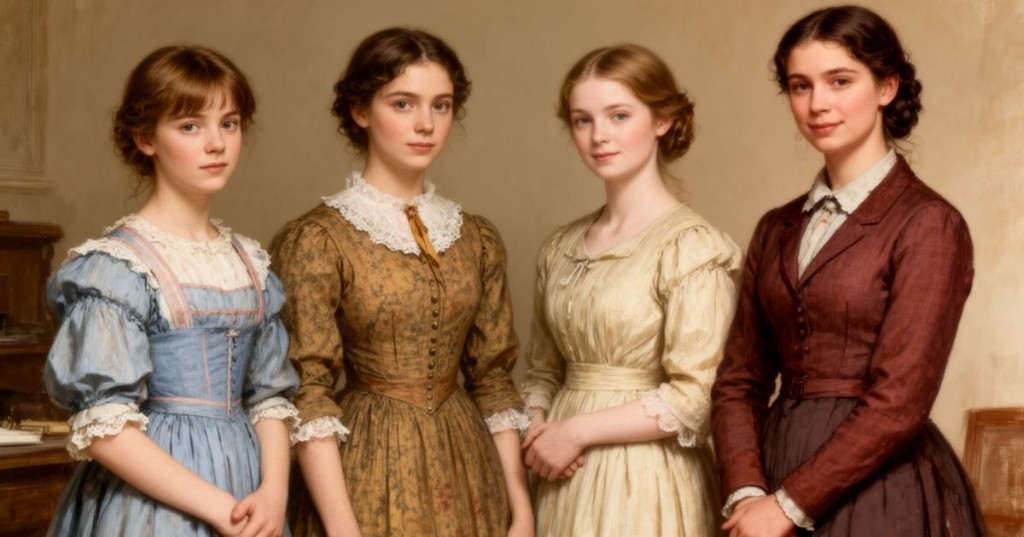
Alcott pauses to gossip before Meg's wedding, sketching three quiet years. Mr. March ministers to a small parish, John Brooke works as a bookkeeper with honest wages rather than borrowed capital, and Meg grows into housewifely skill even when she secretly compares Sallie Moffat's carriage to her own humble start. Jo writes for the newspaper, Amy prospers under Aunt March's patronage, Beth remains gentle and fragile, and Laurie scrapes through college with charm, money, and just enough repentance to escape expulsion.
Laurie christens the little brown house the Dovecote, and the family fills it with love rather than luxury: narrow halls, a tiny parlour, and gifts that carry messages. Laurie arrives each week with comic labour-saving gadgets that fail spectacularly, while Hannah, Beth, and Marmee stock linen and kitchen order. Aunt March, bound by her vow yet unwilling to leave Meg penniless, smuggles house linen through Mrs. Carrol and pretends the pearls are her only bridal gift.
Meg chooses simplicity over fashion for the wedding itself, trusting love and labour more than display. The chapter clears the slate so the reader can enter marriage without loose ends: John earns the home, Meg learns contentment beside envy, and the sisters keep growing on paths that will soon diverge further.
The narrator lingers on Mr. March's quiet authority, Mrs. March's brisk charity, and each sister's path: Amy sketching under Aunt March, Jo spinning romances for the newspaper while a garret pile grows toward fame, Beth an angel in the house before anyone names her so. Laurie brings college friends to flirt with the girls, yet remains tethered to the memory of the old man who loves him and the four innocent girls who believe in him. Wedding plans absorb Meg; Laurie's weekly gadgets clutter the Dovecote; Marmee teaches that mistresses should know how work is done even when they begin with little. Aunt March's smuggled linen becomes a family joke that softens her vow without breaking it. Jo rolls her eyes at Laurie's nutmeg graters and sweeper that steals carpet nap, yet the little house fills with laughter anyway. The chapter clears the slate so Meg's wedding can arrive with minds uncluttered.
In 1868, Alcott understood something we're still learning: there's a fundamental difference between having things and building things. Meg and John's tiny 'Dovecote' represents more than just making do with less—it's about developing what we might call 'foundation muscles.' When you start small and build together, every challenge overcome becomes shared competence. You learn to communicate under pressure, solve problems creatively, and find joy in simple achievements. This isn't just romantic idealism—it's practical psychology. Research shows that couples who weather early struggles together often develop stronger relationships than those who begin with abundance. The same principle applies beyond romance. Small business owners who bootstrap often understand their operations better than those who start with massive funding. Students who work their way through school frequently outperform those whose education is fully funded. The struggle itself becomes an education. Today's culture of instant gratification makes this harder to see. Social media shows us everyone's finished products, not their building process. We see the promotion, not the years of skill development. The vacation photos, not the months of saving. The wedding, not the relationship work. But when you can recognize the Foundation Test in action, you stop measuring your behind-the-scenes against others' highlight reels. You start asking: what am I building that can't be bought? What skills am I developing that no one can take away? The couples, careers, and lives that last aren't usually the ones that started with the most advantages—they're the ones that built the strongest foundations.
Explore this chapter with AI to uncover deeper meaning and practical takeaways.
AI Discussion