
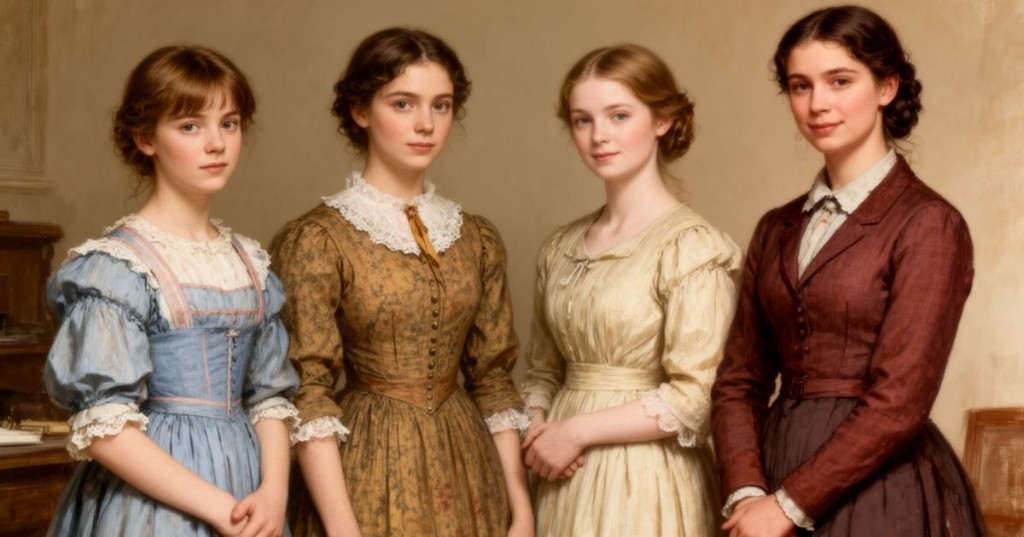
June roses wake on the morning of Meg's wedding, and Meg insists on looking like herself, not a fashion plate. She sews her own gown, wears lilies John loves, and asks for hugs that may crumple the fabric because she wants the day warm rather than ceremonious. Marmee feels the first bird leaving the nest even while she smiles.
There is no grand procession. Mr. March leads the service under a green arch while Meg says "I will" with steady trust, Jo fights tears under Laurie's stare, and Beth hides on Marmee's shoulder. Laurie upsets the cake, cousins flood in, and Meg declares the first kiss for Marmee. Gifts already live in the Dovecote; the feast is cake, fruit, and flowers, with water and lemonade instead of wine by Mr. March's rule.
Meg wins Laurie's promise to refuse wine when a pretty hostess offers it, and Jo baptises him with lemonade. The day ends with dancing, tender leave-taking, and Meg driven away to the little house that love, not fortune, built. Sisterhood remains, but the household rhythm has already shifted.
Aunt March is scandalised by the bride running to welcome guests and the groom hammering garlands, yet the home wedding stays stubbornly natural. Cousins crowd in after Laurie's cake disaster; the service is brief, tearful, and without wine, and Meg wins Laurie's pledge to refuse drink when hosts press it on him. Jo baptises him with lemonade, Beth beams from a distance, and Amy stands like a graceful statue. When Meg drives away to the Dovecote, the nest feels larger and quieter at once.
Meg's wedding reveals something profound about class and authenticity in America. In 1868, a middle-class family could still choose simplicity without losing social standing entirely. Today, the pressure to perform success through consumption has intensified dramatically. We're told that bigger weddings, newer cars, brand-name clothes, and expensive experiences prove our worth. Social media amplifies this—every celebration becomes a performance for an audience of hundreds. But Meg's choice illuminates a crucial truth: the people judging your performance aren't usually the ones who matter most. Her stuffy relatives eventually join the garden dancing because authenticity is magnetic. The pattern repeats in modern life. The parent who admits they can't afford expensive birthday parties often finds their child has more fun with homemade celebrations. The couple who chooses a courthouse wedding and puts money toward a house down payment builds a stronger foundation than those drowning in wedding debt. The worker who speaks honestly about their limitations earns more respect than those who bluff through meetings. Authenticity doesn't mean rejecting all social norms—it means choosing which ones serve your actual values. When you can distinguish between performing for approval and acting from genuine conviction, you stop exhausting yourself trying to impress people whose opinions don't actually matter to your happiness.
Explore this chapter with AI to uncover deeper meaning and practical takeaways.
AI Discussion