
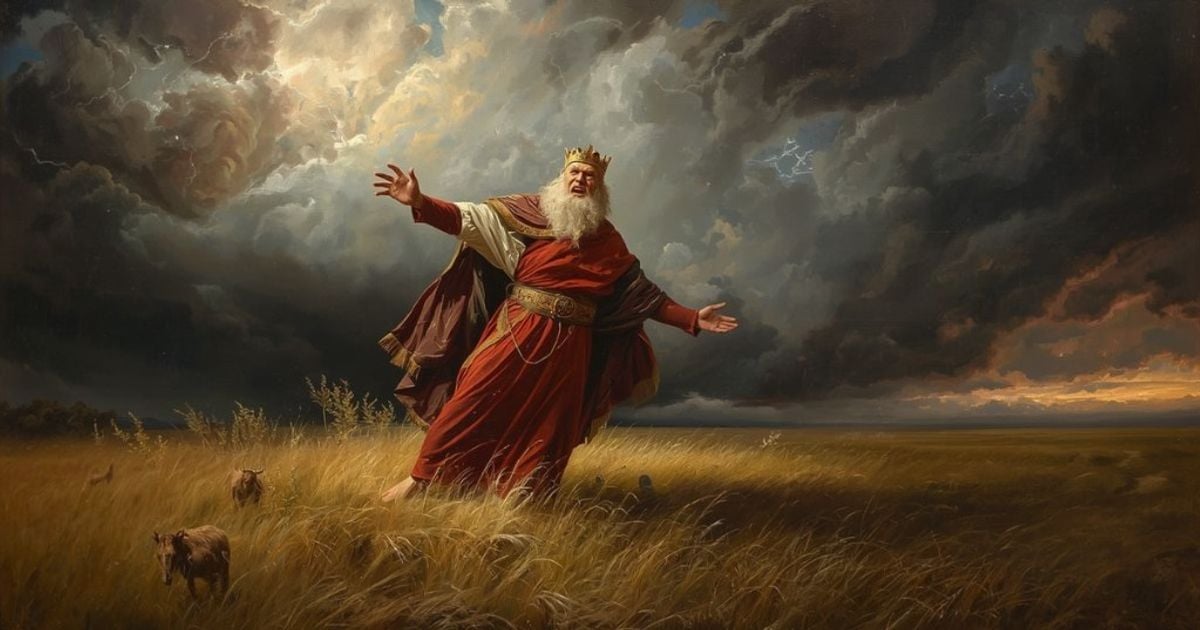
This is where the play's language reaches its highest pitch. Lear opens with a command to the storm: "Blow, winds, and crack your cheeks! Rage! blow! You cataracts and hurricanoes, spout / Till you have drench'd our steeples, drown'd the cocks!" He calls on thunder to "strike flat the thick rotundity o' the world" and crack nature's moulds: he would unmake creation itself rather than endure what his daughters have done to him.
The Fool tries to pull him toward shelter. "Court holy-water in a dry house is better than this rain-water out o' door," he says. It's good advice, delivered as always in the register of a joke, and Lear ignores it.
His second speech makes a distinction that matters. The storm, he says, owes him nothing: "I never gave you kingdom, call'd you children; you owe me no subscription: then let fall your horrible pleasure." He can accept the weather's violence because it is indifferent. What he cannot accept is that his daughters, whom he gave everything, have joined with it against him. He calls the elements "servile ministers" for allying with "two pernicious daughters" against a head "so old and white as this." Then, abruptly: "No, I will be the pattern of all patience; I will say nothing."
Kent arrives, drenched, and tells him no night like this has existed in his memory, "man's nature cannot carry the affliction, nor the fear." Lear responds not with gratitude but with a turn inward and outward at once. Let the gods use the storm to expose hidden sins, he says, the perjured, the violent, the secretly corrupt. And then the line that defines his self-understanding at this moment: "I am a man more sinn'd against than sinning."
Kent offers a hovel nearby. Something shifts. "My wits begin to turn," Lear says, and then looks at the Fool: "How dost, my boy? Art cold? I am cold myself." It is the first time in the play he asks after someone else's comfort. He adds: "I have one part in my heart that's sorry yet for thee."
They go to the hovel. The Fool delivers a final absurdist prophecy about a world turned upside down, and then the stage is empty.
Shakespeare wrote King Lear during a time when the natural order seemed to be crumbling. The old feudal system was breaking down, and people were questioning traditional hierarchies. Lear's storm scene captures this perfectly: when your position gets stripped away, you suddenly see what was always there. This pattern hasn't changed in 400 years. We still see it when the plant manager gets demoted and finally understands what the floor workers deal with daily. When the landlord becomes a tenant and discovers what 'reasonable rent' actually means. When the healthy person gets sick and realizes how dismissive they were of others' medical concerns. The storm in the play isn't just weather, it's the moment when artificial barriers dissolve and human reality becomes visible. Lear spent decades as king without noticing his Fool was cold. Robert spent years as CEO without asking Elena about her family's struggles. Distance breeds blindness, whether that distance comes from a crown or a corner office. The question isn't whether life will eventually strip away our insulation. The question is whether we'll learn to see clearly before it does, or wait for the storm to teach us what we should have noticed all along.
Explore this chapter with AI to uncover deeper meaning and practical takeaways.
AI Discussion