
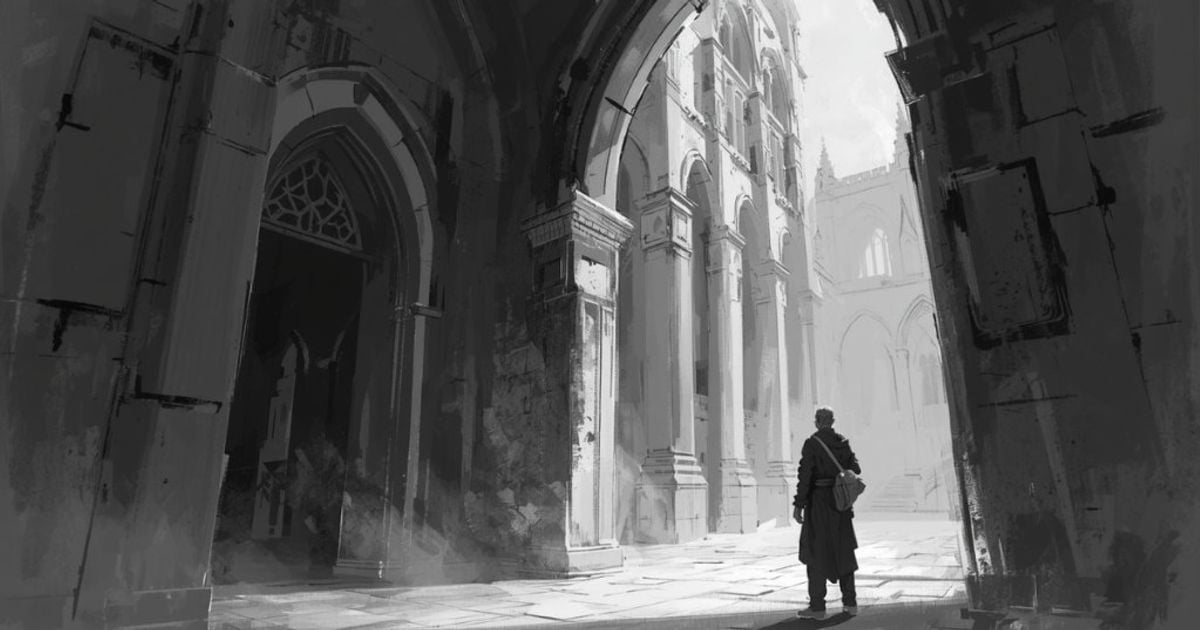
The station is lively with straw hats and bright dresses. Sue sees it is Remembrance Day and says he came on purpose. He did. She wants lodgings first. His soul is full of the anniversary. They go down Chief Street with the baby in his arms, Sue leading their girl, Time walking silently beside. At the barrier by the circular theatre he hugs the youngest while blood-red robes alight under a livid sky. Time whispers that it seems like the Judgement Day. Jude explains a Latin inscription to the crowd. Jack Stagg names him: Tutor of St. Slums, married now, more mouths to fill. Sue begs him not to answer. Time does not like Christminster.
Jude will not shrink. He tells the throng he tried to re-shape his course and failed, and that poverty, not will, consented to be beaten. It takes two or three generations to do what he tried in one. He is in a chaos of principles. Who knoweth what is good for man in this life? Hear, hear, says the populace. Tinker Taylor says a jobbing parson would not have discoursed such doctrine for less than a guinea. A cab-horse is kicked in the belly at the college gates. If that can be done here, Jude says, what shall we say as to how far we have got? Order, says a policeman. The procession of heads of houses passes like inaccessible planets. He stands on the straw to catch a few words of Latin and sighs that he is an outsider to the end of his days.
Sue has gone pale. She saw Richard among the people on the other side. A curious dread of conventions she does not believe in comes over her like a creeping paralysis. In Mildew Lane, a thickness of wall from a college, the first landlady looks at Sue's figure and shuts the door. The second will not let where there are children. Time asks if the great old houses are gaols. A third will take Sue and the children if Jude goes elsewhere. Sue, who has not the art of prevarication, tells the landlady they have not had the courage to repeat the ceremony. The husband comes home angry. She may stay the night. She wanders a dozen houses with the boy and fares worse alone. I ought not to be born, ought I? she hears. Jude has left an address. She will not disturb him till the next day.
Hardy wrote this scene in 1895, when rigid class barriers made social mobility nearly impossible. Today, we tell ourselves anyone can succeed through hard work, yet working-class people still face invisible barriers—from accent bias in interviews to the assumption that manual labourers aren't intellectual. The power of Jude's moment lies not in what he achieves, but in how he reframes failure. Instead of accepting society's narrative that his struggles prove his unworthiness, he speaks from his own experience with dignity. This pattern repeats everywhere: the recovering addict who sponsors others, the single mother who advocates for childcare, the laid-off worker who helps others navigate unemployment. They transform personal pain into social insight. What's revolutionary isn't that Jude succeeds—he doesn't, really—but that he refuses to let others define what his experience means. In our social media age, we're constantly performing success, hiding struggles, maintaining facades. But the people who connect most deeply are those who can say 'I tried, I failed, here's what I learned' without shame or self-pity. They model a different kind of strength. The question isn't whether you'll face rejection or failure—you will. The question is whether you'll let others write the story of what it means, or whether you'll speak your own truth with the quiet dignity of someone who has nothing left to prove.
Explore this chapter with AI to uncover deeper meaning and practical takeaways.
AI Discussion