
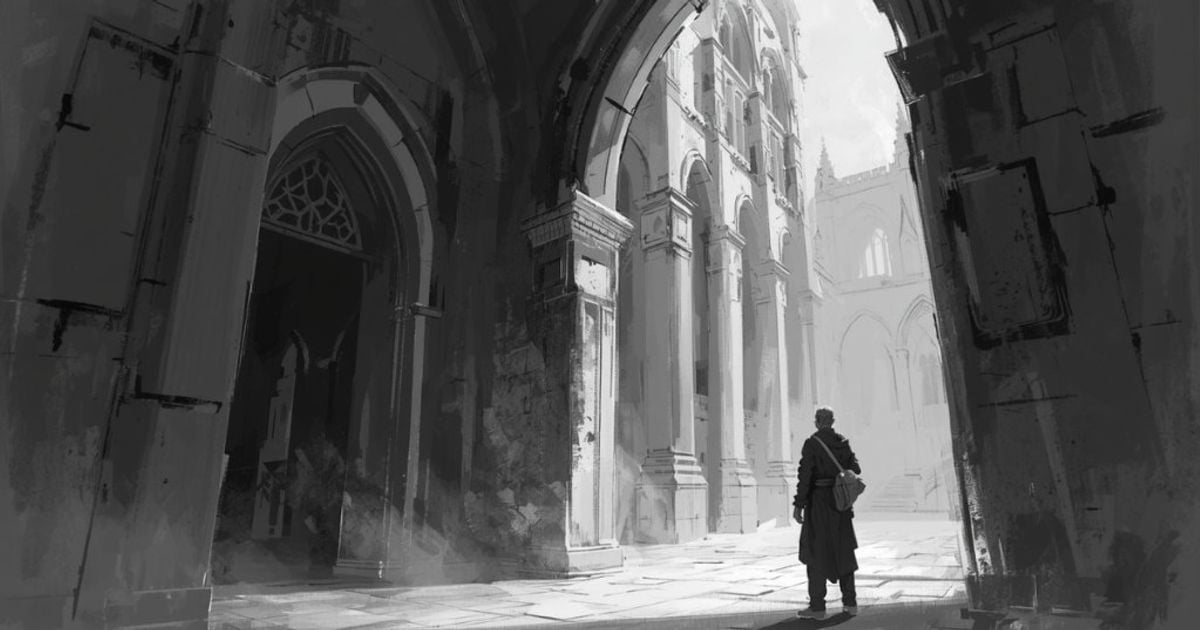
The next Sunday Jude goes to Cardinal College cathedral to watch Sue without being known. She arrives along the quadrangle; he follows her in. The choir chants the 119th Psalm: Wherewithal shall a young man cleanse his way? He takes it as set for him, then remembers it is the ordinary psalm for the twenty-fourth evening. After the service he almost follows her in his Sunday suit, then tells himself a married man must not know her. The ecclesiastical glow had felt like Cyprus as much as Galilee.
Some time before that service, Sue on a holiday walk meets an image-seller at a stile and buys a Venus and an Apollo she cannot quite afford. She wraps them in burdock leaves so the city will see only green stuff, telling herself anything is better than church fallals, and lies to Miss Fontover that they are St. Peter and St. Mary Magdalen.
That night she sets the figures between candles, reads Gibbon on Julian, then Swinburne's line about the pale Galilean. She keeps waking to the white plaster against the Calvary print. At the same small hour, a few streets away, Jude sits over Griesbach and recites Greek aloud until the book closes.
Hardy understood something profound about human psychology: we lie to ourselves more skillfully than we lie to others. Jude's 'spiritual' obsession with Sue and her disguised rebellion against Christian authority reveal a pattern that transcends Victorian England. We all create elaborate justifications when our real desires conflict with social expectations. In Hardy's time, religious conformity demanded these deceptions. Today, different pressures create similar masks. The parent who claims they're 'helping' their adult child by controlling their choices when they're really afraid of being alone. The employee who says they're staying in a dead-end job for 'stability' when they're actually terrified of failure. The person who insists they're 'too busy' for self-care when they're avoiding the hard work of change. Hardy shows us that the mask often becomes so convincing that we believe it ourselves. Sue genuinely thinks she's seeking spiritual truth while hiding pagan statues. Jude truly believes his stalking is religious devotion. The self-deception protects us from confronting uncomfortable truths about what we really want. But it also prevents us from finding healthy paths to legitimate needs. Recognition is the first step toward freedom. When we catch ourselves creating noble reasons for questionable choices, we can pause and ask the harder question: what are we really after here?
Explore this chapter with AI to uncover deeper meaning and practical takeaways.
AI Discussion