
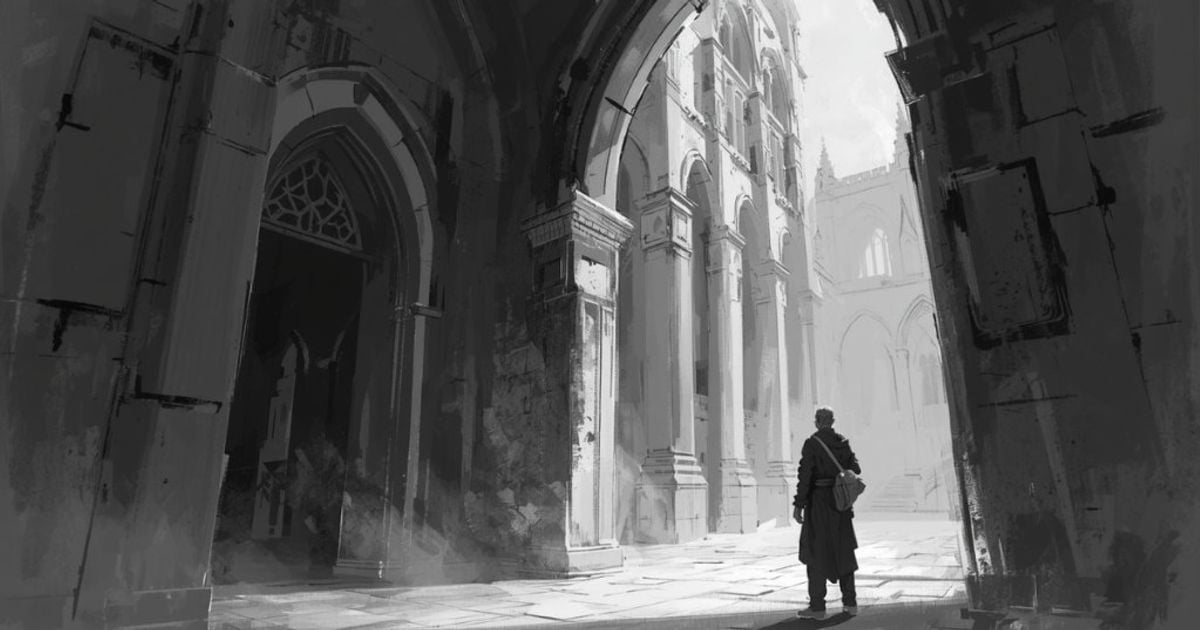
Morning work dissipates the phantoms. The colleges look pompous, like family vaults above ground. Jude reads the stones as a workman, stroking mouldings the night had made sacred, and finds the mason's yard full of new traceries waiting to patch the old walls. For a moment he feels the yard is as worthy as scholarly study. The old idea smothers the thought. He will take any job on his late employer's name, but only as a provisional thing.
He writes for Sue's photograph, kisses it, and sets it over his tea. He haunts the cloisters at odd minutes and at last sees the wall for what it is. He shares a mental life with the young men who read all day, yet they see through him as through a pane of glass: a workman in a white blouse with stone-dust in the creases. He gets the job, buys a shaded lamp for four and sixpence, hangs a curtain and a thick blind, and sits in a great-coat when he cannot afford a fire.
A letter from his aunt gives him Sue's shop. He finds her illuminating the word Alleluja on a zinc scroll and does not speak. Weeks later she pauses at his elbow while he heaves freestone outside Crozier College and looks into his face without seeing him. He lists three reasons he must think of her only as kin: he is married, they are cousins, and Fawley marriages already end in tragic sadness. The reasons stay in place. The emotion does not.
Hardy wrote Jude during England's industrial boom, when skilled craftsmen found themselves caught between old apprentice systems and new factory capitalism. Jude's situation—repairing the very institutions that exclude him—wasn't just literary metaphor but economic reality. Today's version plays out everywhere: hospital cleaners keeping facilities sterile during a pandemic while getting little recognition, restaurant prep cooks creating dishes that make celebrity chefs famous, content moderators protecting social media users from trauma while remaining nameless. The pattern Hardy identified persists because it serves power structures. Making certain work invisible allows society to underpay and undervalue it while still depending on it completely. Jude's attraction to Sue adds another layer—she represents not just romantic desire but access to a world that treats him as furniture. This dynamic appears in modern workplaces where blue-collar workers interact with white-collar professionals. The construction worker fixing the CEO's office, the janitor cleaning the lawyer's conference room, the cafeteria worker serving the doctor's lunch. Eye contact becomes political. Recognition becomes radical. Hardy understood that class isn't just about money—it's about visibility, about who gets seen as fully human. When we can name this pattern, we can choose whether to perpetuate it or disrupt it.
Explore this chapter with AI to uncover deeper meaning and practical takeaways.
AI Discussion