
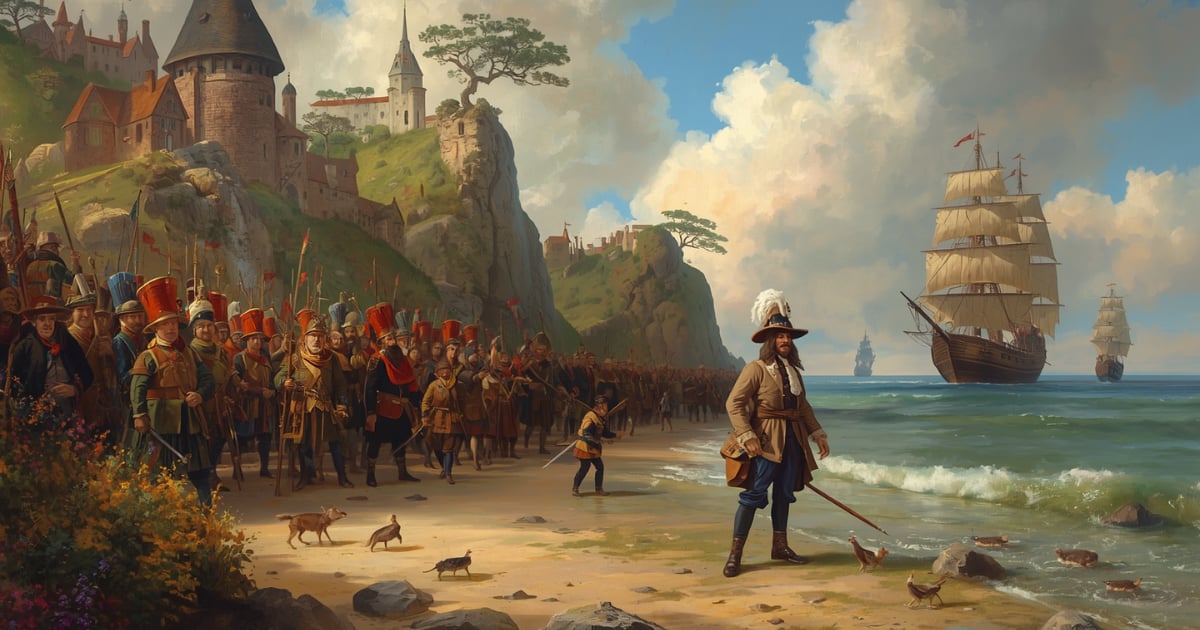
The Blefuscu fleet is anchored 800 yards away across a channel six feet deep at high water. Gulliver spies it from behind a hillock through his pocket perspective glass: 50 men of war plus transports. He orders the strongest available cables, twisted to triple thickness, and iron bars bent into hooks. Half an hour before high water he wades in wearing only his leathern jerkin. The 30,000 Blefuscudians watching from shore leap from their ships and swim to land. He fastens a hook to the prow of every vessel. Arrows pour down onto his hands and face. He pulls out his spectacles and straps them to his nose to protect his eyes, and works on. The ships will not move: all anchored. He lets go the cable, draws his knife, and cuts every anchor line receiving about 200 shots in the face and hands while he does it. Then he picks up the knotted end and walks home to Lilliput dragging 50 warships behind him. The Blefuscudians set up a scream of grief and despair. The Emperor is waiting on shore with the whole court.
While Gulliver was submerged to his neck they could not see him and assumed the fleet was approaching in a hostile manner. When the channel shallows and Gulliver emerges holding the cable, he cries out: Long live the most puissant king of Lilliput. He is made a nardac on the spot, the highest honour in the empire. The Emperor then asks Gulliver to go back for the rest of the fleet and reduce Blefuscu to a province, destroy the Big, Endian exiles, and force the entire world to break their eggs at the small end. Gulliver refuses: he will never be an instrument of bringing a free and brave people into slavery. The wisest ministers agree. The Emperor never forgives him. A conspiracy against Gulliver begins forming in the council. Three weeks later Blefuscu sends ambassadors to negotiate peace. Gulliver helps broker it. The ambassadors visit him privately and invite him to their kingdom. When Flimnap and Bolgolam learn of the meeting they inform the Emperor that Gulliver's contact with the ambassadors amounts to an act of disaffection.
This is the first time, Gulliver notes, that he began to form any clear idea of what courts and ministers actually are. He returns home at midnight to cries of Burglum at his door. The Empress's apartment is on fire: a maid of honour fell asleep while reading a romance and a candle caught. The court has ladders and buckets, but the buckets are the size of large thimbles and the fire is beyond them. Gulliver wishes he had brought his coat, which could have smothered it, but he left it behind in his hurry. He is out of options when he suddenly recalls that the evening before he had drunk deeply of glimigrim wine and had not, as he puts it, discharged himself of any part of it since. The heat of the fire cooperates. He urinates on the flames with precision and extinguishes them in three minutes. He goes home at dawn without pausing to congratulate the Emperor, aware that by the fundamental law of the realm it is a capital offence to make water within the precincts of the palace. The Emperor sends word that a pardon will be drawn up. It never arrives. Gulliver is privately told that the Empress, conceiving the greatest abhorrence of what he has done, has moved to the far side of the court and vowed revenge.
Swift understood something brutal about power structures: they don't actually want competent people who think independently. They want competent people who follow orders without question. Gulliver's military genius makes him valuable, but his moral backbone makes him unpredictable. The emperor can't control someone who might say no to the next terrible order. This dynamic plays out constantly in modern workplaces. The nurse who documents understaffing gets labeled difficult. The construction worker who reports safety violations gets fewer hours. The retail employee who won't push unnecessary warranties gets written up for attitude problems. It's not about performance, it's about control. When you're competent enough to have influence but principled enough to resist corruption, you become a threat to the entire system. The people profiting from dysfunction need everyone else to stay quiet and compliant. Your integrity exposes their corruption simply by existing. Understanding this pattern doesn't mean becoming cynical or compromising your values. It means recognising the game being played around you. When you can see that your good work is being weaponized against you, you can start building alliances with others who share your values, documenting everything, and making strategic decisions about when to fight and when to find a better battlefield.
Explore this chapter with AI to uncover deeper meaning and practical takeaways.
AI Discussion