
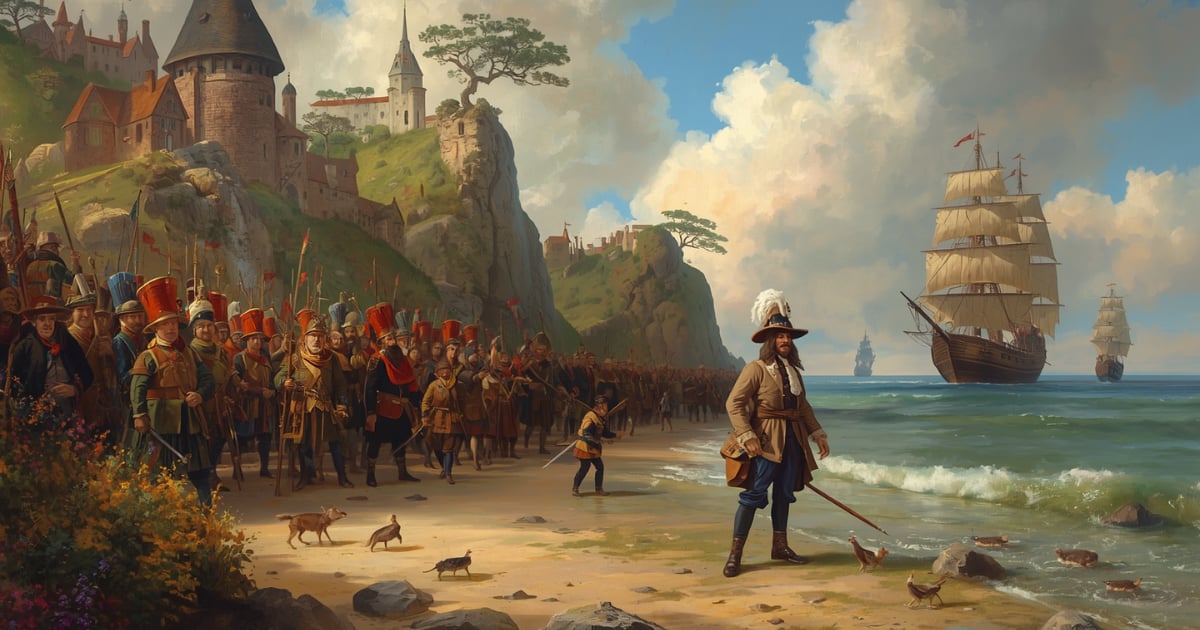
Free at last, Gulliver makes his first real request: permission to visit Mildendo, the capital. The emperor agrees, issues a public proclamation, and orders citizens to stay indoors. Gulliver enters through the western gate and moves as carefully as he can manage, he strips to his waistcoat so his coat tails do not wreck the rooftops, and walks with extreme care to avoid stepping on anyone the proclamation may have missed. Even so, the garret windows and house tops are jammed with spectators. The city is a precise square, five hundred feet to a side; the main streets are five feet wide; the side lanes are twelve to eighteen inches, too narrow for even his foot to enter. The emperor's palace poses a harder problem. The inner courts are separated by gates eighteen inches high and seven inches wide. Gulliver cannot step over the outer walls without destroying them, and the inner apartments he most wants to see are out of reach. His solution takes three days: he walks to the royal park, cuts the largest trees he can find with his knife, and builds two stools each about three feet high. Armed with the stools he returns to the palace, stands on one, lifts the other over the roof, plants it in the gap between the first and second courts, steps across, then hooks the first stool after him.
He repeats the manoeuvre into the inmost court, lies on his side, and puts his face to the middle, story windows, which have been left open for the purpose. Inside he sees the empress and the young princes in their apartments. The empress smiles graciously and offers her hand through the window for him to kiss. About a fortnight after his release, Reldresal, the principal secretary who had quietly helped Gulliver's petition for liberty, arrives at Gulliver's lodgings alone, sends his coach away, and asks Gulliver to hold him in his hand so they can talk at close range. He comes bearing two pieces of news, both bad. The first: the empire is split between two parties, the Tramecksan and the Slamecksan, identified by the height of their shoe heels. The emperor governs entirely through low heels; the high heels outnumber them at court but hold no power. The crown prince's heels appear to be at different heights from each other, giving him a slight hobble, which means neither faction is sure of him. The second problem is Blefuscu.
The war between the two empires began over egg, breaking. The present emperor's grandfather once cut his finger cracking an egg at the large end; his father immediately issued an edict requiring all subjects to break eggs at the small end. Six rebellions followed. One emperor died over it, another lost his crown. Eleven thousand people chose death rather than comply. The controversy has been fuelled by Blefuscu for thirty, six moons, and the war has cost Lilliput forty capital ships and thirty thousand sailors and soldiers. Blefuscu is now equipping a fleet to invade. Reldresal asks for Gulliver's help. Gulliver tells him to convey his respects to the emperor: he will not take sides in domestic factions, being a foreigner, but he is willing to risk his life to defend the emperor's person and state against any invader.
Swift wrote Gulliver's Travels during a time when England was torn apart by religious wars and political factions, much like today's culture wars that dominate our attention while wages stagnate and healthcare bankrupts families. The Lilliputians' egg, cracking war wasn't really about eggs, it was about power, control, and keeping people focused on anything except the real problems. This pattern repeats everywhere in modern life. At work, employees argue over dress codes while management cuts benefits. In families, relatives stop speaking over political candidates while medical bills pile up. Online, we wage wars over pronouns while corporations extract wealth from our communities. The most effective way to control people isn't through force, it's by giving them enemies to fight who aren't actually their enemies. Notice how the most passionate arguments often involve the least consequential issues. Meanwhile, the truly powerful operate in the background, making decisions that actually affect our lives while we're distracted by manufactured outrage. The question isn't whether these small conflicts matter to the people involved, they clearly do. The question is whether engaging in them helps or hurts our ability to address the real challenges we face. When we can step back and see the pattern, we become much harder to manipulate and much more effective at creating actual change.
Explore this chapter with AI to uncover deeper meaning and practical takeaways.
AI Discussion