
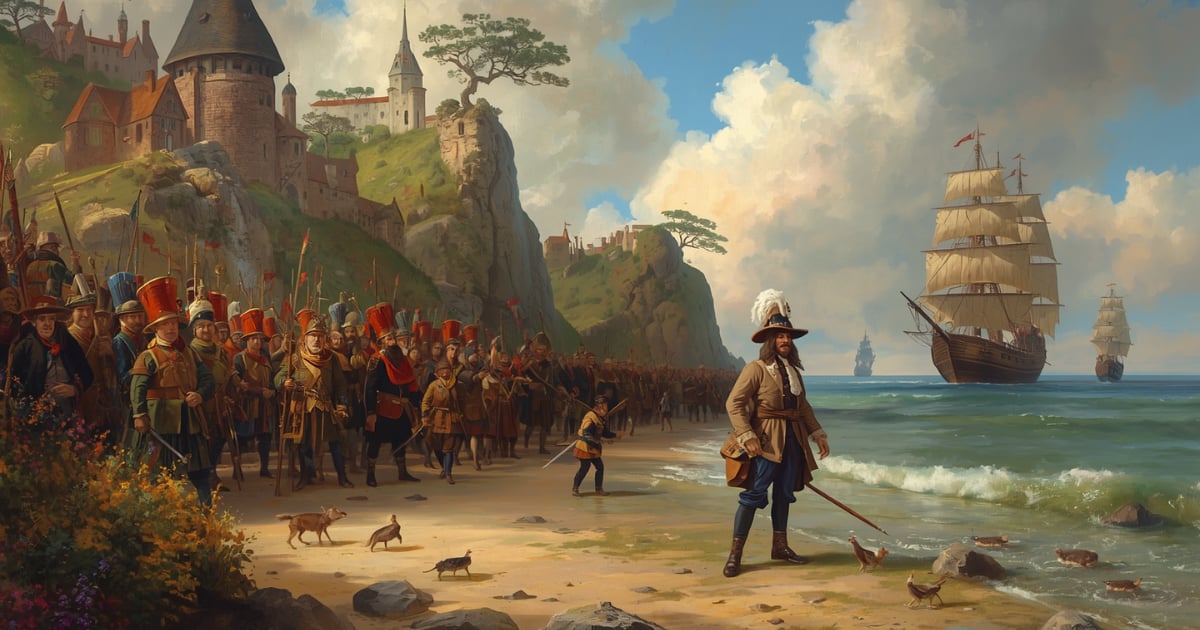
Gulliver turns observer. With the military crisis behind him and his standing still relatively intact, he surveys Lilliputian society from the inside. The physical world is in exact proportion: horses four to five inches, sheep an inch and a half, geese the size of a sparrow. A cook plucking a lark the size of a fly, a girl threading a needle with invisible silk. Writing runs diagonally across the page, like ladies writing in England. The dead are buried head-down because the Lilliputians believe the earth will flip at the resurrection, which would put them neatly on their feet again. Their learned men privately find this absurd but the practice continues by popular tradition. Their laws invert several European norms in ways Gulliver finds harder to dismiss. A person falsely accused and cleared receives quadruple compensation from their accuser, who is then put to an ignominious death. Fraud is punished more harshly than theft, on the reasoning that honesty has no defence against superior cunning, while vigilance can guard against a thief. Citizens who can prove 73 moons of law, abiding earn the title of snilpall and a cash payment from a public fund. Their image of Justice carries a bag of gold in the right hand and a sheathed sword in the left: more disposed to reward than to punish.
For public office, they choose moral character over intelligence, a corrupt person of great ability, they argue, is more dangerous than an ignorant person of good will. Ingratitude is a capital crime. Children of all but the lowest class are taken at 20 moons to state nurseries, sorted by sex and rank. Boys of noble birth receive plain food and simple clothing, are trained in honour and courage, dress themselves from age four, and may receive their parents for one hour twice a year, no whispering, no gifts. Nurses who tell frightening stories to girls are publicly whipped, imprisoned, and banished. Trade apprentices leave at eleven. The whole system is premised on parents being too emotionally invested to educate their own children well. Gulliver's domestic arrangements required considerable ingenuity on both sides. Two hundred seamstresses made his shirts by the mathematical rule: twice round the thumb equals once round the wrist equals once round the neck. Three hundred tailors took his coat measurement by raising a ladder to his shoulder and dropping a plumb, line to the floor. Three hundred cooks worked in huts around his house; twenty waiters stood on his table, a hundred below. He ate geese and turkeys whole and had a sirloin in three bites.
The Emperor once dined at his table with the Empress and royal family. Flimnap the treasurer attended with his white staff, watching Gulliver throughout with a sour countenance. The dining visit gave Flimnap an opening. He reported to the Emperor that the treasury was strained, exchequer bills were circulating at nine percent below par, and Gulliver had already cost 1.5 million sprugs. He recommended dismissal. Then came a rumour, planted by informers Clustril and Drunlo, that Flimnap's wife had visited Gulliver privately. Gulliver's refutation is careful and specific: she came always publicly, always in a coach with at least three companions, which he would lift carefully with both hands and set on a table fitted with a five, inch rim to prevent accidents. He often had four such coaches on his table at once, the coachmen driving gently around while he talked with one set of visitors. He defies Clustril and Drunlo to prove otherwise. The only person who ever came incognito was Reldresal, and that was by express imperial command. He notes, in passing, that he holds the title of nardac while Flimnap holds only the rank of glumglum, one degree lower. Though eventually cleared, Gulliver loses all credit with Flimnap and his interest with the Emperor begins to decline.
Swift shows us Lilliputians who reward good behaviour instead of just punishing bad, who choose leaders based on character rather than credentials, and who remove parental bias from education. These ideas sound radical, but they address real problems in our systems. Today, we see similar resistance to proven improvements. Countries with universal healthcare have better outcomes and lower costs, but we resist because it's 'not how we do things.' Schools that reduce testing and increase play produce better learners, but we cling to metrics that don't measure what matters. Companies that prioritize employee wellbeing often outperform those focused solely on profits, yet we call them 'soft.' The pattern is always the same: we mistake familiarity for correctness and change for danger. Swift understood that sometimes you need an outsider's perspective to see your own society clearly. Gulliver's giant size forces him to observe Lilliputian customs without the blindness of belonging. When we're inside our own systems, we can't see their flaws, they feel natural, inevitable, right. But step outside, and suddenly you realise that many of our 'obvious' approaches create the very problems they claim to solve. The real question isn't whether different systems work, it's why we're so threatened by the possibility that they might work better.
Explore this chapter with AI to uncover deeper meaning and practical takeaways.
AI Discussion