
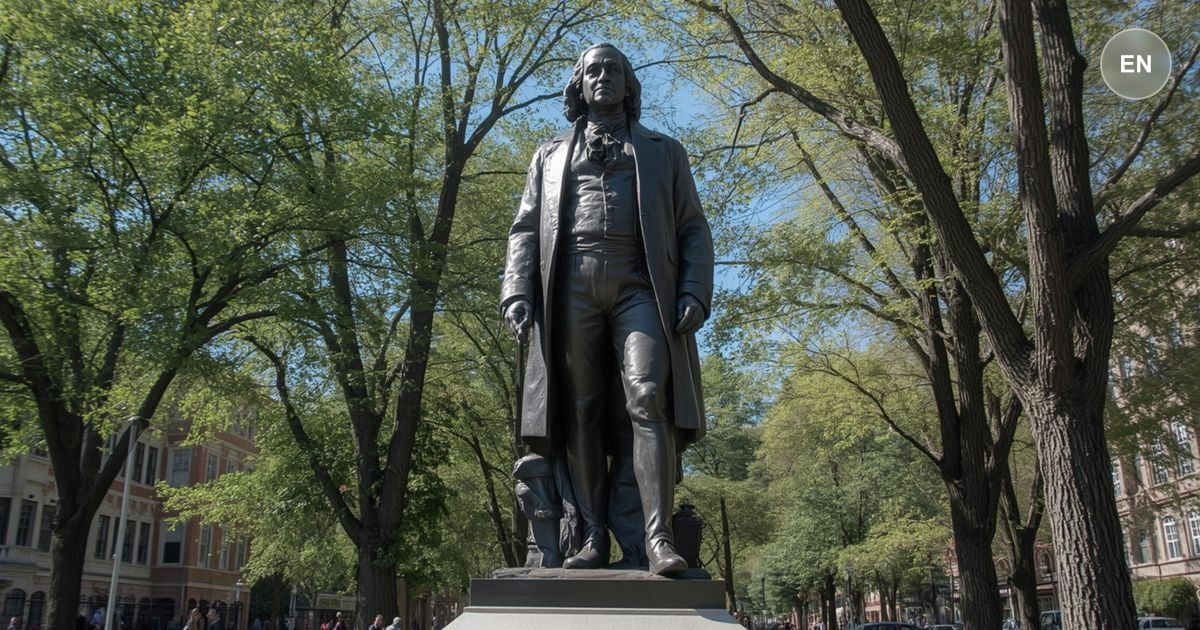
Philadelphia's streets are muddy and dusty, and Franklin cannot ignore the mess near the Jersey Market. He hires a poor woman to sweep the pavement twice a week for sixpence a month from each house, writes a short paper on why the small fee helps everyone, and gets the neighbours to sign on quickly. That success helps push the city toward broader paving and better lamps. He draws a paving bill for the Assembly, improves the lamp design so smoke can escape, credits John Clifton for starting the idea, and argues that human happiness comes from small daily comforts, like learning to shave yourself, more than from rare lucky breaks.
While in London he proposes a better way to sweep dusty streets before shops open, after watching a sick woman clean his whole block in three hours for a shilling. He becomes postmaster-general with William Hunter, invests in improvements, and later triples the crown's revenue from the office before ministers later displace him. At Albany in 1754 he draws a plan to unite the colonies for defence with a president-general and elected council, and both colonial assemblies and the British government reject it as too royal or too democratic. He trades sharp messages with Governor Morris while still dining with him over wine, joking that the Assembly keeps wiping off the governor's insults and smearing them back on his face. He says the best public measures are often forced by crisis, not planned in advance.
When Massachusetts needs aid against the French, Franklin helps Mr. Quincy win Assembly support and finds a way to fund provisions through interest-bearing loan-office orders when the governor blocks the tax bill. War with France brings General Braddock, who lands with almost no wagons for his march and declares the expedition impossible. Franklin removes the general's prejudice against Pennsylvania, then takes on the job of hiring one hundred fifty wagons and fifteen hundred horses when Braddock asks him directly after hearing that Pennsylvania farmers own wagons.
Franklin writes a clear Lancaster advertisement listing pay, horses, and wagons wanted, advances his own money, and gives his personal bond when farmers distrust army promises. In two weeks he delivers more than one hundred fifty wagons and many horses, losing only a few to desertion, and Braddock's officers are astonished at the speed. He says he has no personal profit in the job, only the work and the hope of preventing soldiers from seizing wagons by force. He then begins assembling supply parcels for officers, packing food, drink, and small comforts so the march can continue without the army breaking down local farms.
Franklin does something in this chapter that most people talk about but almost nobody actually does. He puts his own money on the line to guarantee General Braddock's wagons. Not his reputation in some abstract sense. His actual credit. If the farmers did not get paid, Franklin would owe them personally. That is a different kind of commitment than writing a strongly worded letter or attending a meeting.
We talk a lot about accountability in modern life, at work, in families, in communities. But most of what gets called accountability is really just visibility. Someone is watching whether you show up. That is not the same thing as carrying personal risk. Franklin understood the difference. The reason farmers trusted his advertisement when they did not trust the British army's promises was simple: Franklin had something to lose. The army could march away. Franklin lived there.
This raises a question worth sitting with. In your own life, how often do you take on real personal risk for a problem that matters to you, versus how often do you signal concern without absorbing any of the cost of failure? There is no shame in the honest answer. Most institutions are specifically designed to diffuse responsibility so that no single person feels the full weight of inaction. That is actually how bureaucracies protect themselves. But it also means that the person willing to break that pattern, to say 'if this does not work, I am the one who answers for it,' becomes extraordinarily rare and extraordinarily trusted.
Franklin also does something subtle that is easy to miss. He gives credit to his neighbour Clifton for the original lamp idea before explaining how he improved the design. He is not performing humility. He is building a reputation for precision. People who know he will tell the truth about what he did not do are more likely to believe him about what he did.
The question underneath all of this is not really about productivity or civic duty. It is about what kind of person you want to be known as, and whether the way you act in small situations is actually building toward that.
Explore this chapter with AI to uncover deeper meaning and practical takeaways.
AI Discussion