
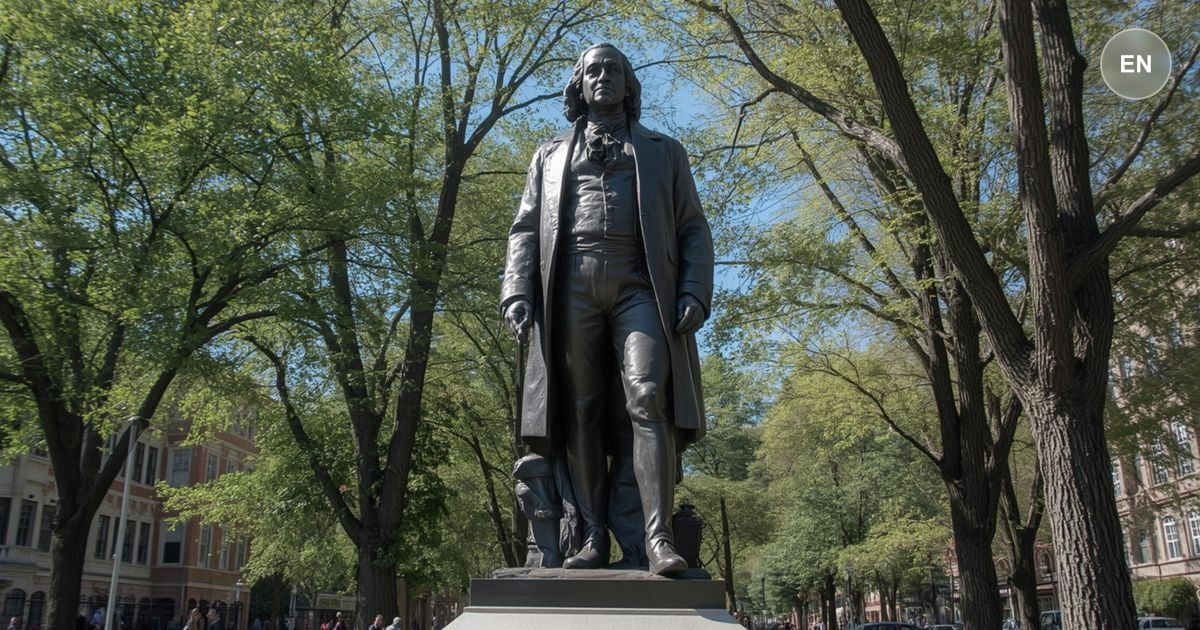
Franklin opens by saying his colonial printing partnerships ended peacefully because he and his partners wrote down every duty up front. That habit of settling details early runs through the whole chapter. He regrets that Pennsylvania still has no militia and no college, so he does not wait for permission. He publishes Plain Truth, gathers more than ten thousand volunteers, and even borrows eighteen cannons from a New York governor after a dinner with a lot of Madeira wine softens the man's refusal. He declines the colonel's rank but helps organise drills, colours, and a battery below the town. He even drafts a public fast day proclamation to rally churches behind the volunteer defence effort.
He also watches how Quakers fund defence without saying they are funding defence. They vote money for bread and grain, knowing the governor will buy gunpowder instead, calling other grain gunpowder in plain sight. At a fire-company meeting, most Quakers stay away so a lottery for cannons can pass without open rebellion, while a few secretly offer to vote if needed. Franklin contrasts that trick with the Dunkers, who refuse to print a creed because they want room to keep learning. He gives away his improved fireplace design rather than take a patent, writing a pamphlet to spread the idea, and an ironmonger in London later profits from copying it.
When peace returns, he launches an academy that grows into the University of Pennsylvania. He publishes proposals, raises subscriptions, and negotiates to place the school in Whitefield's old preaching hall. and partners with David Hall so printing no longer eats his time. Public jobs pile on anyway: justice of the peace, city council, and Assembly member, though he hoped to study science in peace. He goes to Carlisle to treat with Indians, forbids rum during talks, then watches them turn the promised celebration into a drunken riot that looks like hell by firelight.
The hospital story shows his sharpest civic move. Dr. Thomas Bond's idea needs Franklin's name to raise trust, so Franklin writes in the newspapers and helps solicit donors. He writes a bill that gives public money only after private donors raise a matching sum, so opponents vote yes and donors give more because each gift doubles. He admits he felt proud of that maneuver. Reverend Tennent later asks his advice on fundraising and learns to ask everyone, even those unlikely to give. By the end Franklin is helping pave muddy Philadelphia streets, complaining that heavy carts turn them into quagmires in rain and dust bowls in dry weather, still fixing city problems one practical step at a time.
Franklin was not a governor, a general, or an aristocrat. He was a printer who had made some money and paid close attention to how things actually worked. In this chapter he organises a militia, founds a philosophical society, invents a stove, launches an academy, and helps build a hospital, none of it through official authority. He simply kept asking what it would take to fix something right now, with what was available, and who else might help if asked directly. That question sounds small. It is not. Most people, when they see a gap, look around for whoever is supposed to fill it. They report the problem upward, wait for a meeting, wait for a budget cycle, wait for someone with the right title to notice. Franklin's move was to treat the absence of authority as irrelevant. The gap existed. He could see it. That was enough to start. The Dunker story sitting inside this chapter is easy to overlook, but it might be the most important part. This small religious group refused to publish a formal creed because they did not want to freeze their thinking. They believed they were still learning, and a written doctrine would make it harder to change their minds when new evidence arrived. Franklin admired that. He was watching most institutions do the opposite: declare their principles fixed, then spend enormous energy defending those principles even when reality kept suggesting they were wrong. There is a version of this in every workplace and every community. The policy that made sense in 2009 is still the policy in 2025 because nobody wants to be the one who says it stopped working. The person who tries something new without asking permission first gets called reckless. The person who waits for permission watches the problem persist. Franklin's life in this chapter is an argument that initiative, structured carefully and aimed at genuine gaps, is not recklessness. It is the thing that actually builds cities. The question worth sitting with is this: what gap are you watching right now, waiting for someone else to fill?
Explore this chapter with AI to uncover deeper meaning and practical takeaways.
AI Discussion