
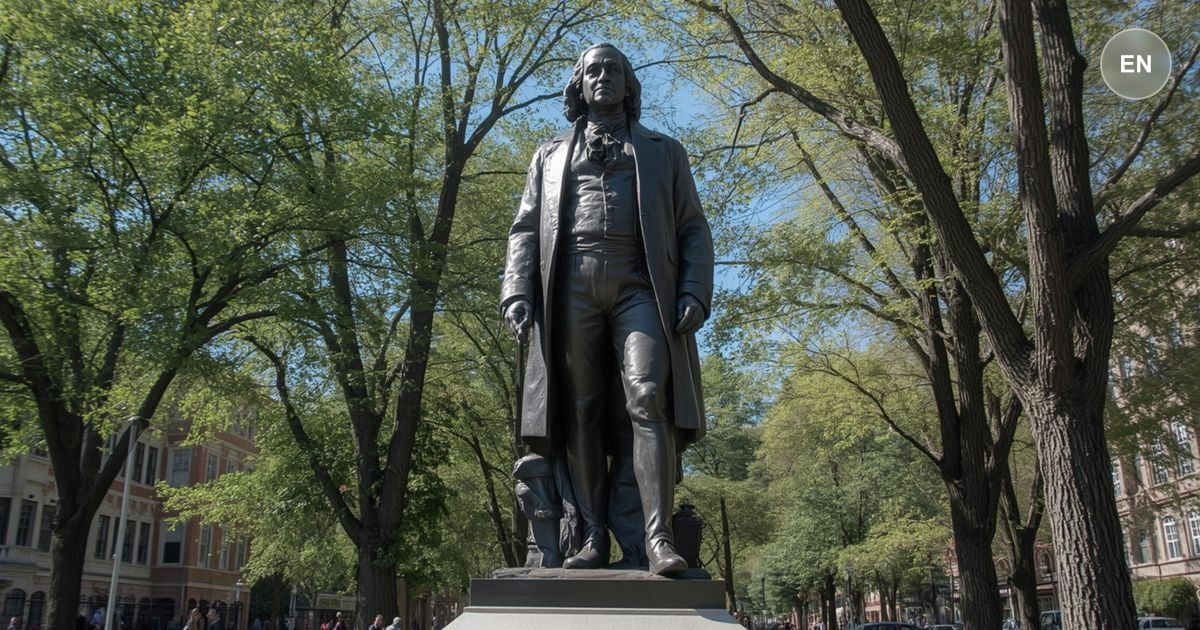
Franklin packs twenty parcels for Braddock's officers and advances more than a thousand pounds of his own money to keep the army fed. The general pays him one thousand pounds a few days before the battle and leaves the rest for a later account Franklin never collects. Franklin warns that a long column winding through woods can be cut to pieces if the enemy strikes before the parts can support each other. Braddock smiles at a civilian's ignorance and says such fighters may frighten raw American militia, but they cannot mark the king's regulars. The enemy lets the army advance to within nine miles of Fort Duquesne, then fires from behind trees. Officers fall fast. Panic spreads. Most of the picked troops are killed or fleeing. Braddock is wounded. Dunbar, who takes command, destroys stores so he can flee faster, and later breaks a promise to return enlisted servants to three Lancaster farmers at Trenton.
Wagon owners come for the bonds Franklin signed. Some sue him. General Shirley at last appoints commissioners and orders payment of claims near twenty thousand pounds, a sum that would have ruined him. Before news of the defeat arrived, the two Doctors Bond had asked him to subscribe for victory fireworks when Fort Duquesne fell. He refused, saying it would be time enough to rejoice when they knew they had occasion. Governor Morris then redoubles his push for tax bills that would spare the proprietary estates. The Assembly holds firm. Franklin helps pass defence money and writes a dialogue answering objections to a militia so that Quakers need not bear arms. The governor then asks him to take charge of the north-western frontier. He raises five hundred and sixty men, takes his son as aide, and marches in winter rain toward Gnadenhut, where Indians had burned a Moravian village.
At Bethlehem he finds the Moravians already stockaded, with purchased arms and a watch. At Gnadenhut his men bury the half-buried dead, time two axemen felling a fourteen-inch pine in six minutes, and raise palisades in a week despite rain every other day. Working days keep the men cheerful. Idle days make them quarrelsome. He tells the chaplain Beatty to serve the daily rum ration just after prayers, and attendance becomes punctual. Officers later choose him colonel of a Philadelphia regiment of about twelve hundred men. Their salute outside his door shakes down glasses from his electrical apparatus. The honour proves as brittle: England repeals the militia law and voids the commissions. Worse, thirty or forty officers in uniform escort him to the Lower Ferry with drawn swords, a piece of state that offends the proprietor, who had never been paid such honour himself. Franklin is chagrined. He had not asked for the parade.
In 1746, at Boston, Dr Spence shows him imperfect electrical experiments. Back in Philadelphia the library company receives a glass tube from Peter Collinson of the Royal Society, and Franklin's house fills with visitors who want to see the shows. He encourages his neighbour Kinnersley, then out of work, to lecture for money and writes him two lectures. Papers on lightning go to London, where some first laugh and later print them in a pamphlet that sells. Count de Buffon has M. Dalibard translate them in Paris. Abbé Nollet, preceptor to the French royal family, will not at first believe an American wrote them, then attacks the experiments in print. Franklin decides not to answer. Anyone can repeat the tests. A dispute across languages will waste the hours he would rather spend on new discoveries. He therefore never answered.
Franklin is one of the most respected men in colonial Pennsylvania. He has already organised a postal system, founded a library, and helped raise a militia. And when he sits across from General Braddock and explains, carefully and with evidence, that marching a long column through dense forest invites ambush, Braddock listens politely and ignores him completely. Franklin has no military rank. That is the only thing that matters to Braddock.
This is not a story from a distant century. It plays out in staff kitchens, team meetings, and family kitchens every single day. A home health aide notices a patient is losing weight and mentions it to the family. The family says the doctor would have caught it. A line cook points out that a prep schedule is going to leave the kitchen short on a Saturday rush. The head chef says he has been doing this for fifteen years. A junior accountant flags a number that does not add up. The senior partner says to trust the process.
What makes the Expertise Dismissal Loop so damaging is not just that the warning gets ignored. It is that the wrong person absorbs the consequences. Braddock dies in the ambush, yes. But so do hundreds of soldiers who had no vote in the decision. Franklin nearly loses his personal finances because he guaranteed those wagons. The people closest to the ground, the ones with the most accurate information and the least power, tend to pay the highest price when the people at the top refuse to hear them.
Franklin's response is the part worth sitting with. He does not keep arguing. He does not perform his frustration. He says what he can say, recognises the limit of his standing, and then turns his energy toward what he can actually build. Forts. Systems. New experiments. He does not let Braddock's stubbornness become his own paralysis.
The question worth bringing to any group is this: think of a time you saw something coming and said so, and were not heard. What did you do with that energy afterward, and what do you wish you had done instead?
Explore this chapter with AI to uncover deeper meaning and practical takeaways.
AI Discussion