
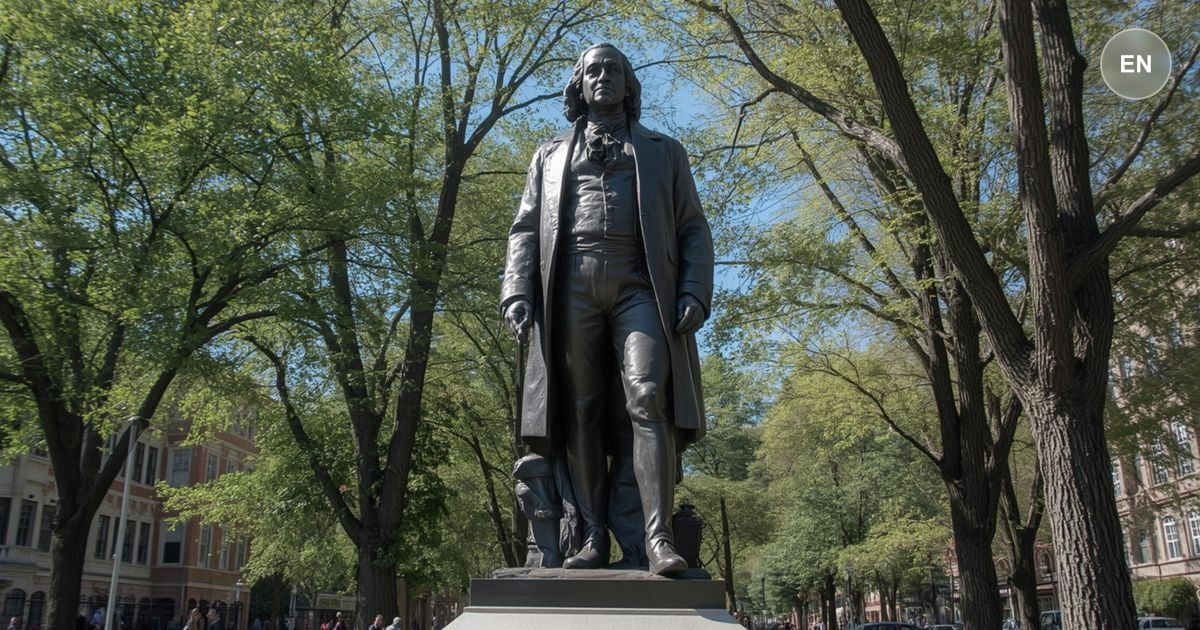
Franklin sketches a dream he calls a United Party for Virtue, a secret league of good people who would help one another and serve the public. He writes a short creed that every religion could accept and imagines members trained in his thirteen-week virtue plan before they join. He never has time to launch it fully, but the idea stays with him as he takes on more civic work. In 1732 he publishes Poor Richard's Almanac under the pen name Richard Saunders and fills the calendar with short proverbs about work and thrift. He also uses his newspaper to spread useful essays and refuses to print personal attacks that would poison public debate. Because almost every household buys an almanac, he uses it to teach plain lessons to ordinary readers who buy few other books. Those sayings later become the famous speech of Father Abraham at an auction.
His business grows through partnerships across the colonies. A Charleston printing deal stays confusing until the partner dies and his widow, trained in Dutch bookkeeping, sends clear accounts and eventually buys the shop. Franklin argues girls should learn accounting, not just music or dancing, because numbers can save a business. He studies languages, revisits Boston, and mourns the death of a young son. He also gets drawn into a church fight over a preacher named Hemphill, defending free inquiry even when it angers powerful men in the congregation.
Back in Philadelphia he expands the Junto into smaller daughter clubs so more tradesmen can share ideas without crowding one room. He wins election as clerk of the General Assembly, a post that pays little but gives him a voice in public business. When a wealthy assemblyman speaks against him, Franklin does not flatter or fight back. He asks to borrow a rare book, returns it with thanks, and turns an enemy into a steady friend by an old rule: people like those they have helped. He also becomes deputy postmaster, which helps his newspaper travel faster and bring in more subscribers.
Franklin helps reform the city night watch and starts the Union Fire Company so neighbours protect one another's homes. He hears the famous preacher George Whitefield, plans to give nothing at the collection, and ends up emptying his pockets, gold and all. He even uses geometry to estimate how far Whitefield's voice carries across the open fields outside Philadelphia, and he defends the preacher's honesty even when they disagree on religion. By the end, his newspaper, post office work, and colonial partnerships are making his business steadily stronger, and he notes that the first hundred pounds is hardest to earn while the second comes more easily once money starts to breed opportunity.
Franklin's story about the hostile assemblyman sounds almost too clean. A man speaks against you publicly, you borrow a book, and suddenly you are friends for life. It seems too simple, maybe even a little manipulative. But Franklin is pointing at something real about how human bonds form, and it is worth sitting with the discomfort it raises.
Most of us were raised to believe that asking for help puts you in a weaker position. You owe the person something. They have leverage. Especially in working environments where hierarchy is visible and resources are tight, asking for help can feel like admitting you cannot handle your own load. So we avoid it. We figure things out alone, or we stay stuck, or we let a strained relationship calcify rather than risk the vulnerability of an ask.
But Franklin noticed something that runs against that instinct. When you ask someone for help, you are not handing them power. You are handing them an invitation to feel capable and generous. And people are deeply attached to that feeling. We remember the moments when we were useful to someone. We remember being the person who had the answer, who had the rare book, who knew how to fix the thing. That memory connects us to whoever gave us the chance to experience it.
This has a darker edge worth naming. The ask has to be genuine. If you are performing vulnerability to manipulate someone, most people will feel it eventually, and the damage is worse than whatever distance existed before. Franklin was not running a technique. He actually wanted the book. The respect embedded in the request was real.
So the question worth sitting with is this: think of someone in your life who is difficult, cold, or has wronged you in some way. Is there something real you could ask them for, something that would let them show up as capable and generous? And if you asked, what would it cost you to receive it graciously?
Explore this chapter with AI to uncover deeper meaning and practical takeaways.
AI Discussion