
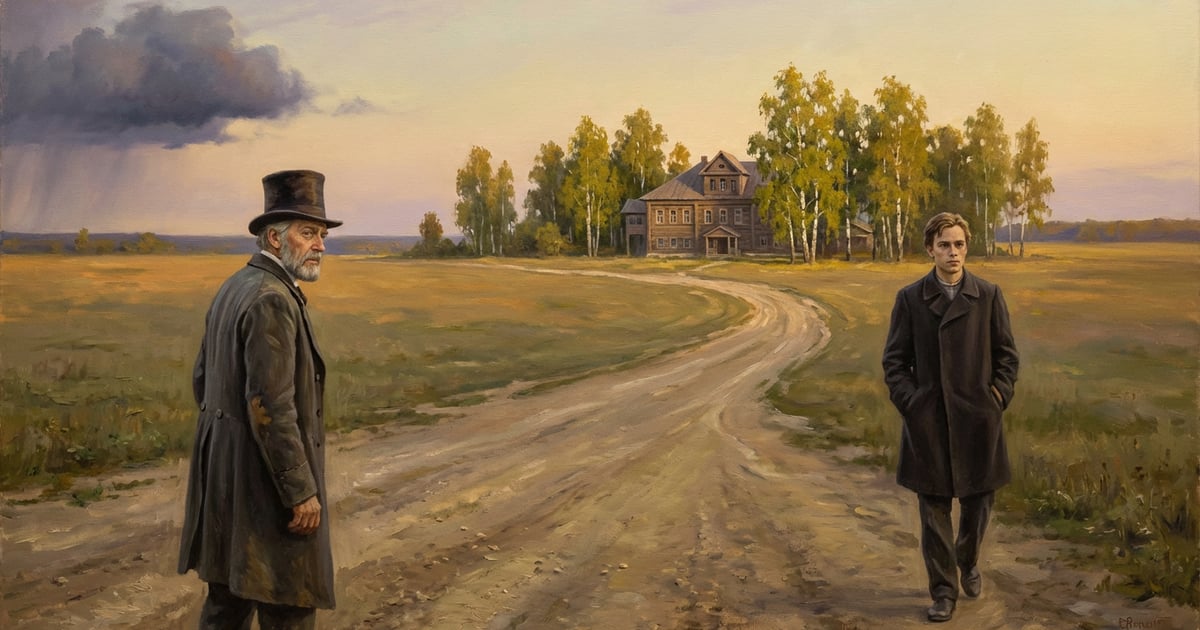
Bazarov is out of doors before anyone else, and his first thought is that this is not much of a place to look at. When Nikolai apportioned land to the peasants he kept four naked desiatins for the house, the servants' quarters, and a homestead. The young trees have failed, the pond holds little water, and the wells taste brackish. Lilacs and acacias are what grew. Bazarov walks the paths, the stables, and the sheds, then takes two household boys to a marsh to catch frogs. One asks what he wants them for. To make them useful, he says. He likes to open them and see what the insides are doing. You and I are frogs too, except that we walk on our hind legs. If the boy falls ill and Bazarov has to treat him, he might avoid some mistakes. Vasika, seven and barefoot, does not like frogs. Bazarov sends his young philosophers into the water.
On the terrace a tea-urn simmers under the awning. A maid announces that Theodosia Nikolaevna is not well enough for breakfast. Nikolai says he will pour the tea himself. Arkady lowers his eyes and asks whether Thenichka is staying away because he is here. The question begins like a lecture he is nervous to give. By the end his own voice has steadied him. He will not summon his father to judgment. If she was asked to live here, she has deserved it. Nikolai thanks him faintly, fingers on his forehead, and admits she might feel embarrassed on the day after the arrival. Arkady springs up to go and tell her she need not shun him. He does not wait for the warning. He comes back kind, triumphant. He has made her acquaintance. She will appear later. And why was he not told he had a little brother? He has already kissed the child. He falls on his father's neck. Paul steps out behind them, elegant even in a morning suit and a small fez, and neither father nor son is sorry to be interrupted.
Paul butters a piece of bread and asks what Bazarov is. A Nihilist, Arkady says, smiling. Nikolai repeats the word. Paul stops the knife, a morsel of butter still on the blade. A man who accepts nothing, the father guesses, from the Latin for nothing. A man who respects nothing, the uncle hazards. Arkady corrects them. A Nihilist will not bow to authority or take a principle on trust, however sanctified it may be. Paul says their generation cannot take a step or draw a breath without principles, wishes these messieurs a general's rank, and asks how they mean to exist in an airless void. He wants his cocoa. Thenichka brings it herself: twenty-three, pale, dark eyes, a clean cotton gown and a new blue kerchief. She sets the cup down shyly, sorry she came, and also sure she has a right to stand at that table. Paul frowns. Nikolai is confused. She goes out with her slightly careless step. Across the flowerbeds comes Bazarov, mud on his linen, a scrap of marshweed on his old round hat, a small bag stirring in his hand. Not leeches. Frogs, for experiment. Paul says, so, he vivisects them. So, he believes in frogs more than in principles. Arkady gives him a reproachful look. Nikolai shrugs. Paul feels the remark was out of place and turns the talk towards the estate and the new steward. The bag is already inside the house.
Turgenev captures something universal about human nature: we don't just hold beliefs, we become them. Pavel's aristocratic values aren't just opinions, they're his entire sense of self-worth. Bazarov's nihilism isn't just philosophy, it's his rebellion against a world that never accepted him. When our identity gets wrapped around our ideas, any challenge feels like a personal attack. This pattern dominates modern workplaces and families. Watch a manager whose entire leadership style is built on being the 'tough boss', they can't admit when kindness might work better without feeling like they're losing themselves. Notice parents who've built their identity around being 'strict' or 'permissive', they can't adjust their approach even when it's clearly not working for their specific child. Social media amplifies this by rewarding people for having the 'right' opinions rather than thoughtful ones. The cost is enormous: relationships break down, learning stops, and problems go unsolved because everyone's too busy defending their ego to find solutions. The antidote isn't having no beliefs, it's holding them lightly enough that you can examine them without feeling threatened. When you can separate your worth as a person from being right about everything, you become someone others can actually talk to instead of just argue with.
Explore this chapter with AI to uncover deeper meaning and practical takeaways.
AI Discussion