
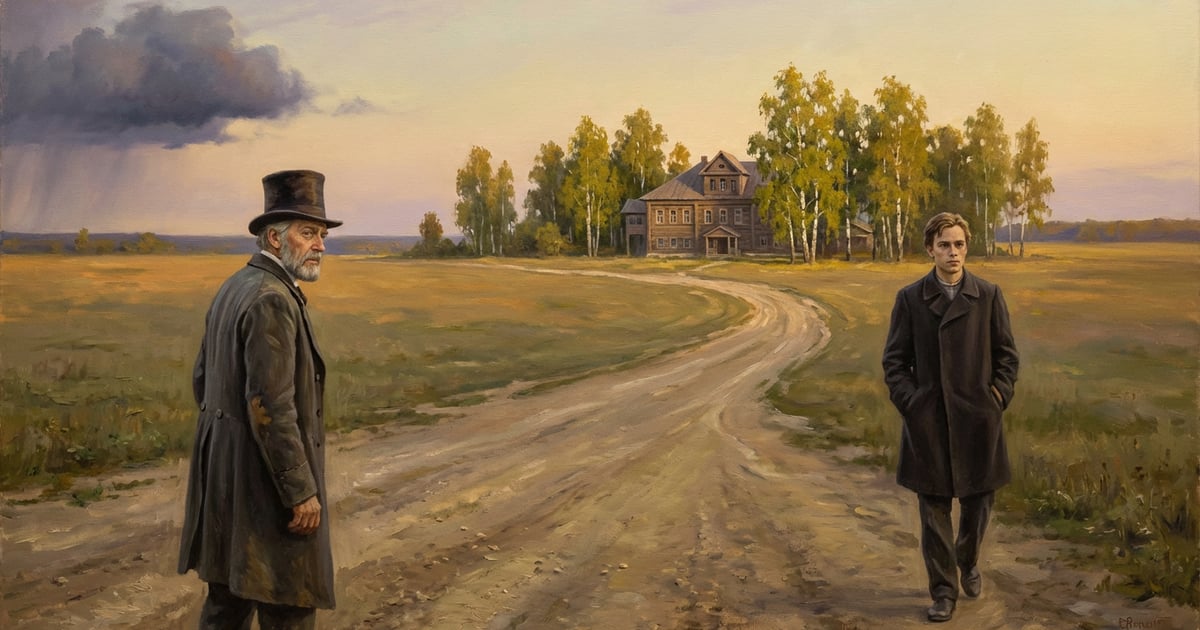
No crowd of servants comes out to meet them. A girl of twelve stands on the verandah, and then Paul Kirsanov's valet, in a grey livery coat with silver-gilt buttons, opens the carriage doors. The three men pass through a dark bare hall. A young woman's face looks out from behind a door and is gone. The drawing-room is upholstered in the latest fashion. Nikolai takes off his cap and calls for supper, then bed. Bazarov yawns, sits on a sofa, and says food would be welcome. Nikolai trips over his own feet for no reason he could name.
Prokofitch, white-haired and sixty, in a cinnamon tail-coat, shakes Arkady's hand with delight, bows to the guest, and asks whether he should lay the table. He carries Bazarov's cloak away on tiptoe, held off from his body with both hands. Paul Petrovitch comes in wearing a dark English suit and patent leather boots. He is forty-five, the cropped grey hair bright as new silver, the pink nails long against a snowy cuff. He gives Arkady a European handshake, then three Russian kisses, a perfumed moustache on the cheek, and 'I congratulate you.' When Nikolai presents Bazarov, Paul inclines his supple figure, smiles faintly, and puts the hand back in his pocket. Once the young men have gone to wash, he asks whether the long-haired fellow is staying, and says in French that Arkady has acquired some polish.
At supper Bazarov eats heartily and barely speaks. Nikolai talks of agricultural life, committees, and machinery. Paul takes no supper. He paces, sips red wine, and lets fall 'Ah,' 'Oh, ho,' and 'H'm.' Arkady drawls a little news from St Petersburg, avoids the word Papasha, and once pushes out Otety with difficulty. He tastes more wine than is good for him. Prokofitch chews his lips and does not take his eyes off the young master. Afterwards Bazarov sits by Arkady's bed in a dressing-gown and says the uncle's finger-nails would take a prize. Such elegance in the country has nothing left to live on but memories, and there is no one here to enslave. The father is excellent too, heart in the right place, though he reads foolish poetry and was nervous tonight. Elderly Romanticists, Bazarov says, over-develop the nerves until the balance goes. His own room has an English washstand, which is progress, and a door that will not shut. Arkady settles under a coverlet worked by loving hands, perhaps his nurse Egorovna's, commends her soul to Heaven, and does not pray for himself.
The two young men sleep. Nikolai leaves a candle burning and lies with his head on his hands. Paul sits until nearly midnight in red felt slippers, holding the latest Galignani and not reading it, his eyes on a blue flame that keeps dying and returning in the stove. The gloom on his face is not the look of a man busy only with the past. In a small back room Thenichka, in a blue jacket and a white scarf, sits on a chest and listens through an open door to a child breathing in a cot.
Turgenev understood something crucial about social mobility: the people who love you most might feel threatened by your growth, and your growth might genuinely threaten the relationships you value most. When The Young Rebel returns home with new knowledge and opportunities, they face an impossible choice - stay authentic to their roots and limit their future, or embrace their growth and risk losing their family connection. This isn't just about individual psychology; it's about how class boundaries work in practice. Uncle Ray's suspicion isn't entirely wrong - management positions do often require abandoning worker solidarity. The Young Rebel's performance isn't entirely fake - code-switching is a survival skill in class-stratified environments. The tragedy is that everyone's protecting something real: Ray protects working-class dignity, the father protects family pride, The Young Rebel protects hard-won opportunities. But protection through performance creates isolation. The solution isn't choosing sides; it's finding ways to honour multiple truths simultaneously. This means acknowledging that growth can threaten relationships while refusing to shrink to make others comfortable. It means respecting working-class values while claiming space for intellectual development. Most importantly, it means recognizing that authentic identity includes contradictions - you can be both loyal to your roots and committed to your growth.
Explore this chapter with AI to uncover deeper meaning and practical takeaways.
AI Discussion