
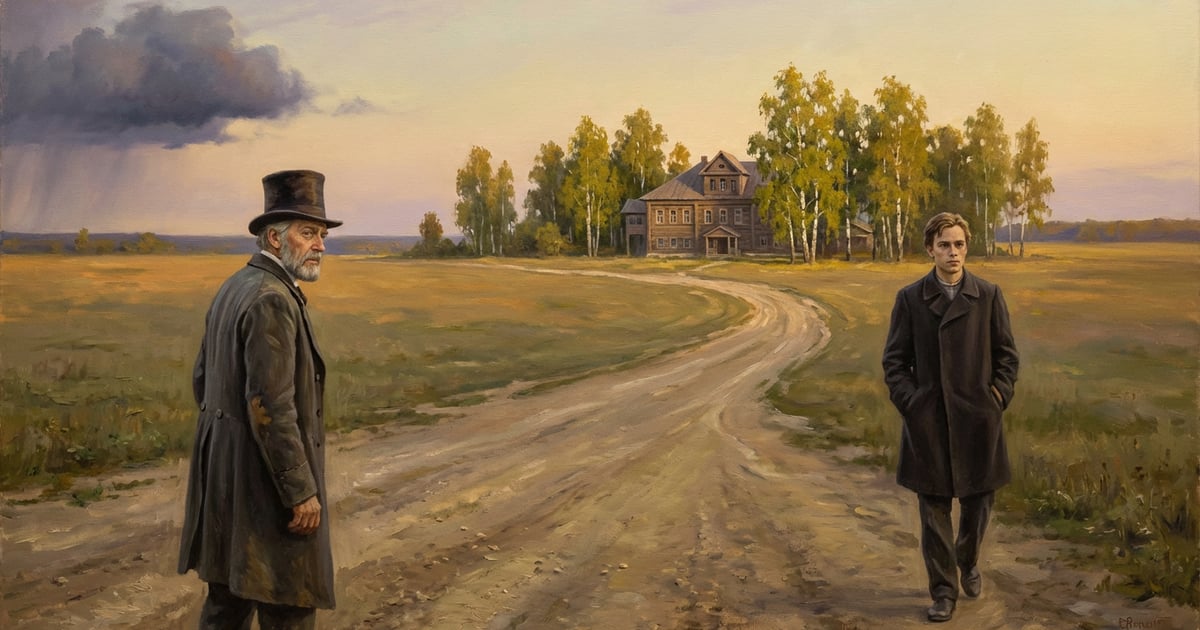
Five hours of waiting come out as a tap on the knee. Nikolai keeps telling Arkady that he is a graduate and home again. Arkady is full of a real, almost childish delight, and he still steers the talk towards facts. Uncle Paul had meant to meet him and changed his mind. There is a splendid horse. The son's room has been repapered. A room will be found for Bazarov, whom Arkady has not known very long and cannot praise enough: natural science, practically everything, a doctor next year. A silence follows.
On a side road, peasants from the estate ride bridleless, blouses unbuttoned. Peter says they are going to town, or, with a wink the old coachman will not share, to the tavern. They will not pay their tithes. The hired men ruin the tools and leave the land untilled. Arkady does not take up estate management. He says the place lacks shade, then praises the air until a glance at the tarantass shuts him up. When his father says the land must matter because Arkady was born here, the son answers that no significance attaches to the place of a man's birth. Half a verst passes with nothing more said.
The old nurse Egorovna is dead. Prokofitch still grumbles. Nikolai has hired a new steward because he will not trust freed serfs with responsibility, and he lowers his voice, because Arkady has looked at Peter, to add that the valet is free. Then he rubs his forehead and switches into French. The girl is living in the house. Arkady says Thenichka too loudly. Nikolai goes red and says the arrangement must change: the friend is coming, and the wing is small. Arkady tells him there is nothing to reproach himself with, and thinks, with a tender sense of being the grown one, why these excuses? The forest ahead has been sold for money, and the land is to go to the peasants who pay nothing yet. Huts sag, church stucco peels, and the cows look pulled out of winter. Arkady decides the district needs education and cannot say how it would arrive. Spring takes the fields back anyway, gold-green, larks up, rooks in the young rye, and he looks so boyish that his father embraces him again. They will draw nearer. They will work the estate together, if Arkady cares to. Nikolai begins Pushkin's sad lines on spring, the season of love. Bazarov shouts from the tarantass for a match. The verse stops. Peter brings the silver box back with a fat black cigar. Arkady lights it. Nikolai, who has never smoked, turns his nose aside so his son will not see. A quarter of an hour later the wheels stop at a new grey house with a red iron roof. The family calls it Marino. The Pushkin line is still unfinished in the carriage.
Turgenev captures something universal: the people we love most are often the hardest to talk to honestly. When stakes feel high, we start performing instead of connecting. Nikolai loves his son so much that he can't just say 'I'm with someone now.' Arkady loves his father but feels compelled to demonstrate his education. Both create exactly the distance they're trying to avoid. This pattern dominates modern family dynamics. Parents rehearse conversations about divorce, addiction, or illness until the rehearsal becomes more important than the relationship. Adult children visit home and unconsciously lecture about politics, technology, or lifestyle choices. Everyone means well, but meaning well isn't enough. The mechanism is self-defeating preparation. When we care deeply about someone's reaction, we craft careful approaches and try to control outcomes. This creates artificial distance. We start performing our relationship instead of living it. Healthcare workers see this constantly, families who can't discuss diagnosis directly, dancing around the truth while everyone suffers in silence. The antidote is naming the care first. 'I love you and this feels awkward to discuss' opens more doors than perfect strategy. Most people would rather have an imperfect honest conversation than a perfect performed one. What conversations in your life have become performances instead of connections?
Explore this chapter with AI to uncover deeper meaning and practical takeaways.
AI Discussion