LIVE
OCD← Home
Fathers and Sons cover
1862
Fathers and Sons
Ivan Turgenev · First Impressions and Social Masks
Chapter 2
Ch. 1
Reading
Ch. 2
Ch. 3
Loading audio...
0:000:00

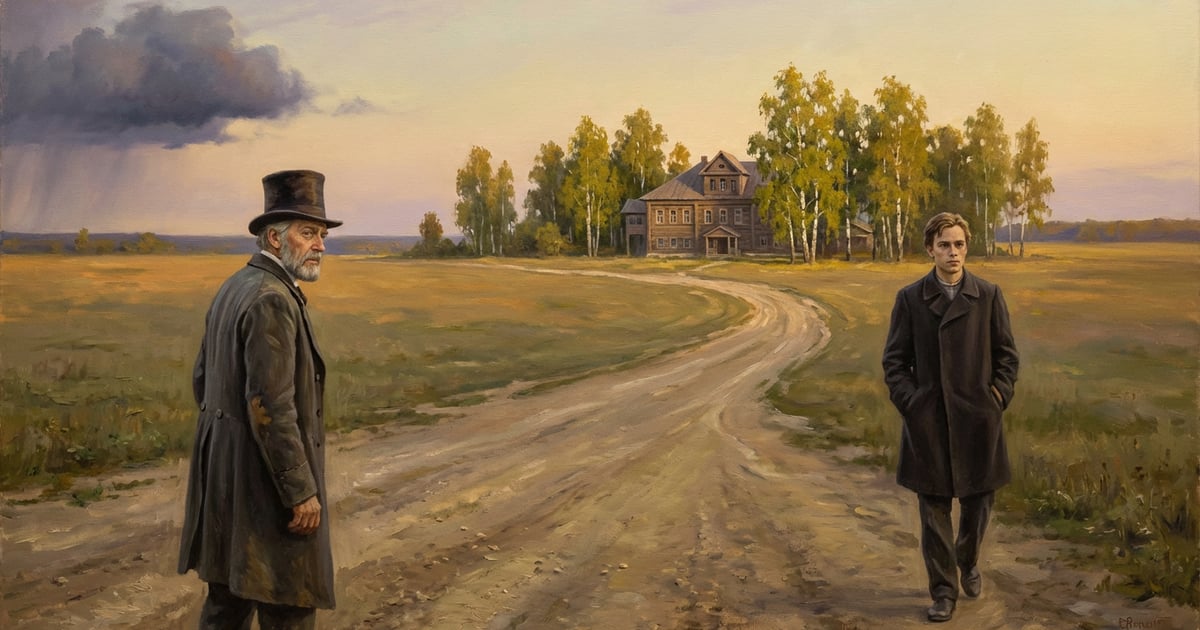
Dust is the first thing Arkady offers his father, and he asks for a rub down before the joy goes any further. Nikolai Petrovitch pats the blue cloak, pats his own jacket, and says the dust will not matter. Then the stammer shows. He is more excited than his son, already steering him towards the inn yard and the fresh horses, until Arkady stops him. The friend from the letters is here too. Bazarov has been kind enough to come for a visit.

Nikolai turns. A tall man in a long coat with a tasselled belt has just climbed down from the tarantass. He waits, then gives a bare red hand. The face is long and thin, the forehead flattened at the top and sharpened towards the nose, the eyes large and green, the whiskers sandy. When it smiles, it looks sure of its own mind. He is glad, he is grateful, he hopes that, and then he has to ask the name. Evgenii Vasiliev. The host hopes time will not hang heavy. Bazarov twitches his lips, lifts his cap, and says nothing. The skull shows through the hair.

Peter bows from a distance and does not come near enough to shake the young master's hand. Bazarov lights a pipe and tells the ostler to bestir himself, fat-beard. A second ostler repeats the name so the first will feel it. Nikolai promises a glass of vodka apiece if the horses are put to at once. Only two can ride in his koliaska. Arkady decides the rest. The friend will take the tarantass, and nobody should stand on ceremony, because he is wonderful and also quite simple. Father and son sit together. Peter climbs their box. Bazarov drops into the other carriage and lets his head fall on the leather cushion. The little procession moves off, and the house is still down the road.

Amplified Discussion
When Smart People Act Stupid

Bazarov represents a type we all recognize: the person whose real knowledge in one area becomes fake authority in everything else. He's genuinely educated, probably brilliant in his field, but he uses that intelligence like a club to beat down anyone who doesn't share his worldview. This isn't about being anti-intellectual, it's about recognizing when intelligence becomes weaponized. The most dangerous people aren't the obviously ignorant ones; they're the smart ones who've convinced themselves their education makes them superior human beings. They're the nurse who talks down to CNAs, the college graduate who dismisses their parents' life experience, the manager who thinks an MBA means they understand people better than someone who's worked the floor for twenty years. The pattern is always the same: they mistake credentials for wisdom, cynicism for insight, and dismissiveness for sophistication. But here's what Turgenev understood that we often miss: the people being dismissed usually have knowledge the 'smart' person desperately needs. The older generation has survival skills, emotional intelligence, and practical wisdom that no textbook teaches. The working-class person understands systems and people in ways that academic theory never captures. When someone uses their intelligence to shut down rather than learn from others, they're actually making themselves stupider. Real intelligence listens before it judges, asks questions before it dismisses, and recognizes that wisdom comes from many sources. The question isn't whether someone is smart, it's whether they're smart enough to know what they don't know.

Explore this chapter with AI to uncover deeper meaning and practical takeaways.

AI Discussion
Why it matters

See Who the Greeting Was Built For

Does a welcome change shape when a second person steps down from the same carriage? Nikolai gets stuck after 'I hope that' and has to ask Bazarov's name, and Arkady sends that friend to the tarantass with the assurance that nobody need stand on ceremony. The next time you introduce someone, or arrive as the extra person, write who the greeting was practised for and what was left over: the paused hand, the second seat, the sentence that got no answer.

Lessons

PracticeThe next time a greeting has to stretch around a second person, write who it was practised for and what was left over.

Psych reading

The Expertise Trap

When knowledge in one area becomes a license to dismiss others' worth and wisdom across all areas of life.

In the mind

This chapter reveals a dangerous pattern: how intellectual confidence can quickly slide into social arrogance, and how we often mistake dismissiveness for sophistication. Bazarov enters the scene with all the markers of intelligence, sharp wit, education, confidence, but immediately reveals something darker underneath. He treats the working-class ostler with casual contempt, responds to genuine warmth with cool superiority, and carries himself as if everyone around him exists for his judgment.

The mechanism is seductive and common: when someone has genuine knowledge or skill in one area, they often assume superiority across all areas of human experience. Bazarov's medical training and modern ideas become a license to look down on traditional courtesy, working-class people, and anyone who doesn't share his worldview. He mistakes his education for wisdom, his cynicism for insight. The real tell isn't what he knows, it's how he treats people he considers beneath him.

This exact pattern plays out everywhere today. The nurse who talks down to CNAs because she has a degree. The tech worker who dismisses anyone not in his field as intellectually inferior. The person who uses political knowledge to shame family members at dinner. The manager who confuses her position with actual wisdom about people's lives. Each believes their expertise in one area justifies their dismissal of others' experiences and worth.

When you spot this pattern, in others or yourself, ask three questions: Is this person's knowledge actually relevant to how they're treating people? Are they using intelligence as a weapon or a tool? Do they show curiosity about what others know, or only interest in proving what they know? Real intelligence listens before it judges. It recognizes that a CNA might understand patient care better than a doctor, that a parent might understand motivation better than a manager. Arrogance closes doors; wisdom opens them.

When you can name this pattern, predict where it leads, and navigate it successfully. When you can name the pattern, predict where it leads, and choose a response that fits the situation, you have done the real work this chapter asks for.

Find the right chapter

Each mood maps to a life skill. Each skill connects to the patterns in classic literature.

😔How do you feel😊

Personalize your match

Optional—life stage, what you need today, and what you're navigating help us pick chapters that fit—not generic lists. You may also freeform using the feeling search below.

Sign in to save your profile

Choices stay on this device until you sign in.

Browse the Full Library
4,582Chapters
118+Books
86Authors