
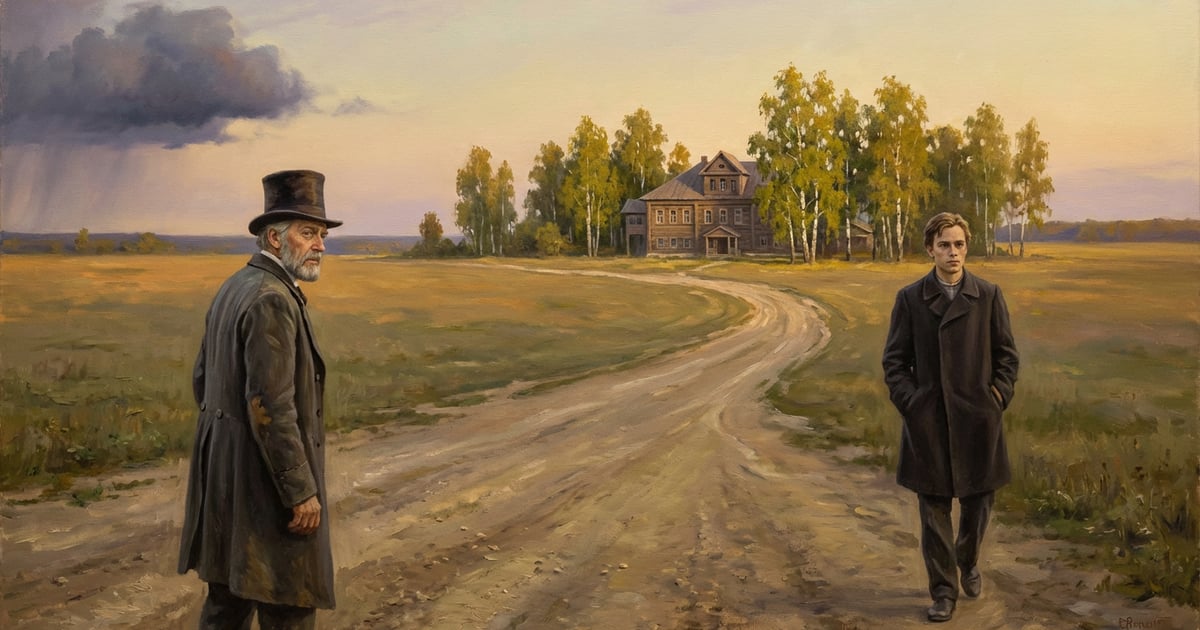
Between the hothouses and the lake is a temple of Russian brick. Only the statue of Silence arrived, a finger to her lips, and the servants knocked off her nose the day she came. Anna has disliked the place since she found an adder there. Katia still sits on the stone bench. The morning after Bazarov arrives, Arkady asks her to come, and she says it must be the last time. After breakfast her sister warned her that the household, and the Princess in particular, have noticed the solitary talks.
He is twenty-three. The change in him, he says, is due to her, and an honourable man must be frank with those nearest him. The feeling concerns Katia. He flounders like a man in a bog. She does not turn her head. Then Anna's voice comes from the path, and she and Bazarov halt, unseen, in front of the temple. They blundered, Anna says. They have no compelling need of one another. They are too much akin. Of late she has given Arkady more of her thoughts, though she is old enough to be his aunt. There is a charm in his young sentimentality. Fascination is the handier word, Bazarov says, and yesterday the boy was secretive. She answers that he and Katia are brother and sister. She trusts Bazarov as a good man. He says she calls him good only because he has lost all significance for her. Ill boots it to weave chaplets for a corpse. The wind takes the rest. They hear him ask whether she is free, and the footsteps die.
Arkady then says what the preamble could not. He will love Katia always, and never another woman, and he is asking for her hand. He is not rich. She looks up and says yes, then yes again, so that there is no mistake. Next morning Anna shows Bazarov the letter and asks what she should do. He scarcely hides a blaze of rancour, then says they must bless the match. The father is easy-going and will raise no difficulty. She agrees, and will send Arkady to Nikolai for consent. So the two of them have become elderly. Need he go? Talking to him is like walking on the edge of a precipice. A flying fish, he says, can stay in the air only so long. She sees the bitter laugh, thinks he still loves her, and holds out her hand. He steps back. Though poor, he has never yet accepted alms. They will meet again, she says. Anything may occur, he answers, and is gone.
He pads an empty space in his trunk with straw, as one pads the empty spaces in life, and tells Arkady they are parting for ever. The younger man lacks the coolness and the venom for the hard life. Something else Bazarov could say, and will not, because it would savour of Romanticism. Get married, he says. They embrace, and the tears come in a torrent. From the cart he points to a pair of jackdaws on the stable roof, the most respected of family birds. Farewell, señor. Before nightfall Arkady, deep in talk with Katia, has forgotten him. Anna asks the pair whether love is an empirical sentiment. Neither of them understands what she means.
Anna and Bazarov had intense intellectual chemistry, they could debate for hours, finish each other's thoughts, challenge each other's minds. But Turgenev shows us this wasn't enough. They lacked what Anna calls 'compelling need', the way opposites create sustainable attraction through difference rather than similarity. Meanwhile, Arkady and Katia succeed because they balance each other: his enthusiasm meets her steadiness, his dreams meet her practicality. This pattern appears constantly in modern relationships. Two ambitious people might have electric conversations but exhaust each other competing. Two creative types might inspire each other initially but struggle with practical decisions. Two analytical people might respect each other's minds but miss emotional connection. The most lasting partnerships often involve people who admire qualities in their partner that they themselves lack. One person's strength covers the other's weakness. One person's calm balances the other's intensity. This doesn't mean opposites always attract, shared values matter enormously. But complementary temperaments create the daily ease that sustains love through ordinary moments. Turgenev understood that the most passionate intellectual connections don't always translate to livable relationships. Sometimes the person who challenges your mind isn't the person who soothes your soul.
Explore this chapter with AI to uncover deeper meaning and practical takeaways.
AI Discussion