
Under a tall ash at Nikolskoe, Katia and Arkady sit without speaking, Fifi in the hare's crouch, crumbs going to the sparrows. He says the Russian name for the ash suits its brightness. She agrees, and he is glad she does not scold him for beautiful language. She likes Heine only when he is languid, not when he laughs. Then, she says, his old satire is not yet cured. Bazarov was a wild bird. She and Arkady are tame ones. The wild one, she adds, would rather have been otherwise. No one holds a rein over Anna for long.
He asks if she is a little afraid of her sister. He is. Anna likes him better than at first, perhaps because he brought her mother's letters, and for reasons Katia will not name. She is not wealthy. The property is her sister's, and she says so without false shame. She is prepared to be ruled, if self-respect stays with the submission. A merely subordinate life she does not fancy. He says she is as independent as Anna, and stronger, and she dislikes the comparison. Then he tells her that neither for her sister nor for anyone else would he exchange Mademoiselle Katerina Sergievna. He rises and walks away, alarmed at his own words. She does not smile. Something she does not put into words stays in her face.
Anna finds her alone, praises her charming feet, and sends her to try new shoes. Katia does not go. She thinks that before long someone shall be at those feet, and runs up the steps. Indoors, Bazarov is waiting on the window-sill, and was not to be announced. He tells the duel. Arkady forces a smile and is hurt and ashamed. Bazarov will not pretend the visit has a sensible reason. A man should pull himself up like a radish from a border. That is what he did last time. Now he has wanted one more look at the place where he used to grow. It is Arkady who has done the forsaking. And those Sunday schools? Arkady swears he is not in love with Anna. Then, Bazarov says, they have no further use for one another. The horses are still harnessed. He has felt as uncomfortable as a governor's lady hearing Gogol read aloud.
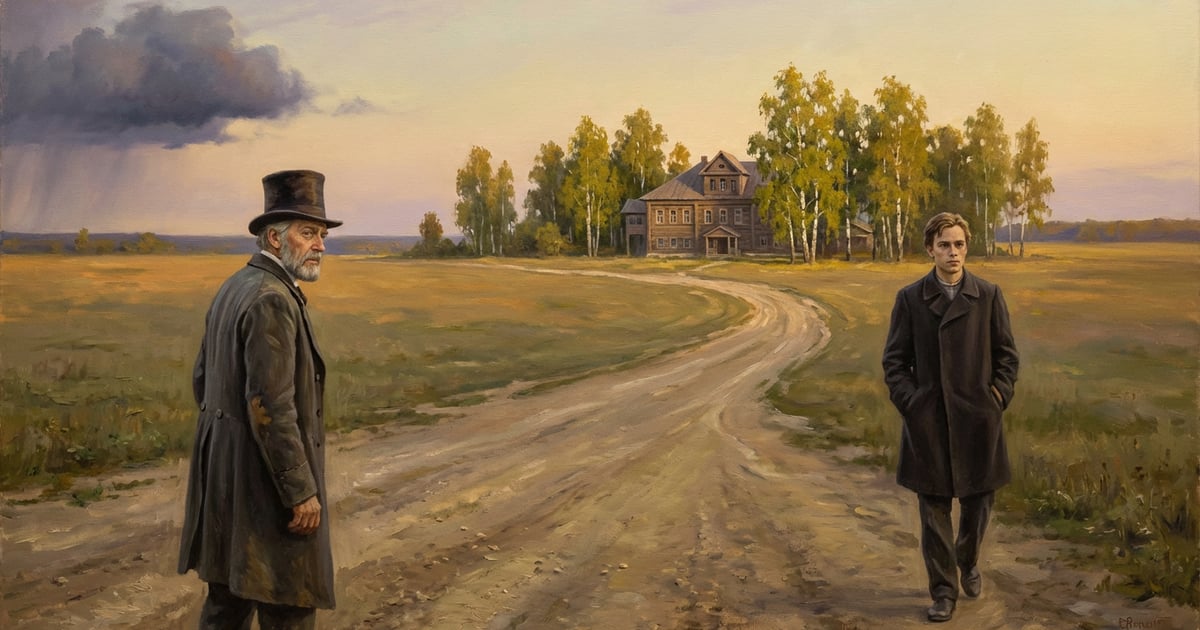
Anna receives him in the drawing-room, not in the room where he told her he loved her, and gives him her fingertips. He calls himself a corpse that has returned to its senses. When sorrow is asleep, do not wake it, she says. It was a dream. Love, he answers, is a mere empirical sentiment. Both believe they are speaking the truth. Whether it is the whole of it, neither can tell. She says Arkady is young, not like the two of them. Bazarov replies that he once had a great passion for her. Her eyes stay on the floor. She believes him wrong. Soon she sends for Arkady, who is at the far end of the garden, without the old jealousy, looking like a man who has come to a decision.
Turgenev understood something we're still learning: the difference between growth and performance. Arkady grows by shedding Bazarov's cynicism and embracing his naturally collaborative nature. Bazarov remains trapped performing intellectual detachment even when it isolates him from everything he actually wants. This isn't about Arkady being weak or Bazarov being strong, it's about the devastating energy cost of living against your grain. In working-class communities, we often face pressure to adopt survival personas that served us in one context but drain us in another. The single mother who learned to be hypervigilant and controlling might struggle to let her guard down when she finally finds stability. The worker who developed a tough, unemotional exterior to survive a hostile workplace might find it hard to connect with family. The person who learned to be the peacemaker in a chaotic household might struggle to advocate for themselves as an adult. Katia's insight about 'wild birds' and 'tame ones' offers crucial wisdom: different natures aren't hierarchical. A collaborative person trying to be a fighter will exhaust themselves. A natural fighter trying to be diplomatic will feel constantly constrained. The intelligence lies in recognizing which you actually are, not which you think you should be. When you can distinguish between authentic growth and performance, you stop wasting energy on roles that don't fit and start developing the strengths that actually belong to you.
Explore this chapter with AI to uncover deeper meaning and practical takeaways.
AI Discussion