
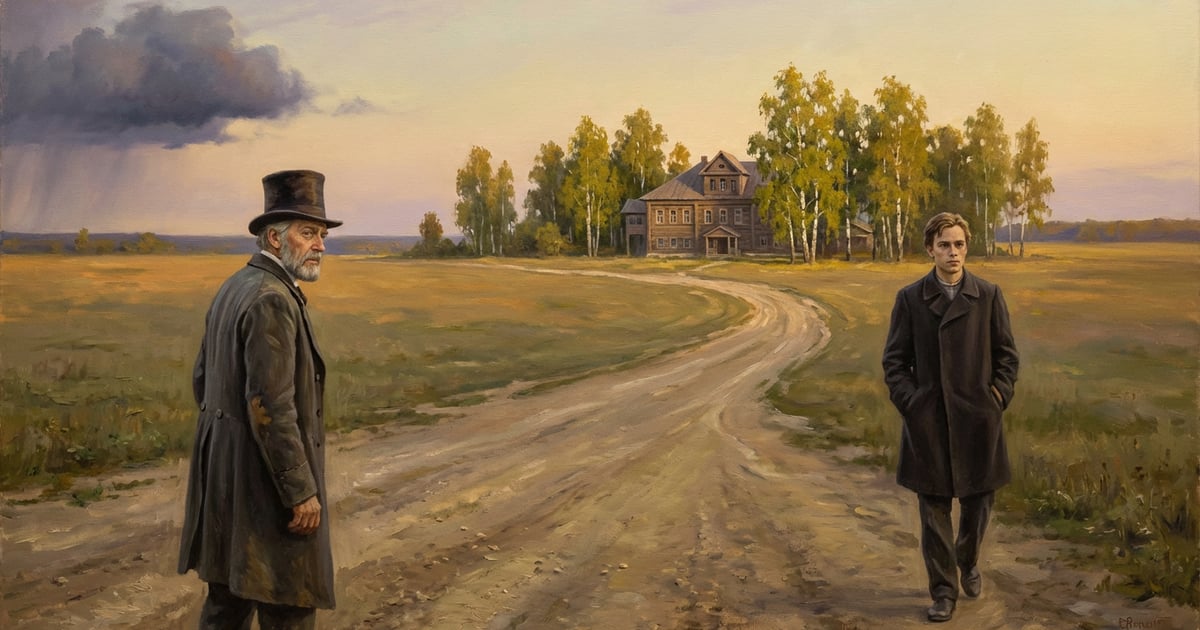
Two hours later Paul knocks, with a cane he does not usually carry, and asks what Bazarov thinks of duels. An absurdity in theory, Bazarov says. In practice he would not take an insult without satisfaction. Then Paul will fight him. He will not give the reason, beyond that he detests him. Bazarov might have refused. He will not. The cane is set aside. Tomorrow at six, behind the copse, pistols, ten paces, two shots, and a letter in each pocket taking the blame if either falls. Bazarov refuses the letters. That is a French novel. Peter the valet can stand as witness. Paul offers pistols he has not fired in five years. Alone, Bazarov calls it splendid and stupid. If he had refused, Paul would have struck him, and then he would have strangled him like a kitten. He thinks Paul saw the kiss, and that Paul himself is in love with her. He tears up a letter to his father. If he is killed, his parents will hear soon enough. He will not be killed. He has far yet to wander.
At dawn Peter goes green and leans on a birch. A peasant drives past and does not doff his cap. Paul arrives in white trousers, a green box under his arm, having preferred not to wake his valet. Bazarov adds two paces to the ten. Something whistles past his ear. He fires without aiming. Blood runs down the white leg. The bone is intact. Peter, crossing himself, asks if Paul is dead. A scratch, Paul says, and today at least Bazarov has acted like a gentleman. They agree to call it politics. When Nikolai arrives, the story he is given is a disrespectful word about Sir Robert Peel, and that Paul alone was at fault.
By night the wound has brought fever. The town doctor, told it was a self-inflicted accident, says H'm, and for twenty-five roubles agrees that such things happen. Towards morning Paul asks whether Thenichka does not resemble Nelly, the Princess R., about the upper part of the face. Bazarov leaves without a word to her. Where the road brings the farm and the new house into line, he calls them cursed tomnoddies.
A week later, from the sofa, Paul asks Thenichka if her conscience is clear, and whether she would exchange Nikolai for the man who has just left. He saw her in the lilac arbour. She swears she is innocent, and would rather die than be suspected of deceiving Nikolai. A tear runs down Paul's cheek. He begs her never to stop loving his brother, raises her hand to his lips, and sobs. Nikolai comes in with Mitia, and she throws her arms around them both, which she has never done in front of a third person. Paul then asks his brother, on his word of honour, to marry her. She loves him, and she is the mother of his child. Nikolai has held off only out of respect for Paul. Then, Paul says, he has respected him wrongfully. They embrace. Paul tells him not to inflame the leg of an old fool who at fifty fought like a young ensign. They need not tell her yet. After Nikolai has gone, Paul wonders why he was thanked. Once the marriage is made, he himself must go to Dresden or to Florence, and abide there until he dies. He closes his eyes. In the sunlight, his head on the pillow, he looks like a corpse.
Paul's duel wound forces him to stop performing aristocratic pride and start acting on love. This reveals something profound about human psychology: we often need shock to interrupt our protective patterns and see clearly. In Turgenev's time, social class created rigid scripts that prevented honest emotion. Paul couldn't simply admit jealousy or loneliness, aristocrats didn't do that. Today, we have different scripts but the same problem. Professional personas, social media images, family expectations, all create barriers to authentic action. We know what matters but feel trapped by what we think we're supposed to do. Crisis gives us permission to break those scripts. The manager who finally addresses team toxicity only after losing a star employee. The parent who stops trying to control their adult child only after a health scare forces perspective. The friend who finally sets boundaries only after complete emotional exhaustion. We wait for external pressure to justify internal wisdom. Paul's transformation suggests a different approach: regular priority audits before crisis forces them. What would you do differently if social expectations disappeared tomorrow? What conversations are you avoiding because they feel uncomfortable but not urgent? Crisis reveals that most of our daily concerns are performance, while our deepest needs, connection, purpose, genuine care for others, require no justification at all.
Explore this chapter with AI to uncover deeper meaning and practical takeaways.
AI Discussion