
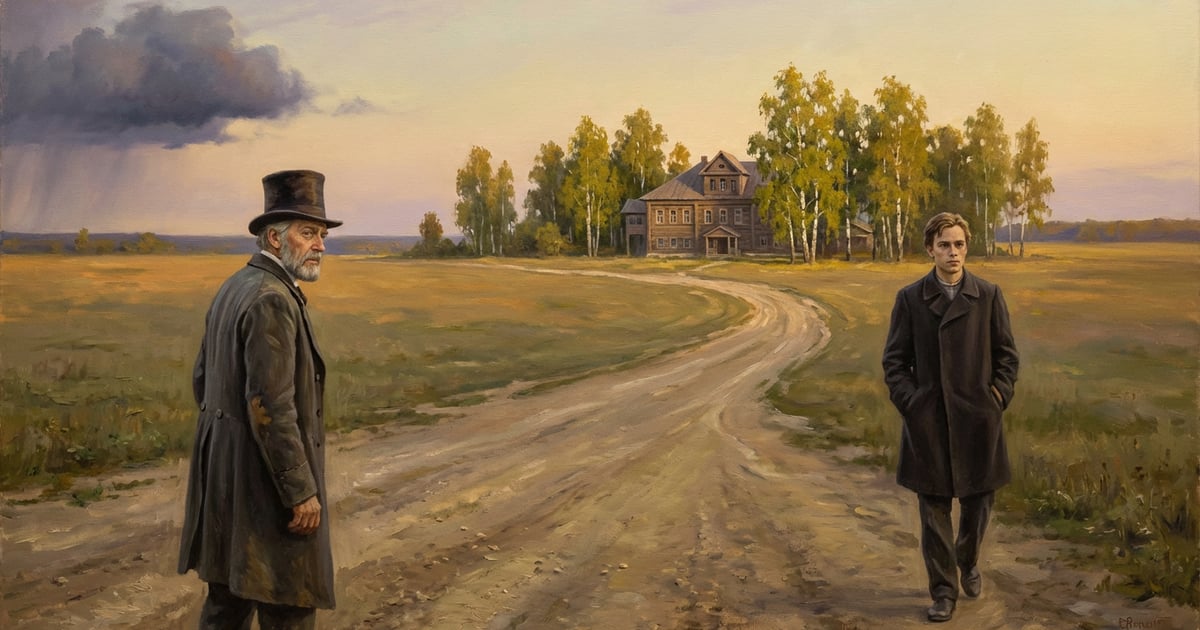
Once Arkady has gone, Bazarov shuts himself in with his work, and Paul Petrovitch speaks only in monosyllables. Once they begin on the rights of the gentry, and Paul checks himself. It is clear they will never understand one another. At all events he has not the honour to understand Bazarov. True, Bazarov says. A man may understand what is happening in the sun, and still be lost if another man blows his nose differently from himself. Even so, Paul once puts his perfumed face to the microscope to watch an infusorium swallow a green particle. Nikolai comes more often, sits in a far corner, and at meals turns the talk towards chemistry, because politics will only make his brother's enmity sorer. Cholera has taken two people at Marino. One night Paul faints, and will not send for Bazarov. Next day, pale and as carefully brushed as ever, he asks: did not you yourself tell me that you have no belief in medicine?
There is one person Bazarov does not hold off. He meets Thenichka in the early morning, in the garden or the yard, and she is less shy with him than with Nikolai. In him she finds no lordly superiority, only a clever doctor. She will dandle Mitia in front of him, and once, with a headache, takes a spoonful of his medicine. Paul she fears as much as ever. He appears behind her in the English suit, hands in his pockets, as if he had sprung out of the floor. Whenever she sees him, she tells Duniasha, she feels cold all over. Meanwhile she is unfolding in the July heat, dressed in white, too languid to work, her hands sunk in her lap.
At seven one morning he finds her on a bench among lilacs that are still green, a white scarf on her head and a bunch of red and white roses, still dewed, beside her. They are for breakfast. Nikolai is fond of such things. Bazarov takes her wrist, finds the pulse too regular to count, and says she will live to be a hundred. God preserve her from that. Her grandmother lived to eighty-five, blind, deaf, crooked, and a burden to herself. He says he cares nothing for youth or age. His youth is loneliness, and he wishes someone would take pity on it. She does not answer that. He asks her to read a page, not so that she will understand it, but so that he can watch her nose twitch. The page is on creosote. She laughs, and the book slips to the ground. All the fine clever ladies in the world, he says, are worth less than her little finger. She reminds him of the capsules. Since those, Mitia has slept. Doctors, he says, do not work for nothing. She thinks he means money, and that she must ask Nikolai. He wants one of the roses, a red one, and not too large. She laughs with relief, then bites her lip and listens. Everyone has gone to the fields. She fears only Paul. Smell the rose, he says. She bends, the scarf slips, and he kisses her on the parted lips. She presses her hands to his chest, but the push is too weak to stop him. A dry cough sounds in the lilacs. Paul bows, says it is you, then, and walks away. She gathers the roses and whispers, as she passes, that it was indeed wrong. Bazarov's mind goes back to another scene. He is ashamed, and angry at himself, and goes to his room. At breakfast Paul looks so dark that Nikolai asks if he is ill. He suffers, he says quietly, from biliousness, as Nikolai knows.
Bazarov's kiss reveals something uncomfortable about human nature: we're all capable of betraying our own principles when the right pressures align. He genuinely cares about Thenichka, respects her situation, and believes in treating people as equals rather than objects. Yet in one moment, all of that gets swept aside by physical attraction and emotional vulnerability. This isn't about him being a bad person - it's about how even well-intentioned people can cause harm when they act on impulse. The tragedy isn't just the kiss itself, but how it shatters the trust Thenichka placed in him as someone different from the aristocratic men who might exploit her position. In modern workplaces, we see this pattern constantly: the mentor who crosses professional boundaries with a mentee, the supervisor who shows favoritism during personal stress, the coworker who shares confidential information when feeling emotionally close to someone. The damage isn't just to the immediate relationship - it ripples through entire systems of trust. What makes this particularly relevant today is how our stressed, always-connected world creates more opportunities for these pressure-cooker moments. We spend more time in close quarters with people we care about professionally, often while dealing with personal pressures that cloud our judgment. The question isn't whether we'll face these moments - it's whether we'll build the safeguards to navigate them without betraying the trust others place in us.
Explore this chapter with AI to uncover deeper meaning and practical takeaways.
AI Discussion