
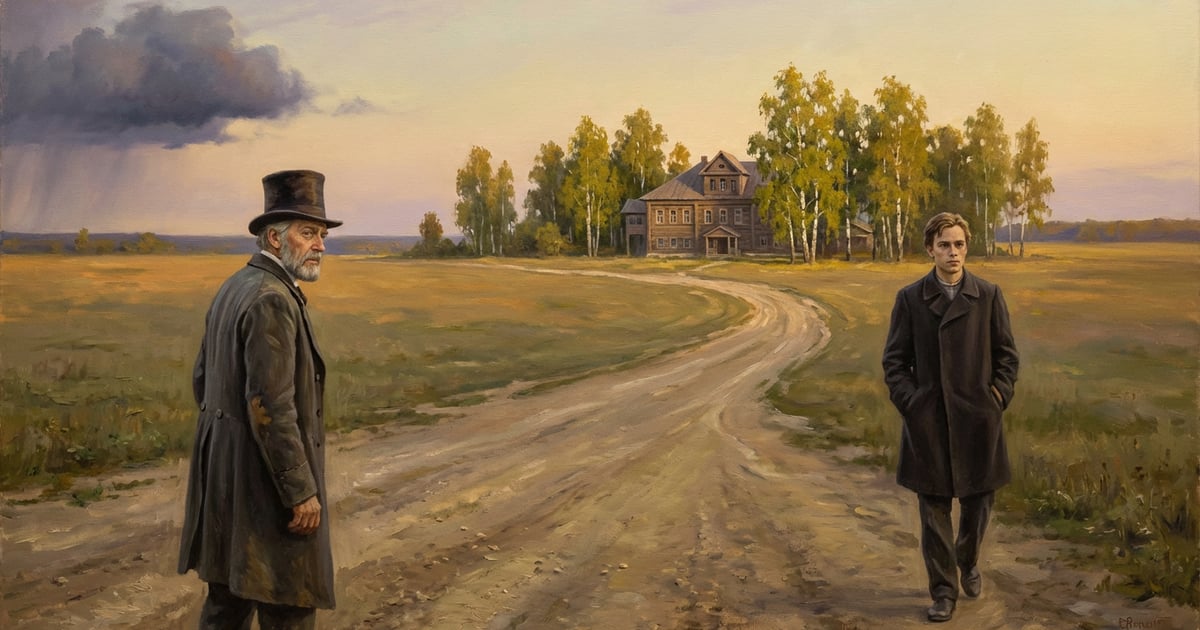
At Thedot's the driver asks which road. The right leads to the town, and so to Arkady's father. The left leads to Madame Odintsov. Arkady looks at Bazarov. To the left, Evgenii? Why that folly again? Folly, Arkady says, but they need only call in passing. Bazarov pulls his cap over his eyes. Do as you like. The tarantass turns towards Nikolskoe, and neither of them speaks.
They know they have been unwise before the butler reaches the verandah. No one expected them. Anna's welcome is smooth, a little surprised, and not, at heart, pleased. They explain that in four hours they will go on to the town. She asks Arkady to carry her greetings to his father. The Princess has only just woken, and looks more malignant than usual. Katia is unwell and does not leave her room, and it comes to Arkady that he would have been as glad to see her as to see Anna. The hours pass without one smile. Only at parting does the old friendliness stir. She is out of humour, she says, and they must not mind. Come again soon. She addresses the invitation to them both. They bow and drive on to Marino. Bazarov gazes at the horizon and scarcely opens his mouth. Neither mentions her.
At Marino, Thenichka runs to say the young gentlemen are arriving, and Nikolai leaps from the sofa. Even Paul smiles as he shakes their hands. Supper lasts far into the night on porter just come from Moscow, until Nikolai's cheeks are raspberry-coloured and his laugh is half a boy's. The pleasure sits on a bad season. Hired men take their earnest-money and leave. A milling machine from Moscow is too heavy to use. Half the cattle sheds burn because a blind old woman tries to smoke her cow with a firestick in a wind. The steward prods a passing pig and spends the rest of the day in bed. Peasants steal timber and turn horses into the meadows. Nikolai decrees the horses forfeit, feeds them for a day or two, and gives them back. He will not send for the magistrate. His principles forbid it. Without a threat, he says, one can do nothing. Paul advises calm, then growls and twists his moustache.
Bazarov keeps to his frogs. Arkady listens to his father, and once offers advice meant only to show interest, not to be used. He is surprised to find his thoughts turning towards Nikolskoe. Then letters come to light, written by his mother to Anna's mother, and he will not rest until the mouldy packets are out of the boxes. The invitation was to both of them, he whispers. Damn it, he will go. The cold reception returns, and with it the old timidity. Ten days later he invents a study of Sunday schools, and drives towards the high roof. On the bridge he thinks it would be better to turn back. The troika does not stop. In the firs he sees a pink dress and a face under a parasol. It is Katia. He knows her at once, and is more pleased than if she had been his own sister. There will be no butler and no announcement. Anna is in the garden with her back to him, and turns at the sound of steps. He begins to say he has brought something she will not have expected. She answers that he has brought himself, and that that is the best bringing of all.
Turgenev understood something we've forgotten in our hyper-connected age: sometimes the biggest risk is bringing backup. When Arkady and Bazarov visit Anna together, they create a dynamic where no one can be authentic. Everyone's performing for multiple audiences simultaneously. But when Arkady finally goes alone, despite his terror, real connection becomes possible. This pattern dominates modern working-class life in ways that would have amazed Turgenev. We text in group chats instead of calling directly, then wonder why relationships feel shallow. We attend family gatherings only when siblings are present, avoiding the deeper conversations that could heal old wounds. We stay quiet in meetings because speaking up feels risky, then watch someone else voice our exact idea. The irony is brutal: our safety nets guarantee the very superficiality we're trying to avoid. Turgenev shows us that authentic connection requires authentic vulnerability, and that means sometimes going it alone. The young Russian nobleman sweating on his way to face Anna mirrors every working parent who finally makes that difficult phone call to their estranged sibling, every employee who asks for a one-on-one meeting with their boss instead of hiding in group discussions. The courage to risk rejection individually often leads to the very acceptance we couldn't find collectively. What emotional shields are you using that might actually be blocking the connections you seek?
Explore this chapter with AI to uncover deeper meaning and practical takeaways.
AI Discussion