
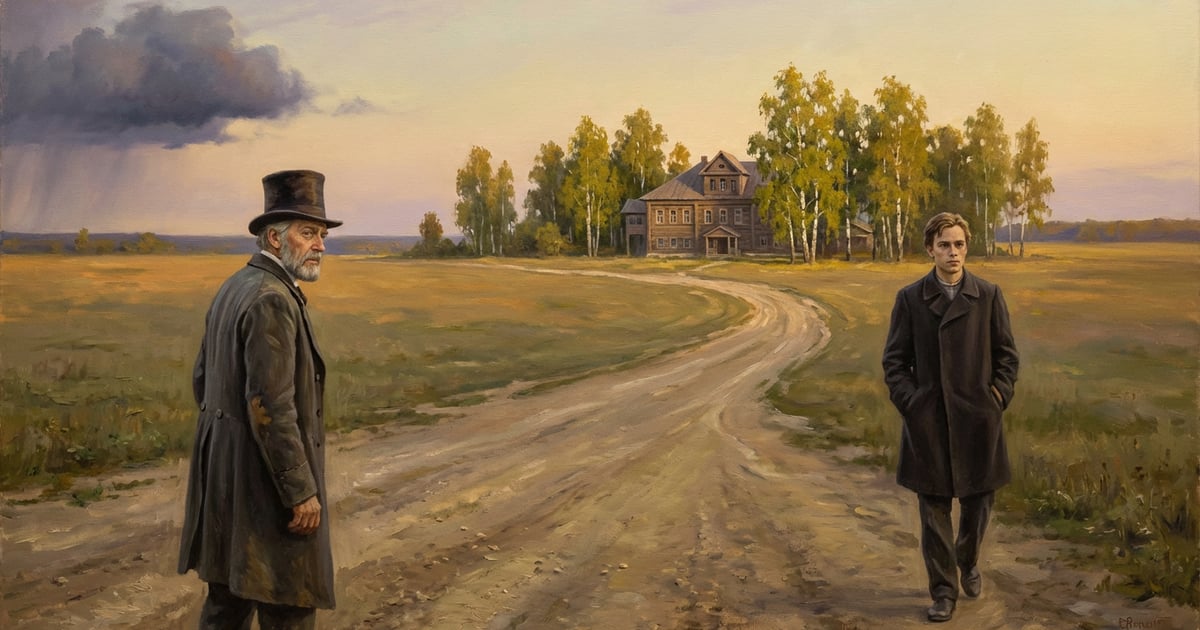
In the morning Vasili Ivanitch is digging a bed of late turnips and calling the work Cincinnatus. Half an hour ago he gave a woman opium for dysentery, and drew another's teeth when she refused ether. He asks Arkady, as a father, for a frank opinion of his son. Evgenii is the most remarkable man Arkady has ever met, and the name will be famous. The spade slips. Vasili presses his lips to the young man's shoulder. He idolises his son, and dare not show it, because Evgenii dislikes such feeling. His one conceit is a line he hopes may stand in a biography: that the subject was the son of a plain military doctor who had the wit to see his merits and spare nothing in his education.
At noon, under a hayrick, Bazarov says an aspen that was a boy's talisman against boredom has lost its power. He loves his parents, whose days are full, and feels only weariness and rancour, a point of no account in an immensity that has no use for him. No woman will get him into trouble, and Arkady will hear no further word on that. Honour, he says, is an instinct. When Arkady compares a withered maple leaf to a butterfly, Bazarov calls beautiful language indecent, and calls Paul Petrovitch an idiot. He stretches out his fingers as if to seize Arkady by the throat. The smile is not a jest. Vasili arrives to say that Father Alexis will dine, the thanksgiving for the son's return already over. Forgive me if I hurt you, Bazarov says under his breath. Arkady presses his hand.
Arina sits beside her son at cards and does not dare a caress. Once he asks for her hand for luck, and the game grows worse. Next day he tells Arkady he must leave. He can hear his mother groaning, and when he goes to her he has not a word to say. In the same talk he says that a few days ago his father rightly had a thief flogged, and Arkady looks his indignation. At good-night Bazarov yawns and asks that the horses be sent on to Thedot's. Three days only, after three years. Vasili does not mention the flowers Arina fetched for the room, nor the notes he has been giving Timotheitch for food and wine. Freedom, he begins, is the greatest thing in the world, and his voice breaks. He gives no look back. Upstairs he will not tell her overnight. She wakes anxious about the sofa, and he lets her believe the son is comfortable.
They leave. He talks loud and cannot meet his son's eyes. She weeps. Bazarov frees himself from the arms that try to keep him and promises to return within a month. When the dust has settled, Vasili drops into a chair. He has gone for ever, he says, and once more the old man is as lonely as the sand of the desert. Arina presses her grey head to his. Their son is a falcon. He has flown as he willed. She and Vasili are like lichen in a hollow tree, still side by side. He takes his hands from his face and embraces her as he never did, not even in the days of his courtship.
Turgenev understood something about love that modern culture often misses: sometimes the most loving thing you can do is watch someone walk away without making them feel guilty about it. Vasili's morning garden work reveals a father desperate for connection, but when Bazarov announces his departure, Vasili doesn't guilt-trip or manipulate. He quietly prepares for goodbye. This restraint comes from painful wisdom, he knows his son's respect matters more than his own comfort. In our age of helicopter parenting and emotional manipulation disguised as care, this feels almost revolutionary. We're taught that love means fighting for what we want, but Turgenev shows us love that prioritizes the beloved's needs over our own desires. Arina's wisdom about being 'like lichen in a hollow tree' captures this perfectly: enduring love adapts to circumstances rather than demanding circumstances adapt to it. This pattern appears everywhere in modern relationships. The parent who doesn't guilt their adult child for moving away for better opportunities. The manager who doesn't micromanage their best employee. The friend who gives space during difficult times without taking it personally. Each situation requires the same painful calculation: short-term emotional satisfaction versus long-term relationship health. The counterintuitive truth Turgenev reveals: people often return to those who let them go freely, and stay away from those who cling desperately.
Explore this chapter with AI to uncover deeper meaning and practical takeaways.
AI Discussion