
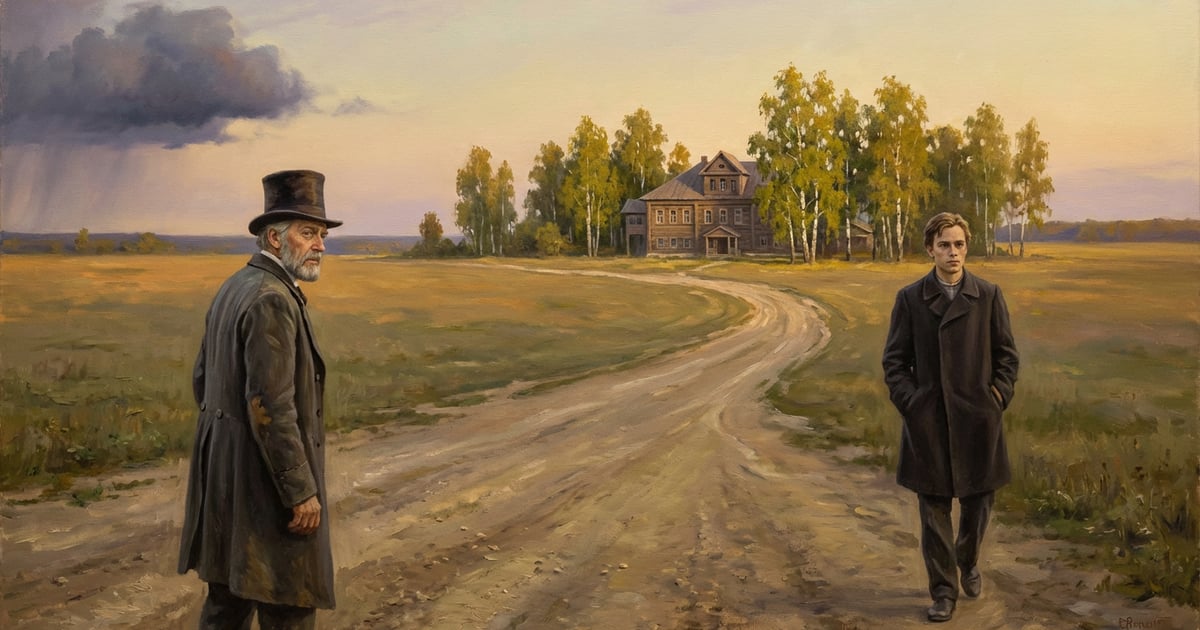
On the steps stands a tall thin man with dishevelled hair and a narrow nose, an old military tunic flying open, a long pipe rattling in his fingers. So you have come at last. He embraces his son again and again. From the doorway a short woman in a white cap cries Eniusha and would have fallen if Bazarov had not caught her. Her arms lock around his neck, her head on his chest, and only her sobs break the stillness. Enough, Arisha, says Vasili Ivanitch, and blinks harder than he breathes. Arkady is still by the tarantass. Even the peasant on the box has turned his head away. Pardon a woman's weakness and a mother's heart, the father says. His own lips and chin are working. He is trying to look indifferent.
Indoors he warns the guest not to expect much. They live as if in camp. Nightingales cannot be fed on air. Arina hurries off to see about a meal, for it must be three years since she last gave Eniusha one. The study holds Turkish weapons, a portrait of Hufeland, a diploma under glass, stuffed birds, and a broken electric battery. When the father has gone, Bazarov tells Arkady that the old man is just such a good-hearted, queer fellow as Nikolai, though of another kind, and that the mother does not try to hide what she feels. The place is hers, he says, about fifteen souls. Twenty-two, Timotheitch corrects, with pride. A boy in a torn blue coat and odd shoes, Thedika, is set to wait on them, and can at least fill a pipe. Bazarov notices The Friend of Health for 1855. They ridicule all medicine, he tells his father, and bow to no one. Then you do not wish to be a doctor? He does. The one does not preclude the other. Vasili, who served under Arkady's grandfather, calls the general a true soldier. Bazarov drawls that he was a decent old curmudgeon, then praises the birch plantation so the old face can brighten. Every tree in the garden was planted with Vasili's own hands.
Dinner, got in a hurry because they were not expected, is excellent. The wine tastes of resin and honey. Arina wears a high cap with yellow ribands and a blue shawl. She weeps again at the sight of her son, and wipes the tears at once for fear of staining the shawl. She wants to ask how long he will stay, and dares not, in case the answer is two days. Vasili brings champagne, toasts the young men, and makes her drain her glass. Arkady eats sweet things he cannot bear, because they were made for him. Bazarov declines them and lights a cigar. In the garden the father points to a bench where he meditates, and to a few of Horace's favourite trees. Acacias, he says, when Bazarov asks which. The son yawns, and is told it is time for the arms of Morpheus.
At bedtime he kisses his mother on the forehead. She embraces him three times and, covertly, blesses him. Arkady sleeps in a mint-scented room beside the bathroom, a cricket answering a cricket behind the stove. Bazarov sends his father from the foot of the sofa, says he wants to sleep, and does not close his eyes. Childhood moves him less than the bitter thing he has just left behind. Arina prays with a full heart, then talks a long time with one-eyed Anfisushka about what the son will do. She is a housewife of an older Russia, kind, full of portents, afraid of almost everything, in love with her husband and in fear of her son past telling. Such women are now extinct. Only God knows whether we ought to be glad of the fact.
Turgenev captures something profound about class mobility and family dynamics. When we climb social or economic ladders, we often develop new identities that feel necessary for survival in different worlds. The Young Rebel needs their professional persona to navigate workplace hierarchy, just as Bazarov needed his intellectual nihilism to navigate aristocratic society. But family love operates on different rules entirely. It predates our achievements and exists independent of our performance. This creates both comfort and tension. Parents like Rosa and Eddie love fiercely but may not understand the worlds their children now inhabit. They try to connect through what they know - trade knowledge, union solidarity, family traditions. Meanwhile, their children struggle between honouring their roots and protecting their new identities. The danger lies in either extreme: completely abandoning family connections or never allowing yourself to grow beyond them. The wisdom is learning to code-switch gracefully, to be authentic in multiple contexts without losing core values. Family visits become practice in maintaining integrity across different worlds. Success isn't about choosing between your old life and new opportunities - it's about building bridges strong enough to honour both.
Explore this chapter with AI to uncover deeper meaning and practical takeaways.
AI Discussion