
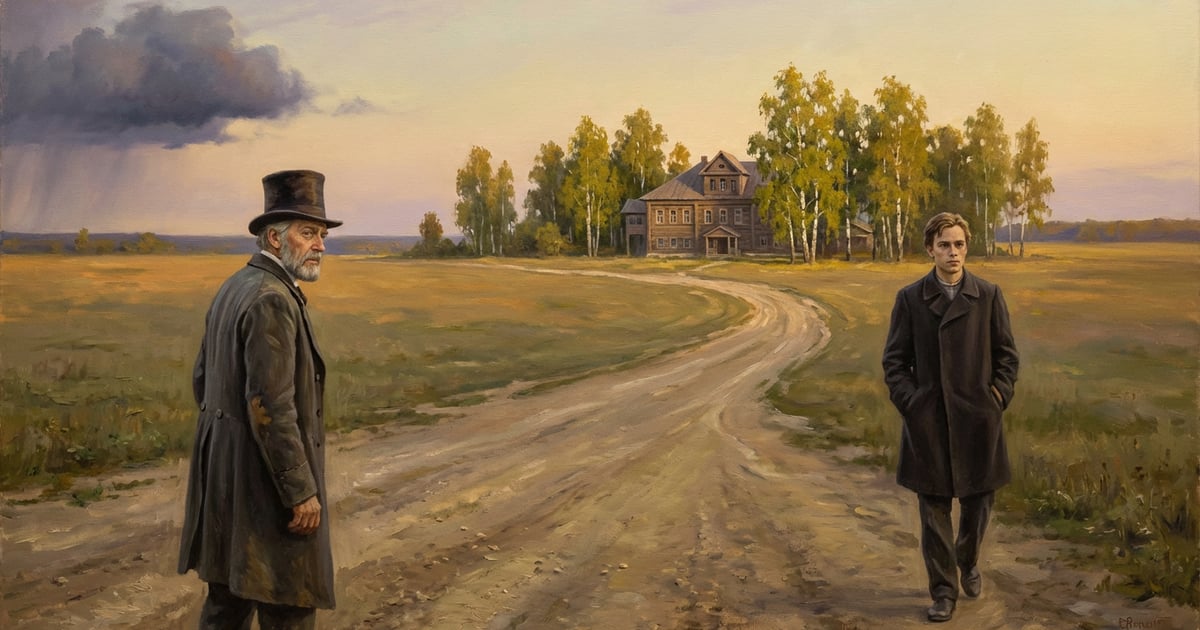
Dinner is quiet and uncomfortable. Porphyri Platonitch tells how Governor Bardeloue ordered spurs for his whole staff, so he could send them on horseback. Arkady talks with Katia and is diplomatic with the Princess. Bazarov sits rigid. Anna glances at him and thinks: no, no, again no. In the garden he begs her pardon with his eyes on the ground. She is not so much angry as grieved. So much the worse, he says. By tomorrow he will have gone. He knows only one condition on which he could stay, and it is never likely to arise. He supposes she neither loves him now nor ever could. She does not answer. The only thought in her is that she is afraid of this man. Farewell, he says, as though he had divined it, and walks towards the house.
She keeps Katia's arm all evening and laughs in a way that does not match her blanched face. Arkady keeps asking what this can mean. At tea she wants a kind word for Bazarov and has none. Then the butler announces Sitnikov, who blurts that Evdoksia Kukshin sent him to ask after Anna's health, loses his head, and sits down upon his own hat. No one bids him depart. The paltry arrival loosens a string drawn too tight, supper is easier, and they go to bed half an hour early.
In the dark Arkady recalls an old question of Bazarov's. Why are you down-hearted? Have you just fulfilled a sacred duty? Tomorrow, Bazarov says, he goes to his father's. Arkady is surprised, and for some reason glad. And Anna Sergievna? I am not her hireling. He turns his face to the wall. Arkady will leave too, as far as Khokhlovskïe Viselki, where horses can be had of Thedot. He will not impose upon the parents. Bazarov has left some of his things at Marino. Later, one tear already on the pillow, Arkady asks what brought that idiot Sitnikov. We need the Sitnikovs, Bazarov says. Such donkeys are necessary. The gods ought not to have to bake pots. Then you and I are the gods, Arkady answers, or are you a god, and I a donkey? You are. As yet.
Next morning Anna looks weary when she hears he will go as well. Katia is grave and silent. The Princess crosses herself under the shawl. Sitnikov panics at being left and says he will depart too, so Arkady must not vex him by refusing the koliaska. She gives Bazarov her hand. I hope we shall meet again. Only if you wish it. Then we shall meet again. At the posting-station Arkady crosses to the tarantass. Take me with you. Get in, then. He shouts right away. Sitnikov is left to tell Madame Kukshin that he has had enough of those odious churls and upstarts. On the road Bazarov, sleepless, throws a tasteless cigar into the dust. Better break stones, he says, than let a woman obtain the least hold. He asks the peasant whether he beats his wife. Sometimes, and never without good cause. Does she beat you? The man is offended. You and I have been similarly beaten, Bazarov says. That is what comes of being gentry. Arkady laughs. Bazarov does not speak again. The twenty-five versts feel like fifty. His father is stepping onto the verandah. He will have heard the collar-bells. How grey he looks, poor old fellow.
Turgenev understood something about human nature that remains painfully relevant: we often abandon situations not because they're wrong, but because they make us feel vulnerable. Bazarov's immediate departure after Anna's rejection reveals how our defence mechanisms can sabotage genuine connection. He'd rather preserve his self-image as someone above such feelings than learn from the experience of being human and fallible. This pattern transcends class and era. The factory worker who switches shifts after an awkward conversation with a crush. The retail employee who requests a department transfer after a manager gives constructive criticism. The healthcare worker who avoids certain patients after a difficult family interaction. In each case, wounded pride masquerades as practical decision-making. We tell ourselves we're making smart choices when we're actually being controlled by our bruised egos. The tragedy isn't the initial rejection or awkwardness - it's how quickly we flee instead of learning to navigate complex emotions. Sometimes the most growth happens in the uncomfortable space between vulnerability and retreat. The question isn't whether we'll face rejection or awkwardness, but whether we'll let pride determine our response to it.
Explore this chapter with AI to uncover deeper meaning and practical takeaways.
AI Discussion