
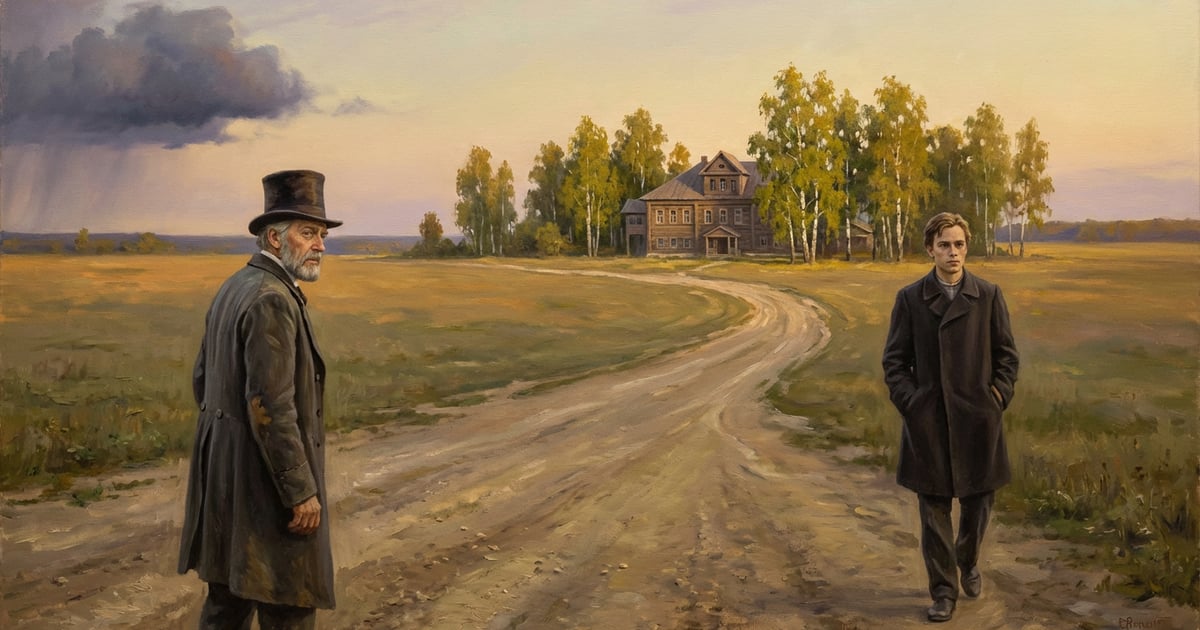
The speckled hen is already a sign that the morning will not hurry for him. It tap-taps up the old verandah steps on splayed yellow legs, and a fastidious cat watches from the balustrade as if the hen had no right to be there. Nikolai Petrovitch Kirsanov, hatless, in a dusty jacket over tweed, has asked his servant Peter whether anyone is in sight. Peter, turquoise ear-ring and pomaded hair, the walk of a man who knows he belongs to the rising generation, says no. Then he takes himself off to the gates to light a pipe. The master sits with his knees drawn under him. It is the 20th day of May, 1859, and the wait is long enough for a life to be told in it.
He was born to follow his brother Paul into the army. Their father had commanded a division after 1812. On the day Nikolai's commission arrived, he broke his leg, and after two months in bed he was lame for good. University replaced the regiment. In 1835 he took his degree, and as soon as mourning allowed he married the landlord's daughter, a comely girl called advanced because she sometimes read a science article in the papers. They left his post, played duets, kept a poultry-yard, and had a son, Arkady. Ten quiet years ended in 1847. The husband's hair went grey in a few weeks. He tried travel, came home, took up industrial reform, and in 1855 sent Arkady to St Petersburg to become a graduate in his own footsteps. This fourth winter he could not go to the capital. So he waits, grey, a little bent, wholly middle-aged.
Hot rye straw smells from a dark granary. The same words keep circling: his son Arkady a graduate. He tries to think of something else. The words return, and then they become his dead wife. A fat blue pigeon drinks from a pool by the well. Wheels sound in the same moment. Peter says he thinks they are coming. Nikolai springs up. A tarantass, three stagehorses, the band of a student's cap, a face he loves. He runs with his arms waving. His lips meet a sun-tanned, dusty, hairless cheek.
Turgenev wrote this in 1862, but he captured something timeless about family dynamics under pressure. Nikolai waits for his son, caught between pride and terror, the exact feeling every parent has when their child surpasses them. This isn't just about education or class mobility. It's about the fundamental tension in healthy relationships: we want the people we love to grow, but growth means change, and change threatens connection. Today's version plays out everywhere. The factory worker whose daughter becomes a teacher. The high school dropout whose son gets his GED. The recovering addict whose kids start therapy. The immigrant parent whose American-born children navigate systems they never learned. In each case, love creates a double bind. The person who's grown fears being judged by old standards. The person left behind fears being abandoned or found lacking. Both sides perform instead of connecting. The tragedy isn't the growth, it's the silence that follows. We're so afraid of disappointing each other that we stop being real with each other. Turgenev shows us that acknowledging change directly is the only path through. The alternative is watching love calcify into polite distance. What relationships in your life are suffering from this performance pressure?
Explore this chapter with AI to uncover deeper meaning and practical takeaways.
AI Discussion