
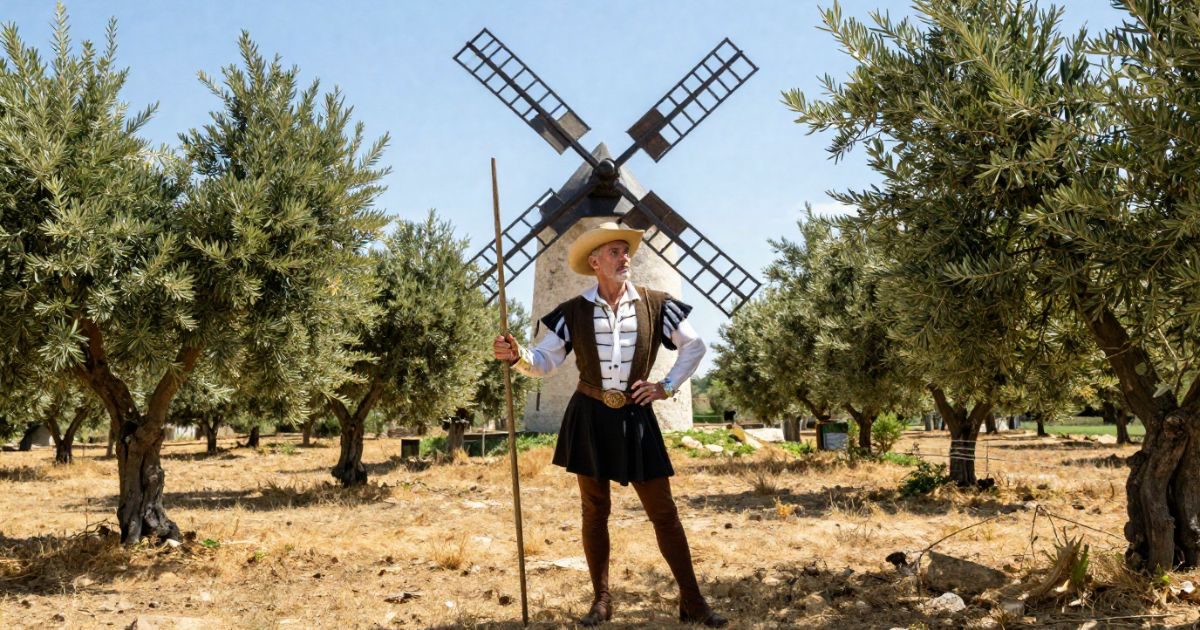
Don Quixote listens with the greatest attention while the ragged knight of the Sierra thanks him for courtesy he cannot yet repay. Quixote had resolved not to quit these mountains until he found him, to relieve the sorrow if it admits of relief, or to join in lamenting it, and he swears by the order of knighthood to serve him. The Knight of the Thicket stares from head to foot, then asks, if they have anything to give him to eat, for God's sake to give it, and after he has eaten he will do all they ask. Sancho from his sack and the goatherd from his pouch furnish him. He gorges rather than swallows, utters no word, then signs them to a green plot round the corner of a rock, stretches on the grass, and warns that they must promise not to break the thread of his sad story with any question, for the instant they do so the tale will come to an end. The warning reminds Quixote of Sancho's goats that were never finished. He gives the promise for himself and the others.
The man begins. His name is Cardenio, his birthplace one of the best cities of Andalusia, his family noble, his parents rich, his misfortune so great that wealth cannot lighten it. He loved Luscinda from his earliest years, and she him, until her father, like Thisbe's, refused him the house and they wrote instead of speaking. He asked her for his lawful wife; her father said the demand belonged to Cardenio's father. That same hour the father put into his hand a letter from Duke Ricardo, a grandee of Spain, asking that the son be sent as companion, not servant, to the eldest boy. Two days later he departed, with Luscinda's vows and her father's promise to defer her hand. At the duke's house envy worked among the old servants, but the second son, Fernando, a gallant of noble, generous, and amorous disposition, made him so intimate a friend that no secret remained unshared. Fernando was deep in love with a beautiful peasant vassal and determined to pledge his word as husband. Cardenio tried to dissuade him, then to tell the duke; Fernando, seeing that a good servant could not conceal it, proposed they both go to Cardenio's city to buy horses and let absence cool the passion. In fact he had already enjoyed the girl under the title of husband and wanted to avoid keeping the promise.
They arrive. Cardenio, to his sorrow, extols Luscinda so warmly that Fernando desires to see her. One night at a window, by the light of a taper, she in her dressing-gown drives all other beauties out of his recollection. He reads their letters under pretence of enjoying their wit, and finds a note begging Cardenio to demand her of her father. Then Luscinda asks for a book of chivalry she is very fond of, Amadis of Gaul. Don Quixote no sooner hears the title than he breaks the pact: had he known her taste, no other laudation would have been needed; he has more than three hundred such books, or had them until envious enchanters intervened, and he cannot help talking of knights-errant any more than the sun can help giving heat. Cardenio lets his head fall on his breast. When he raises it he cannot get rid of the idea that Master Elisabad made free with Queen Madasima. Quixote, in high wrath, calls it villainy and will give the lie on foot or on horseback. The mad fit comes on. Cardenio snatches a stone and lays the knight on his back. Sancho attacks with his fist and is crushed under him; the goatherd shares the same fate. The Ragged One withdraws to his hiding-place. Sancho, raging, seizes the goatherd by the beard for not warning them, though the man says he did. Quixote makes peace, then asks if Cardenio can be found, for he feels the greatest anxiety to know the end of the story. The goatherd can give no certainty of the lair, only that if they wander this neighbourhood they cannot fail to fall in with him, either in or out of his senses.
The listener who breaks a promise can stop the wound from finishing its sentence. Cardenio eats, asks them not to interrupt, and begins: love for Luscinda, the duke's summons, and Fernando's growing treachery as he reads their letters and courts her in secret. When Luscinda asks for Amadis of Gaul, Quixote breaks the pact and praises her taste for chivalry until Cardenio falls silent. Then Quixote pardons himself for interrupting and urges him to continue. Cervantes makes the cost visible: not only what the characters suffer, but what bystanders must decide once the story can no longer stay private. The chapter asks whether comfort, silence, or intervention is the truer form of care when someone is living inside a plot of their own.
Explore this chapter with AI to uncover deeper meaning and practical takeaways.
AI Discussion