
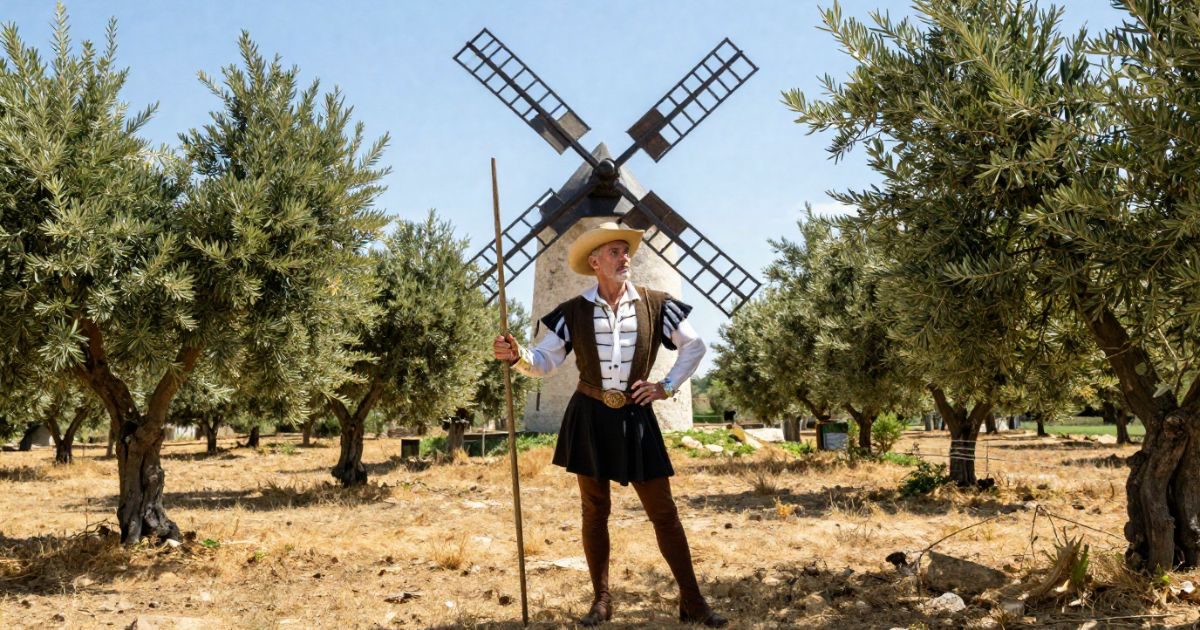
Sancho finally gets leave to speak and asks why Quixote interrupted Cardenio over Queen Madasima when the man was already out of his wits. Quixote will not concede the point. Against men in their senses or against madmen, every knight-errant is bound to stand up for the honour of women, especially a queen of such dignity, and the vulgar lie who call Master Elisabad her lover. Sancho strings proverbs until he is told to prod his ass and keep out of chivalry. Then the real errand of the mountains comes out. Quixote is not hunting the madman so much as hunting an achievement: to copy Amadis, the polestar of knights, who as Beltenebros did penance on the Peña Pobre. Cleaving giants is hard. Weeping in a wasteland is available, and this rugged place offers its forelock.
Sancho objects that legendary knights went mad when they had proof of betrayal, and Dulcinea has not scorned Quixote because she does not know he exists. Quixote calls that the point. There is no thanks to a knight who turns crazy with cause. The beauty is to turn crazy without provocation, so she may know what he would do in the moist if he does this in the dry. They fight over Mambrino's helmet versus a dinted barber's basin that Sancho means to take home and trim his beard in. Sancho begins to suspect kingdoms and islands are wind and lies. Quixote answers that enchanters change everything according as they wish to aid or destroy, and that the sage on his side made the helmet look like a basin so the world would not rob him. He chooses a high peak, a brook, and a green meadow, frees Rocinante with a slap on the croup, and announces that Sancho must watch him tear garments, scatter armour, and knock his head on the rocks. Sancho begs him, if knocks are required, to take them against water or cotton and leave the telling to a squire who will swear the rock was harder than a diamond.
Quixote will not lie even by substitution. The knocks must be real, solid, and valid, and they will need lint because the balsam is already lost. Paper is missing too, so the letter and the ass-colt order go into Cardenio's notebook, to be copied by a schoolmaster or a sacristan, never a notary. The love letter need not be signed in his own hand. Dulcinea can neither read nor write, and in twelve years he has not seen her four times. Sancho then learns that the exalted lady is Aldonza Lorenzo, who can fling a crowbar and whose voice carries half a league from a belfry. Quixote answers with the widow who chose a stupid lay-brother because, for all she wanted with him, he knew more philosophy than Aristotle. For all he wants with Dulcinea, she is as good as the most exalted princess on earth. He pictures her as he would have her be. Helen and Lucretia do not come up to her.
He reads the pierced-by-absence letter and an order on his niece for three ass-colts dated from the heart of the Sierra Morena. Sancho wants to ride at once without watching more fooleries. Quixote insists on a witness, strips to his shirt, and turns somersaults heels over head so the squire can swear without a weight on his conscience. Sancho marks the path with broom branches, as Theseus used a clue, and leaves his master among the rocks, satisfied that madness has been seen.
Sancho finally gets leave to speak and asks why Quixote interrupted Cardenio over Queen Madasima when the man was mad anyway. Quixote insists a knight must defend any queen's honour, then admits he is in the mountains mainly to imitate Amadis as Beltenebros and do penance for Dulcinea. Sancho objects: legendary knights went mad when rejected, but Dulcinea has not scorned Quixote because she does not know he exists. Quixote calls that the point, the beauty being to turn crazy without provocation. They fight over Mambrino's helmet versus a barber's basin; Sancho learns Dulcinea is Aldonza Lorenzo, a peasant woman he knows well. Cervantes makes the cost visible: not only what the characters suffer, but what bystanders must decide once the story can no longer stay private. The chapter asks whether comfort, silence, or intervention is the truer form of care when someone is living inside a plot of their own.
Explore this chapter with AI to uncover deeper meaning and practical takeaways.
AI Discussion