
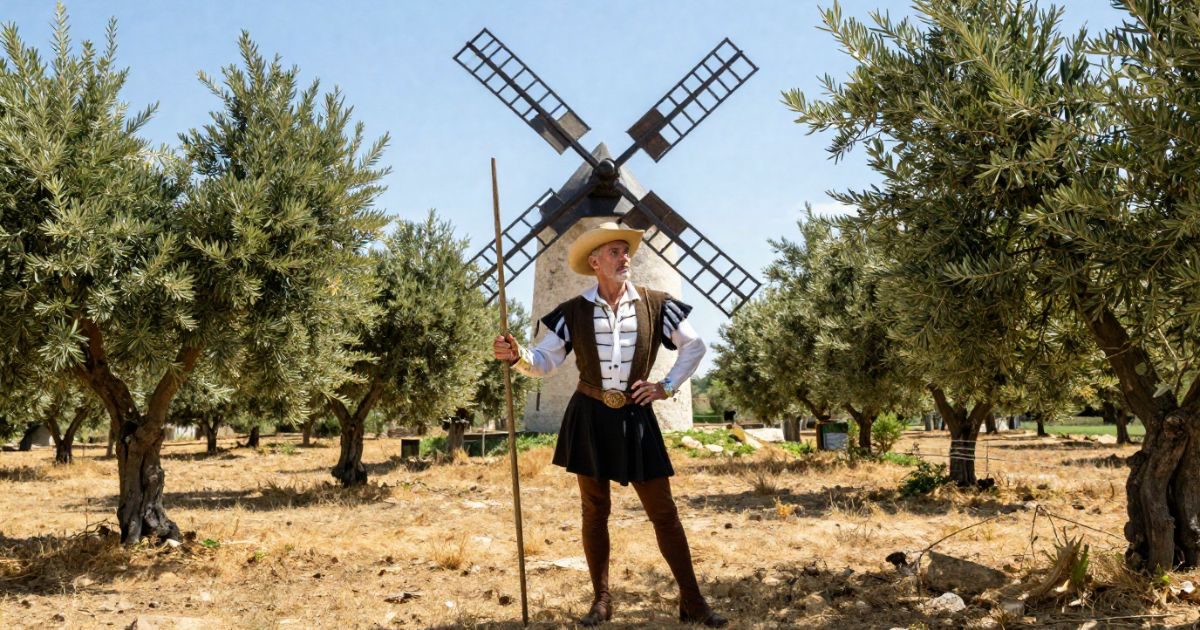
Seeing himself so served, Don Quixote tells Sancho that to do good to boors is to throw water into the sea, and that if he had believed the squire he would have avoided this trouble. Sancho answers that his worship will take warning as much as I am a Turk, but chivalry is of no account with the Holy Brotherhood, who do not care two maravedis for all the knights-errant in the world; he fancies he hears their arrows whistling past his ears this minute. Quixote calls him a coward by nature, yet this once he will withdraw, on condition that never, in life or in death, Sancho is to say he retired from fear, only in compliance with entreaties, or the lie is given from this time to that. Sancho answers that to retire is not to flee, and that they have more need of legs than hands. They enter the side of the Sierra Morena, meaning to come out at El Viso or Almodóvar del Campo and hide among the crags. That night they camp between two rocks among cork trees. Gines de Pasamonte, driven by the same fear, reaches the same spot, waits until they sleep, and steals Dapple, not troubling himself about Rocinante, a prize no good to pledge or sell.
Aurora brings sadness to Sancho. He finds the ass missing and begins the saddest lament in the world: son of my bowels, born in my very house, my children's plaything, my wife's joy, the envy of my neighbours, and half supporter of myself on six-and-twenty maravedis a day. Quixote promises a letter of exchange for three out of five ass-colts at home. Sancho dries his tears. The knight is rejoiced to be in mountains that recall marvellous adventures; Sancho, laden with what Dapple used to carry, has no care but to empty the sack into his paunch. Then Quixote's pike lifts a rotten saddle-pad and a valise still chained and padlocked. Inside are four shirts of fine holland, other linen, a handkerchief of gold crowns amounting to near a hundred, and a richly bound memorandum book. Quixote tells Sancho to take the money and keep it. The first page is a sonnet to Chloe, or Love, or fate; Sancho hears a clue in it. Next is a prose letter from a rejected lover: thy false promise, a wealthier rival, peace be with thee who hast sent war to me. Sancho rips every seam of the pad lest anything escape, and holds the blanket flights, balsam vomits, stake benedictions, and stolen coat cheap at the price of this treasure-trove.
On a height a man springs from rock to rock, unclad, black-bearded, long-haired, in ragged tawny velvet breeches. Rocinante cannot follow such ground. Sancho will not take a short cut, for when he separates, fear lays hold of him, and besides, if they find the owner of the crowns it is plain he must restore them. Quixote says that now they have a suspicion they are bound to seek him. In a ravine they find a mule saddled and bridled, dead and half devoured by dogs and jackdaws. A whistle brings an old goatherd down from a flock. He will not lift the valise for fear of being charged with theft; Sancho, hearing him, claims he would not go within a stone's throw of it either. The goatherd's tale is this: about six months ago a well-bred youth on that same mule asked for the most rugged and retired part of the sierra, then vanished, later cuffed a shepherd and took bread and cheese by force. They found him in a cork-tree hollow, dress torn, face burned, working out a penance, promising henceforth to ask in God's name. In a fit he attacked the nearest man, crying Oh faithless Fernando, here shalt thou pay the penalty. Yesterday four lads resolved to take him, by force or consent, to Almodóvar to cure him or learn who he is.
Chance arranges it better. In a gorge the youth appears, talking to himself, wearing a tattered amber-tanned doublet that argues he is not of very low rank. He greets them hoarse but courteous. Don Quixote dismounts and holds him close in his arms as if he had known him a long time. The other, whom we may call the Ragged One of the Sorry Countenance, as Don Quixote was of the Rueful, pushes him back a little, places his hands on the knight's shoulders, and stands gazing as if to see whether he knew him, not less amazed at the face, figure, and armour than Quixote is at him. The first to speak after the embrace was the Ragged One, and he said what will be told farther on.
Every act of mercy can bill you twice: once on the road and again in the hills. After the galley-slave disaster Quixote admits that doing good to boors is throwing water into the sea, then retreats into the Sierra Morena while insisting he is not fleeing from fear. Gines de Pasamonte steals Dapple in the night. Sancho wails; Quixote promises ass-colts from home. They find a saddle-pad, gold, fine linen, a love sonnet, and a rejected lover's letter, then spot a naked man leaping among the rocks. Cervantes makes the cost visible: not only what the characters suffer, but what bystanders must decide once the story can no longer stay private. The chapter asks whether comfort, silence, or intervention is the truer form of care when someone is living inside a plot of their own.
Explore this chapter with AI to uncover deeper meaning and practical takeaways.
AI Discussion