
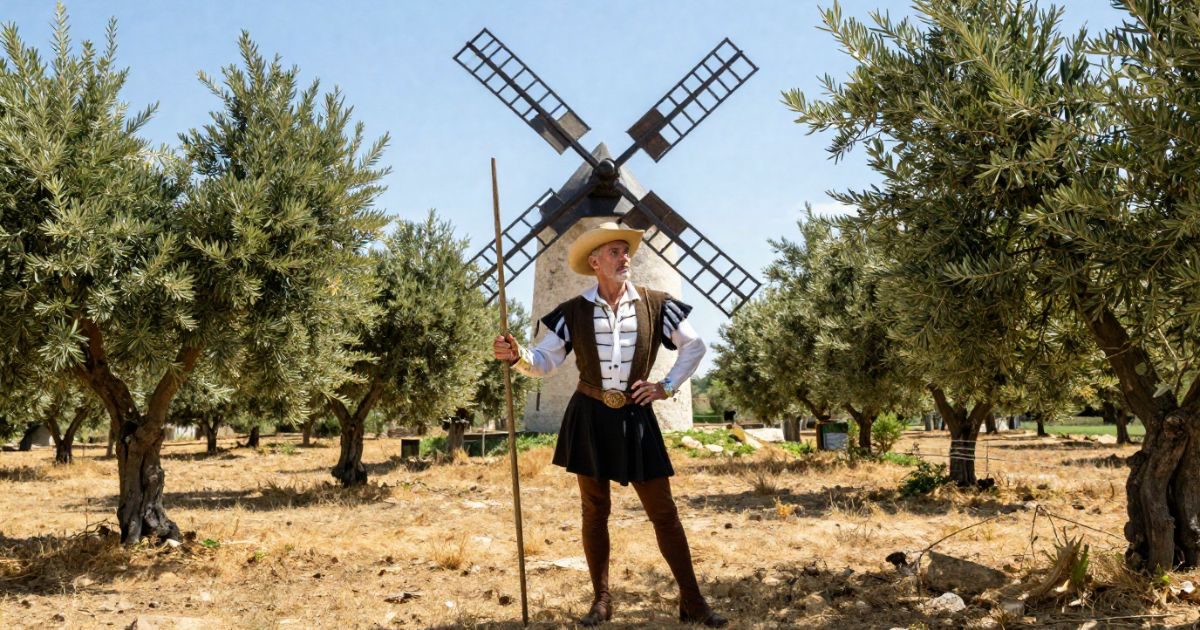
At dawn five of the six goatherds rouse Don Quixote for Chrysostom's burial. They have not gone a quarter of a league when they meet six shepherds in black sheepskins, crowned with cypress and bitter oleander, and two men of quality on horseback with three servants. All are bound for the same grave. One rider, Vivaldo, already calls Marcela a homicide shepherdess from what the mourners have told him that morning.
Vivaldo asks why a man goes armed in so peaceful a country. Quixote answers that ease is for courtiers and toil for knights-errant, then traces the order from King Arthur and the Round Table through Amadis, Tirante el Blanco, and Don Belianis. The travellers set him down as mad. Vivaldo keeps him talking: the calling is more austere than a Carthusian's, yet knights commend themselves to ladies rather than to God in the charge. Quixote will not omit the lady, and says no true knight lacks one, Don Galaor being a swallow that does not make summer. Pressed for a name, he sighs out Dulcinea of El Toboso, a princess whose hairs are gold and whose eyes are suns, of a lineage modern enough to furnish gentle blood for ages to come. Sancho alone half believes, knowing his neighbour from birth, yet he has never heard of any such princess though he lives close to El Toboso.
Twenty shepherds then come down between two mountains with a flower-covered bier. Ambrosio confirms the rock: here Chrysostom first saw that mortal enemy of the human race, declared an honourable passion, and was scorned. He eulogises a phoenix in friendship who wooed a wild beast and pursued the wind, and says the papers on the bier must burn after the body is laid in the earth. Vivaldo will not let Augustus Caesar's fault be repeated; he snatches some sheets so Marcela's cruelty may live as a warning. Ambrosio grants those already taken and no more. Vivaldo opens the last paper the unhappy man wrote. Its title is Lay of Despair, and he is to read it aloud while the grave is dug.
At dawn the goatherds rouse Don Quixote for Chrysostom's burial. On the road they meet mourning shepherds and two gentlemen, Vivaldo and his companion, who already know Marcela's story from Pedro's account. Vivaldo draws Quixote out on knight-errantry: Arthur and the Round Table, hardship versus monks, ladies commended before God in battle, and the rule that no true knight lacks a lady. Quixote names Dulcinea of El Toboso and describes her with every poetic hyperbole while Sancho alone half believes. The travellers decide he is mad but keep him talking until the grave. Cervantes makes the cost visible: not only what the characters suffer, but what bystanders must decide once the story can no longer stay private. The chapter asks whether comfort, silence, or intervention is the truer form of care when someone is living inside a plot of their own.
Explore this chapter with AI to uncover deeper meaning and practical takeaways.
AI Discussion