
John Stuart Mill doubted that any mechanical invention had lightened any person's day of toil. Marx replies that lightening toil was never the capitalist's aim. A machine is bought to cheapen goods and to shrink the part of the day in which the worker works for himself, so that the part he gives free to the capitalist grows. To see how, Marx asks what a machine really is. Some writers call a machine a complex tool. Others say it is anything not driven by human muscle, which would make an ox-drawn plough a machine and Claussen's circular loom, weaving 96,000 picks a minute under one labourer's hand, a mere tool. John Wyatt began the industrial revolution in 1735 with a spinning machine, and never mentioned that an ass might drive it. He called it a machine "to spin without fingers". For Marx the break comes when the working tool leaves the hand and is fitted into a mechanism. A person can work only as many tools as he has hands and feet. German spinners found two wheels at once too hard, while the Jenny spun with twelve to eighteen spindles from its birth. Once the tool is detached, any force can drive it. The horse was the worst, since it has a head of its own, and wind and water were unreliable and tied to the countryside. Watt's double-acting engine, patented in 1784, made its own force from coal and water, stayed under human control and could stand in a town, so one engine could drive many machines. One envelope machine made over 3,000 an hour, work that once passed through several hands, and a spinning mill or a paper mill became a chain of machines handing the material along without a human touch. The factory turned into "a mechanical monster whose body fills whole factories". It grew from manufacture, which supplied the first skilled mechanics, but soon outgrew them. Iron machines of giant size could not be made by hand, so industry built machines with machines. Henry Maudsley's slide rest replaced the hand that guides a cutting tool, and Nasmyth's steam-hammer could crush granite or tap in a nail. In the old workshop the process was fitted to the worker. Now the process is worked out without regard to human hands, and the worker becomes "a mere appendage" to a system that already exists. Does the machine at least make goods cheaper? Only if it hands on less value than the labour it replaces. It creates no new value. It gives up its own value to the product a little at a time as it wears out, so beyond wear, coal and oil it works for nothing, like a force of nature. Mr. Baynes of Blackburn reckoned that one horse-power drives 450 mule spindles, and that two and a half workers on them turn 366 pounds of cotton into yarn in 150 hours, where a hand spinner would need 27,000. One machine now prints as much four-colour calico in an hour, with a man or boy, as 200 men did by hand. A steam plough does in an hour, for three pence, what 66 men do for fifteen shillings. But the capitalist's own limit is tighter than the labour saved. He pays for labour-power, not for labour, so a machine is worth buying only if it costs less than the wages it displaces. That is why machines are invented in England for use in North America. It is also why the owners of woollen mills, once the Factory Acts forced them to use two sets of half-time children, replaced the half-timers with machines, since parents would not sell them cheaper than full-timers. Where human beings are cheap, machines wait. English women still haul canal boats, because the cost of keeping them is below all calculation.
The first thing capital wanted from the machine was workers who needed no muscle: women and children. Machinery threw the whole family onto the labour market and spread the value of one man's labour-power across four people, who now had to give surplus-labour to keep a home that one wage had kept before. The workman had sold his own labour-power as a nominally free agent. Now, Marx says, he sells wife and child and becomes a slave-dealer. A factory inspector found an advertisement for "12 to 20 young persons, not younger than what can pass for 13 years". The Factory Act let children under thirteen work only six hours, and a certifying surgeon had to confirm their age. According to the inspectors themselves, those surgeons overstated the ages to suit the masters. At Bethnal Green, children from nine years old hired themselves out to the silk makers at a public market every Monday and Tuesday morning, at one shilling and eightpence a week for their parents and twopence "for myself and tea". Women let workhouse children out for half a crown a week, and more than 2,000 boys were still sold by their parents as chimney-sweeps. When Parliament limited children's hours in one trade, owners complained that parents sold them to the trades still free. Marx says capital is by nature a leveller, so a limit in one branch spreads to others. The cost showed in the death register. In Manchester 26,125 of every 100,000 infants under one year died in a year, against about 9,000 in the healthiest districts. An inquiry in 1861 blamed mothers working away from home, and the neglect, opiates and starving that followed. Dr. Julian Hunter found much the same in farming districts on the North Sea, where married women worked in gangs under a contractor called the undertaker. The factory inspector Baker wrote that it would be a happy day when no married woman with a family could work in a textile mill. Parliament at last made schooling a condition for factory children, and the manufacturers made it a sham. Inspectors found certificates signed with a cross because the schoolmaster could not write. One master, asked if he could read, answered "Aye, summat", and added that at least he was ahead of his scholars. In Scotland Sir John Kincaid counted 75 children in a schoolroom 15 feet by 10. In the print works, children made up their 150 school hours in scattered afternoons whenever the printer chose to spare them, and lost it all again at work. Machinery also gave capital new reasons to lengthen the day. The machine is an automaton that would go on producing for ever, were it not for the weak bodies and strong wills of those who tend it, and capital, in the person of the capitalist, wants to wear that resistance down. There is money in it. A machine working sixteen hours a day for seven and a half years passes on no more value than one working eight hours for fifteen, but it earns back its price twice as fast, and it is safer from "moral depreciation", the loss of value when a cheaper or better machine appears. While a machine is still rare, its owner makes extra profit and works it hard, to enjoy "the sunny time of this his first love". Mr. Ashworth, a cotton magnate, told Professor Senior that when a labourer lays down his spade he idles a capital of eighteen pence, but when one of his people leaves the mill he idles £100,000. Marx finds it monstrous that a single worker should ever leave the factory. Yet the capitalist is caught in a contradiction he does not see. Surplus-value comes only from living workers, and a machine replaces workers. He cannot squeeze as much from two men as from twenty-four. To make up for fewer workers, he lengthens the day of those he keeps, and the workers the machine throws out form a surplus population that must accept his terms. So the tool that could shorten labour becomes the surest way to place every moment of the worker and his family at capital's disposal. Aristotle dreamed that if shuttles wove by themselves, masters would need no slaves. Marx adds that the ancients lacked "the bump of Christianity" to see that machines are the best means of lengthening the day.
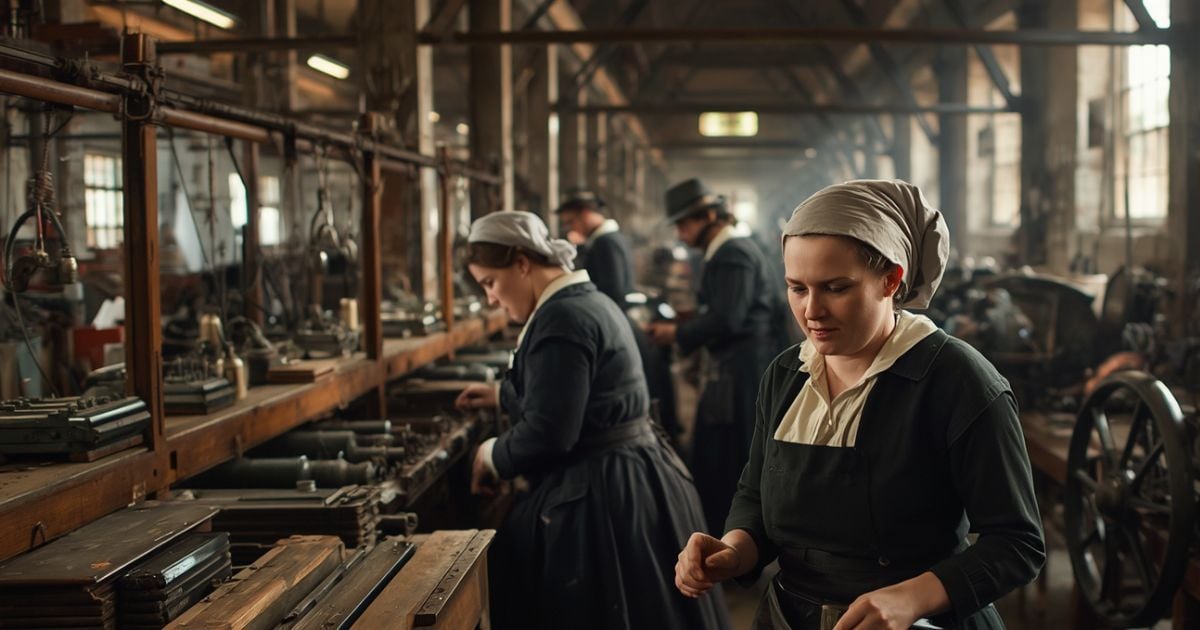
Lengthening the day without limit finally menaced society's own sources of life, and Parliament fixed a normal working-day by law. Capital then turned to the second route: if the day cannot grow longer, make each hour denser. In 1844 the masters swore that nothing more could be got from the attention of their workers. Experiment said otherwise. In April 1844 Robert Gardner cut the day in his two Preston mills from twelve hours to eleven. A year later he had the same output at the same cost, and his weavers' average weekly wage had moved from 10s. 1½d. to 10s. 3½d. The workers gained an hour and the master saved an hour's coal and gas. Once a shorter day became compulsory, machinery became capital's tool for squeezing more labour into it, by speeding the machine and giving each worker more machines to mind. Lord Ashley told the House of Commons that a spinner following a pair of mules walked eight miles in 1815 and twenty in 1832, and that the stretches he put up in a day rose from 1,640 to 4,800 by 1844. Power-loom picks went from 60 a minute in 1819 to 140 in 1842. Even the inspector Leonard Horner, who argued in 1845 that eleven hours could not produce as much as twelve, later admitted he had underestimated how far both machine and man could be stretched. After the Ten Hours Act of 1847, spindle speeds rose by a tenth on throstles and a fifth on mules, and James Nasmyth reported that engines which had given 50 horse-power now gave over 100. Cotton mills grew by 32% from 1838 to 1850 and by 86% from 1850 to 1856. In the silk mills between 1856 and 1862 spindles grew by 26.9% and looms by 15.6% while the number of operatives fell by 7%. In 1863 Mr. Ferrand told the Commons that one weaver now minded three looms without helpers, sometimes four, so that twelve hours of work were packed into under ten. The inspectors praised the Acts, yet admitted that the pace was harming health, and one tied it to the lung disease Dr. Greenhow had found in the cotton, worsted and silk mills. Marx expects that this too must end in a call for shorter hours. Now he walks inside the factory. Dr. Ure, whom he calls the Pindar of the automatic factory, hails the factory as a vast automaton and the steam engine as an autocrat who summons "his myriads of willing menials". Marx notes that Ure has run two pictures together: workers using machines in common, and a machine using workers. Capital's factory is the second. The skill passes from the hand to the machine along with the tool. What is left is machine-minders, a crowd of child attendants, and a small separate class of engineers. Because the work is easy to learn, people can be swapped at will, as the masters' relay system showed in 1848 to 1850. "In handicrafts and manufacture, the workman makes use of a tool, in the factory, the machine makes use of him." The knowledge that built the machine now belongs to the master, and he tells his hands that their skill is of a low sort that six months' education can teach. Discipline is a barracks, with overlookers as sergeants and workers as private soldiers. The master writes the factory code himself, and the overlooker's book of penalties replaces the slave-driver's lash. A footnote shows how it works. At Westbury Leigh a cloth maker named Harrup fined weavers sixpence for two minutes' lateness, had a boy blow the start whistle early, and kept no clock in the mill. Heat, dust, deafening noise and the yearly list of the killed and wounded complete the picture, and Marx asks whether Fourier was wrong to call factories "tempered bagnos".
Workers did not take this quietly, and Marx now turns to their strife with the machine. Lancellotti, writing in 1579, tells how the mayor of Danzig feared that a ribbon loom weaving four to six pieces at once would throw workers on the streets, so he had the inventor, Anthony Müller, secretly strangled or drowned. Leyden banned the loom after riots, Hamburg burnt it in public, and an imperial edict forbade it across Germany in 1685. In 1758 a crowd of 100,000 who had lost their work set fire to Everet's water-driven wool-shearing machine. In the first fifteen years of the nineteenth century the Luddites broke power-looms, and the government used it as a pretext for harsh measures. It took time and experience, Marx says, for workers to learn to attack not the machine but the way capital uses it. The cost of defeat was heavy. The English hand-loom weavers died out over several decades until 1838, many of them starving and many living on twopence halfpenny a day. In India the Governor General reported in 1834 and 1835 that the bones of the cotton-weavers were bleaching the plains. Economists call all this "a temporary inconvenience". Marx answers that machinery keeps seizing new fields, so its temporary effect becomes permanent. During the American Civil War a Manchester manufacturer went from 75 carding engines to 12. Between 1861 and 1868, 338 cotton factories disappeared, power-looms fell by 20,663 while their output rose, and spindles grew by 1,612,541 while operatives fell by 50,505. Machines are also a weapon against strikes. After the engineers' strikes of 1851, Nasmyth cut his grown-up men from 1,500 to 750, saying that every boy can now watch "the beautiful labour of the machine". Ure cheered the self-acting mule as proof that when capital enlists science "the refractory hand of labour will always be taught docility". Then comes the economists' comfort, the theory of compensation. Mill, MacCulloch, Senior and others claim that a machine which displaces workers sets free enough capital to employ the same workers again. Marx tests it on a carpet factory with 100 men at £30 a year, a wage bill of £3,000, and raw material costing £3,000. The owner discharges 50 men and spends £1,500 on a machine. Before, half his £6,000 was variable capital. Now only £1,500 is, and the £6,000 can employ no more than 50 men. Nothing was set free. The £1,500 of food the discharged men used to buy was never capital to them, only goods they bought with their wages. They have turned from buyers into non-buyers, demand falls, and the workers who made their bread are "freed" in turn. Even if the sacked men find new work, it comes from fresh capital, not from the old, and they are crippled by their narrow trade, so most of those in transition starve. The economists then say the harm comes from the capitalist use of machines and not from machines. Marx retells the defence of Bill Sykes, who admits that the commercial traveller's throat was cut but blames the knife. Some trades do grow with machinery. Cotton spinning drove the growth of slavery in the United States, whose slaves rose from 697,000 in 1790 to nearly four million in 1861. Ireland's people fell by nearly half in twenty years to suit its landlords and the English woollen manufacturers. The new industries of gas, telegraphs, photography, steam navigation and railways employed only 94,145 people in England and Wales in 1861. Domestic servants numbered 1,208,648, more than all those in textile factories and mines put together at 1,208,442.
Marx next shows how the factory both throws workers out and calls them back. Between 1860 and 1865, in the district of the inspector Mr. Baker, looms rose by 11% and spindles by 3% while the number of workers fell by 5½%. Yet factories can still employ more people overall. If a weekly capital of £500 shifts from three-fifths wages to one-fifth, two-thirds of the men go. Let that capital grow to £2,000, and 400 men are employed, where the old way would have needed 1,200. Machines also reach abroad. By ruining handicrafts in other lands, they turn those lands into suppliers of raw material, and so India was made to grow cotton, wool, hemp, jute and indigo for Britain, and Australia became a colony for growing wool. The system lives by jumps, and its life is a cycle of moderate activity, prosperity, over-production, crisis and stagnation. The cotton trade shows the pattern year by year. From 1770 to 1815, while England held a monopoly, only five years were bad. From 1815 to 1863, twenty-eight of forty-eight years were depression. In 1842 the masters locked their hands out to force the repeal of the Corn Laws, and in 1847 they cut wages by ten per cent or more "in honour of the big loaf". Then the American Civil War brought the cotton famine, which Marx says came "in the nick of time" for manufacturers with glutted warehouses. By October 1862, 60.3% of spindles and 58% of looms stood still. Mills that did run used poor Surat cotton and loaded the thread with size, so that one cloth weighing 8 pounds held 2¾ pounds of size. Piece-rates fell, and Mr. Redgrave found self-acting minders taking home 6s. 11d. for a fortnight after rent was deducted, and weavers earning from 2s. to 6s. a week. Marx likens the owners' constant changes of cotton and size to experiments on a worthless body, and the workers paid for them with their lungs, their pay and, in some towns, famine fever. Machinery then reaches the old trades. Adam Smith's ten men made 48,000 needles a day, but one machine now makes 145,000, and one girl minding four machines makes about 600,000. At Coventry, the "cottage factories", where weavers rented steam power by the loom, were all ruined within twelve years, all 300 of them. Steel pens fell from £7 4s. a gross in 1820 to between 2d. and 6d. Capital also keeps an unseen army working at home. The Londonderry shirt factory of Messrs. Tillie employs 1,000 people inside and 9,000 in their own houses. The squeeze is harshest where no machine has yet come. Birmingham's hardware trades use 30,000 children and young persons and 10,000 women, and London printing houses have won the name of "slaughterhouses". At a tile-field in Mosley, a young woman of 24 made 2,000 tiles a day with two little girls who carried 10 tons of clay up the slippery sides of a pit 30 feet deep. One of the better brickmakers told a chaplain that you might as well try to improve the devil. Dr. Simon's table of deaths shows London tailors and printers dying faster between 25 and 35 than farm workers, at 958 and 894 per 100,000 against 743. Lace shows the same horror at home. Of 150,000 people making lace in England, only about 10,000 came under the Factory Act of 1861, and almost all the other 140,000 were women, young persons and children. Dr. Trueman of Nottingham found that among his female patients who were lace-makers, consumption rose from one in 45 in 1852 to one in eight in 1861. In the "mistresses' houses", children started at six, sometimes under five, with 67 to 100 cubic feet each, where an English soldier had 500 to 600. In Nottingham 14 to 20 children were packed into a room perhaps 12 feet square for fifteen hours out of twenty-four. The youngest never raised their eyes from the work, and the mistress used a long stick. A commissioner wrote, "Their work is like slavery." At night the capitalist handed children a bundle to finish, saying "That's for mother", though he knew they had to sit up to help. In the straw-plait schools, children of three or four were set a task of thirty yards a day, and one commissioner said they had less than half the room a child would have if packed in a box three feet each way.
But even this cheap labour meets a limit, and then the hour strikes for the machine. In clothing, 1,024,277 people worked in England and Wales in 1861, as many as in farming. The sewing machine hit every branch at once. It sent the youngest children away, lifted the wages of machine hands above those of house-workers, and lowered those of the handicraftsman. London's deaths from starvation rose in step with machine sewing, and in workrooms with 30 to 40 machine hands, Mr. Lord saw three or four faint every day. Steam gave the finishing blow, as small owners of machines were crushed by big capitalists. The law pushes the same way. Extending the Factory Acts forces masters to buy more machinery and use steam, and small masters decline. The masters cried that the Acts would ruin them, as the potters did. In 1864 the potteries were brought under the Act, and within sixteen months every "impossibility" had vanished, with exports up. A dipping machine appeared in the match trade once boys could no longer dip matches while bolting their dinner. "No poison kills vermin with more certainty than the Factory Act removes such everlasting barriers." Capital accepts change only "under the pressure of a General Act of Parliament". Marx calls factory legislation the first conscious and methodical reaction of society against a system that grew by itself. Its sanitary clauses are meagre. In Ireland's 1,800 scutching mills, women and girls from the farms were hurt so often that at Kildinan, near Cork, six died and sixty were mutilated in four years, though a few shillings of guards would have prevented every case. Dr. White wrote that in many cases a quarter of the body is torn from the trunk. Doctors want 500 cubic feet of air per worker, but enforcing it would expropriate thousands of small employers, so the law stalls. Yet the school clauses prove something. Children who spend half the day in school learn as much as full-time pupils, and Robert Owen saw in the factory the germ of an education that joins work, lessons and exercise. The printing machine shows the other side. It sets boys of 11 to 17 to feed sheets for fourteen to sixteen hours, sometimes 36, and sacks them at seventeen as "recruits of crime". Modern industry, Marx says, "compels society, under penalty of death", to replace the detail-worker, "the mere fragment of a man", with a person fit for many kinds of work. The old family is broken too, and the 1866 commission found that children most need protection against their parents. Some masters themselves ask for the law. The Bristol nail makers Cooksley complained that their boys were enticed away after six, and a paper-box maker named Simpson said he could never rest at night, lest others be working later than he. The commission wanted the Acts applied to more than 1,400,000 children, young persons and women. The Factory Acts Extension Act of 15 August 1867 and the Workshops' Regulation Act of 21 August followed, and the second was left a dead letter in the hands of local authorities. When inspectors took it over in 1871, they gained over 100,000 workshops and only eight assistants. The coal mines were worse. A Select Committee's report in 1866 ran to five lines, saying more witnesses must be heard, and mine-owners sat on the panel cross-examining the miners. In 1865 there were 3,217 coal mines and 12 inspectors, so each mine could be visited once in ten years. Marx concludes that extending the Acts will ruin the small trades, remove the last refuge of the "redundant population", and sharpen the contradictions that will break the old order. Farming goes the same way. Machines there displace labourers more fiercely, the peasant is wiped out and replaced by the wage-labourer, and the food and clothing that cities consume never return their elements to the soil. Every gain in robbing the worker is a gain in robbing the soil, and capitalist production develops technology only by sapping the original sources of all wealth, the soil and the labourer.
Marx understood that machinery itself isn't evil—it's who controls it that matters. The same factory system that ground down workers in 1867 could have liberated them if they owned the machines. Today, we face identical choices with digital platforms, artificial intelligence, and automation. Amazon's algorithms could help workers organize more efficiently, but instead they prevent bathroom breaks and fire people for productivity metrics. Uber's app could be owned by drivers as a cooperative, but venture capital ensures profits flow upward. Even healthcare technology—from electronic records to diagnostic AI—gets designed to extract maximum revenue rather than improve patient outcomes. The cruel irony is that we have the technical capability to create genuine abundance and reduce human suffering, but our economic system transforms every innovation into a new form of exploitation. This isn't inevitable—it's a choice. Worker-owned cooperatives, open-source software, and community-controlled infrastructure prove alternatives exist. The question isn't whether technology will reshape society, but whether we'll organize to ensure it serves human needs rather than capital accumulation. When you hear promises about how new technology will solve social problems, ask the Marx question: who owns it, who controls it, and who captures its benefits?
Explore this chapter with AI to uncover deeper meaning and practical takeaways.
AI Discussion