
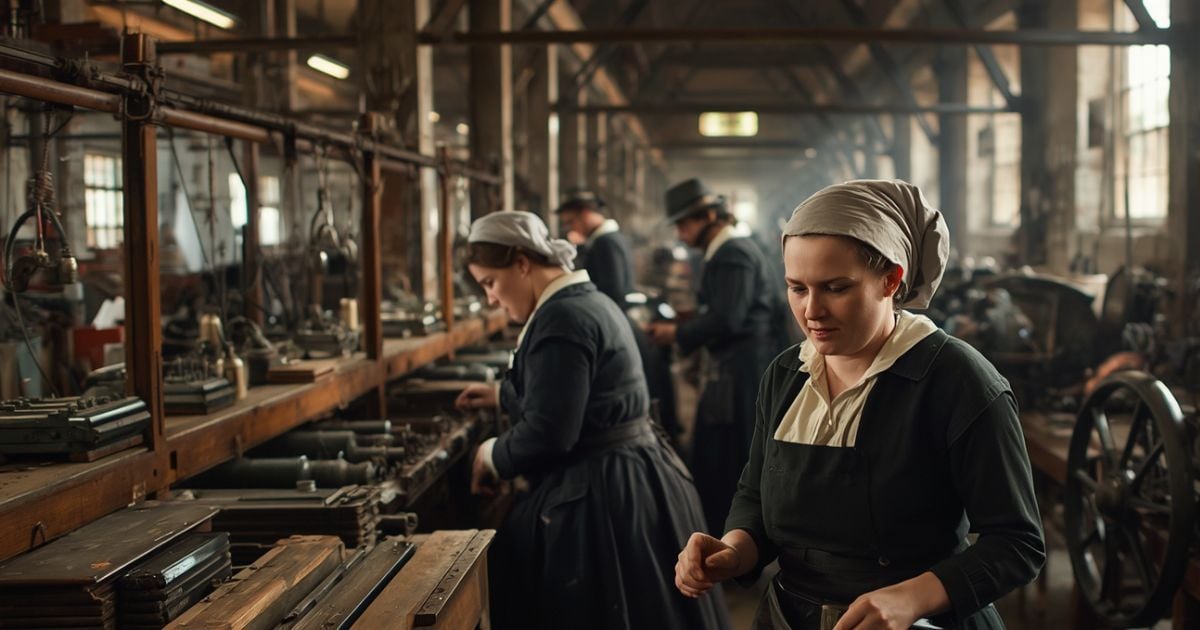
Marx starts with a carriage. Wheelwrights, harness-makers, tailors, locksmiths, upholsterers, glaziers, painters and gilders once worked as independent craftsmen. Now one capitalist gathers them into one building. At first they only work into one another's hands, but each man is busy with carriages alone, and he slowly loses the skill to practise his whole old trade. What he keeps is a narrow motion, done better than before. The second route runs the other way. A capitalist hires a crowd of papermakers, type-makers or needlemakers, each of whom makes the whole article. Then a bigger order has to be filled in a fixed time, so the job is cut into pieces and every man is given one, all done at the same moment. A needlemaker in Nuremberg did perhaps twenty operations one after another. In England twenty needlemakers stand side by side, each doing one, and each of those is cut up again. Both routes end in the same place: a productive mechanism whose parts are human beings. Since every step must still be done by hand, skill stays the base, and that is why each man is tied for life to one fragment, with his labour-power turned into the organ of it.
Take the man at the bench. A worker who repeats one simple act all his life turns his whole body into the tool for it. He does it faster than the craftsman who changes tasks, because the gaps in that craftsman's day, spent moving from one place or tool to another, close up. The small tricks the detail worker learns are kept and handed down among the generations working together. Marx sets beside him the weaver of Dakka, whose muslins have never been surpassed. That weaver works alone, to a customer's order, on a loom of rough branches and bars in the open air, and his skill comes down from father to son. So manufacture does not invent skill. It takes the division of trades it finds in society and drives it to an extreme inside the workshop. Tools change as well. Once the jobs are separated, each needs its own implement, and Birmingham alone makes 500 kinds of hammer, some of them for different steps of one process. Marx adds that this builds one condition for machinery, which is a combination of simple tools.
Marx then sorts manufacture into two kinds. In the first, parts made separately are fitted together, and his example is the watch. It was once the work of one Nuremberg craftsman. Now a crowd of mainspring makers, dial makers, case makers, screw makers and gilders make it, and the last man puts the pieces together and hands over a going watch. Whether they share a shop is chance. Around Vaud and Neufchâtel they work as separate craftsmen, while Geneva has large watch workshops under one capitalist. Even there the dial, the springs and the case are seldom made on the premises, because scattering the work saves the capitalist the cost of workshops. The second kind is the finished form. A wire for needles passes through the hands of 72, sometimes 92, different workers. The steps that once followed one another in time now happen side by side in space, so more needles come out in the same hours. Each worker also depends on the next, so no one may spend more than the time his step needs. That pace stops being the result of competition and becomes a technical law of the shop. Steps take unequal time, so the numbers must fit. In type-making, four founders and two breakers serve one rubber, since the founder casts 2,000 type an hour, the breaker breaks up 4,000 and the rubber polishes 8,000. In a glass house, five men at each furnace mouth, the bottlemaker, blower, gatherer, putter-up and taker-in, form a group called 'the hole', and the whole body is paralysed if one member is missing.
Out of this grows the collective labourer, the special machinery of the manufacturing period. A detail worker's one-sidedness is a weakness alone, but it becomes a strength inside the group. Because the jobs need different training, manufacture also builds a ladder of labour-powers with a matching scale of wages. At the bottom it makes something handicraft never had: the unskilled labourer, who is given the simple tasks anyone can do. The cost of apprenticeship vanishes for him and shrinks for the skilled man, so the value of labour-power falls for both. Marx spells out who gains. Whatever shortens the time needed to produce the labourer's keep lengthens his surplus labour, so the fall is a direct gain for capital. Then he asks whether dividing work inside a workshop is the same as dividing it across a society. Adam Smith thought the difference was only what an observer can see at one glance. Marx says it is a difference in kind. The cattle-breeder, the tanner and the shoemaker are linked because they sell their products to one another. The detail labourer produces no commodity at all. Only the common product of all the detail labourers becomes one, and what links them is that one capitalist has bought their labour-power and uses it as combined labour-power.
Inside the workshop, an iron law of proportion places set numbers of men at set tasks, under the undisputed authority of the capitalist. Outside it, independent producers answer only to competition, and swings in market prices decide how much of society's time goes into each trade. Marx notes that the same bourgeois mind praises workshop discipline and the life-long tying of a man to one operation, yet denounces any plan to regulate production for society as an attack on property, freedom and the individual capitalist. The worst its apologists can say against such a plan is that it would turn society into one immense factory. Older societies show the reverse. An Indian village community of anything from 100 acres to several thousand has a fixed division of labour, laid down like a plan. A chief inhabitant is judge, police and tax-gatherer in one, and beside him stand a book-keeper, a water-overseer, a Brahmin, a schoolmaster, a smith, a carpenter, a potter, a barber and a washerman, about a dozen people kept by the whole community. Yet each smith or carpenter works his whole craft in the old way, on his own, so there is no division inside a workshop. The guilds did the same by law. They limited the apprentices and journeymen a master could hire, so he could not become a capitalist, and a merchant could buy any commodity but not labour. The craftsman stayed joined to his means of production like a snail to its shell. Division of labour inside the workshop, Marx concludes, is a special creation of the capitalist mode of production alone.
In the last section, the capitalist grows more necessary. A given division of labour fixes the least number of workmen he must hire, and more division needs more workmen, more tools and still more raw material, so the minimum capital in every capitalist's hands must keep rising. The collective worker belongs to him, so the power that comes from combined labour looks like the power of capital. For the worker the cost is severe. Manufacture 'converts the labourer into a crippled monstrosity', as in La Plata they butcher a whole beast for its hide or tallow. Once he sells himself, his labour-power can work only inside the capitalist's shop. What each detail labourer loses is gathered in the capital that employs him: to make the collective labourer rich in social productive power, each labourer must be made poor in individual productive powers. Marx cites a glass-works manager who is asked how young workers are kept steady and answers that they are just the same as parts of a machine. He cites Adam Smith on the stupefied detail labourer, and Garnier, who replies that teaching the masses would break the first law of the division of labour. Marx calls manufacture a refined and civilised method of exploitation, a way of producing relative surplus-value. Yet it never fully mastered its workers. Skilled men insisted on seven-year apprenticeships, and Ure complained that the more skilful the workman, the more self-willed he becomes. Order was missing, Ure says, until Arkwright created order. The workshop that made tools had grown from the same division, with a different workman for the file, the drill and the lathe. It now produced machines, and machines sweep away the handicraftsman's skill as the base of production, taking with them both the technical reason for tying a man to one fragment and the fetters that held back capital.
Marx identified something we're living through right now: the more specialized our jobs become, the more helpless we become as complete human beings. Think about how many people can't cook, can't fix basic household problems, can't understand their own finances, can't help their kids with homework past elementary school. We've become incredibly efficient at narrow tasks while losing the broad competencies that used to define adult capability. This isn't just about work—it's about life. When you can only do one thing really well, you become dependent on systems and other people for everything else. And that dependence makes you vulnerable. If your specialized skill becomes obsolete, if the company changes direction, if the industry shifts, you're left with almost nothing transferable. Meanwhile, the people who control those systems—who can see the big picture, who understand how all the pieces fit together—accumulate more power. They're not necessarily smarter or more talented. They just maintained their wholeness while everyone else got fragmented. The question isn't whether to specialize—in a complex economy, we have to. The question is how to specialize without becoming helpless. How do we get really good at something while still maintaining enough broad competency to navigate life independently? How do we avoid trading our capability for efficiency, our autonomy for productivity?
Explore this chapter with AI to uncover deeper meaning and practical takeaways.
AI Discussion