
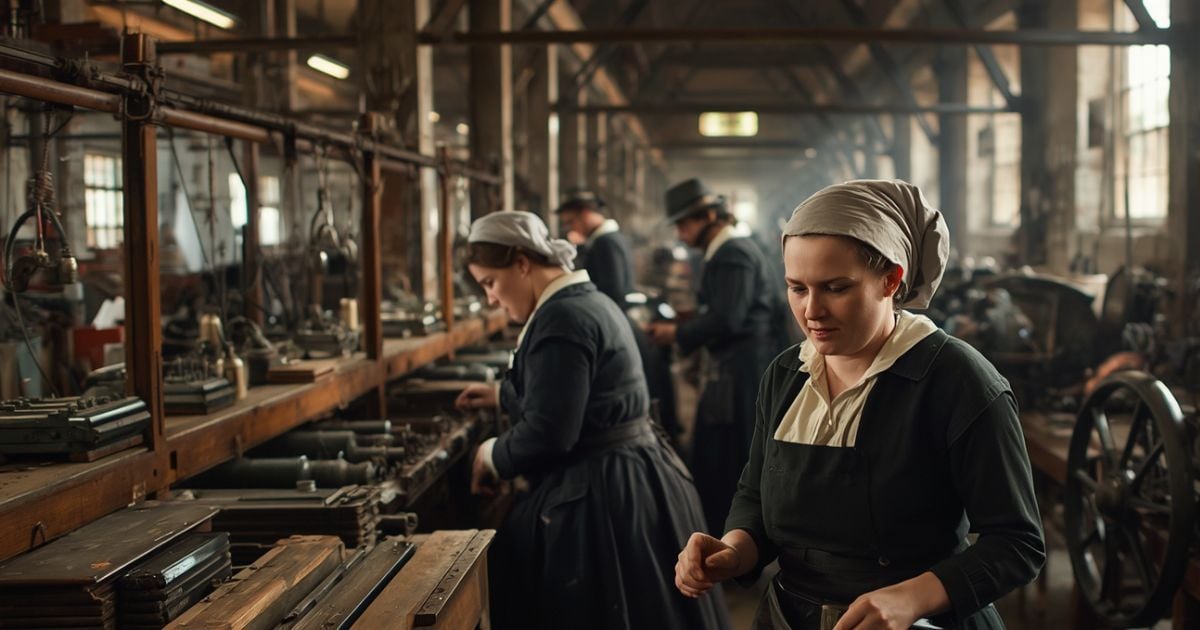
Marx starts from the lone worker, who holds head and hand together and answers to nobody. Later the product becomes the joint work of a collective labourer, and head and hand part company. So the idea of productive labour stretches: you need only serve as one organ of the collective worker. Yet it also narrows. Capitalist production is above all the production of surplus-value, so a worker counts as productive only if he makes surplus-value for the capitalist. Marx's example is a schoolmaster who, besides drumming lessons into his pupils, works like a horse to enrich the school's owner. It changes nothing that the owner put his capital into a teaching factory and not a sausage factory. "To be a productive labourer is, therefore, not a piece of luck, but a misfortune."
Next Marx sets his two forms side by side. Absolute surplus-value comes from stretching the day past the point where the worker has replaced his wage. It is the groundwork of the system and the starting point of relative surplus-value, which shortens necessary labour by new methods and remakes technique and society. Some half-way forms remain, such as the usurer or merchant feeding like a parasite on independent producers. In one view the difference is an illusion, since each forces the other. But once capitalist production has taken hold, the choice is real. With productiveness and intensity given, the rate of surplus-value rises only if the day is lengthened. With the day given, it rises only by changing the split between necessary and surplus labour.
Then Marx asks where surplus-labour comes from at all. A worker who spends all his time on his own subsistence has no time to work for others, and without that spare time there would be no capitalists, slave-owners or feudal lords. The productiveness it rests on is a gift of history across thousands of centuries, not of nature. Nature still matters at the margin. Egyptian children, Diodorus reports, cost their parents about twenty drachmas each, so many people could be spared for great works. But a lavish nature keeps people in leading-strings and gives them no need to develop. The temperate zone, not the tropics, is the mother country of capital, because varied soils and changing seasons push people to master natural forces, as in the irrigation works of Egypt, Holland and India.
The sago example drives the point home. In the eastern islands a bread-cutter fells a wild sago tree and needs only twelve working hours a week to meet all his wants. Nature's gift to him is leisure. To make him spend it on surplus labour for strangers takes history and compulsion. Under capitalist production he might work six days a week to keep one day's product. Marx finishes with John Stuart Mill, who says profit exists because labour produces more than it consumes, and because food, clothing, materials and tools outlast the time it takes to make them. Marx replies that this confuses the lasting of labour-time with the lasting of products: birds would have no nests if nests did not outlast their building. Mill's 20 per cent also fails. With £500 advanced, £400 on means of production and £100 on wages, a surplus-value rate of 20 per cent gives a profit of 4 per cent. On a level plain, Marx says, simple mounds look like hills.
Marx exposes something we rarely question: who gets to decide what work is valuable? In his time, a teacher was only considered 'productive' if they generated profit for a school owner, not if they actually educated children. Today, this same logic dominates our economy. Healthcare workers are measured by patient throughput, not healing outcomes. Teachers face evaluations based on test scores that generate funding, not actual learning. Retail workers are judged by sales metrics, not customer satisfaction. Even care work - raising children, tending elderly parents, maintaining households - is deemed 'unproductive' because it doesn't generate measurable profit. This isn't accidental. When systems control how we define value, they control how we see ourselves and each other. A nurse working extra shifts might feel 'productive' while burning out, never questioning why hospital profits soar while her wages stagnate. The real question becomes: whose definition of productivity are we accepting, and what does that cost us? Marx suggests that true productivity might look completely different - focused on human flourishing rather than capital accumulation. When we let others define our worth, we've already lost the most important negotiation of our lives.
Explore this chapter with AI to uncover deeper meaning and practical takeaways.
AI Discussion